
Strategic Asset Allocation Amid U.S. Government Shutdown Risks: Navigating Policy-Driven Downturns
The U.S. government faces a high risk of shutdown on October 1, 2025, as Congress remains deadlocked over funding legislation, according to TD Economics. While short-term economic impacts are likely muted, prolonged disruptions could erode investor confidence and complicate Federal Reserve policy decisions, as reported by Reuters. For investors, this environment demands a strategic reevaluation of asset allocation, hedging, and sector positioning to mitigate policy-driven risks while capitalizing on historical patterns.
Macroeconomic Implications: Short-Term Noise vs. Long-Term Resilience
A shutdown would initially disrupt non-essential federal operations, affecting approximately 25% of government spending, according to TD Economics. Essential services like Social Security and national security remain unaffected, limiting immediate economic fallout. However, prolonged shutdowns could delay critical data releases-such as the monthly jobs report-and disrupt supply chains reliant on federal contracts, as noted by Reuters. Historically, GDP growth has rebounded post-shutdown, but the Congressional Budget Office (CBO) estimates a 0.2% annual GDP contraction for each week of prolonged gridlock, as cited in an MFS insight.
Investor sentiment is a key wildcard. While markets often exhibit short-term volatility-reflected in spikes in the CBOE Volatility Index (VIX)-historical data suggests these effects are temporary, according to a YCharts analysis. For example, the S&P 500 gained 10.3% during the 35-day 2018-2019 shutdown as trade negotiations and Fed policy dominated market focus, per a MarketClutch analysis.
Asset Class Performance: Lessons from History
Historical patterns reveal distinct asset class behaviors during shutdowns:
1. Equities: The S&P 500 has shown mixed but generally flat returns during shutdowns. For instance, the 1995-96 shutdowns saw the index rise amid a strong economy, while the 2013 shutdown initially triggered a 3% drop before recovery, according to Dave Manuel. Defensive sectors like utilities and healthcare tend to outperform, while defense and aerospace firms face headwinds due to delayed contracts, as reported by The New York Times.
2. Bonds: U.S. Treasuries historically act as a safe haven, with yields dropping by an average of 0.59% during past shutdowns, according to Plante Moran. The 2025 shutdown has already seen Treasury yields decline as investors seek stability, per Forbes.
3. Commodities: Gold, a traditional safe-haven asset, has historically gained during shutdowns due to uncertainty, as noted by Archyde. The U.S. Dollar, however, may weaken as political instability dampens its appeal, according to Morningstar.
Strategic Allocation: Sector Tilts and Hedging Mechanisms
Given the current risk profile, investors should adopt a dual approach: defensive positioning and strategic hedging.
- Sector Rotation:
- Overweight Defensive Sectors: Utilities, healthcare, and consumer staples are less sensitive to government spending cuts and may provide stability, per American Century.
Underweight Sensitive Sectors: Defense and aerospace firms face near-term risks from delayed contracts. For example, Lockheed Martin and Boeing saw pre-market declines during the 2025 shutdown, according to EY.
Hedging Volatility:
- VIX Exposure: The VIX spiked to 16.29 during the 2025 shutdown, per YCharts. Investors can use VIX-linked products or options to hedge against further volatility.
Safe-Haven Assets: Increase allocations to U.S. Treasuries and gold, which historically outperform during political crises, as shown by MarketClutch.
Diversification and Liquidity:
- Maintain a diversified portfolio with a focus on high-quality, liquid assets to weather short-term disruptions.
- Consider short-duration fixed-income to mitigate interest rate risks, as prolonged shutdowns could force the Fed into policy uncertainty, per Investing.co.
Policy-Driven Downturns: A Long-Term Perspective
While shutdowns create near-term uncertainty, their long-term economic impact is typically limited. The 2013 shutdown, which cost $24 billion in economic output, saw GDP recover fully within two quarters, according to Modern Diplomacy. Investors should avoid overreacting to short-term volatility and instead focus on structural trends, such as the resilience of the tech sector and the Federal Reserve's ability to adapt policy post-shutdown, as noted by American Century.
Conclusion
The looming 2025 shutdown underscores the need for a disciplined, adaptive asset allocation strategy. By leveraging historical insights-such as sector-specific vulnerabilities and safe-haven demand-investors can navigate policy-driven downturns while preserving long-term growth. As always, maintaining a diversified portfolio and a long-term horizon remains the cornerstone of resilience in turbulent political climates.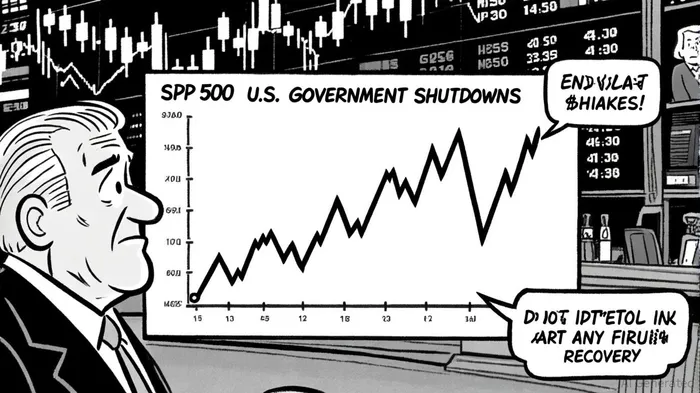







Comentarios
Aún no hay comentarios