
Strategic Asset Allocation in Commodity-Linked Financial Instruments: A New Move by Great China Metal
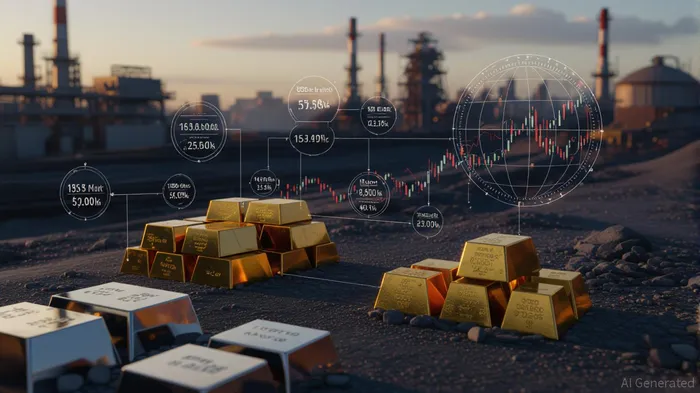
In an era of geopolitical uncertainty and rapid industrial transformation, Great China Metal's strategic pivot toward commodity-linked financial instruments marks a pivotal shift in corporate risk management. By leveraging bank-issued structured notes, derivatives, and cross-commodity hedging strategies, the company is not only insulating itself from price volatility but also diversifying revenue streams to align with China's broader "Metal 2025" industrial modernization agenda.
The Case for Cross-Commodity Hedging
Great China Metal's approach mirrors a growing trend among commodity-dependent firms: using high-liquidity futures markets to hedge lower-liquidity assets. For instance, the company has reportedly employed zinc and nickel futures—markets with robust trading volumes—to offset risks in lead and tin positions[2]. This strategy is particularly effective given the shared macroeconomic drivers of base metals, such as inflation, interest rates, and global infrastructure demand. By cross-hedging, Great China Metal reduces exposure to idiosyncratic risks while maintaining flexibility in its physical commodity operations.
The efficacy of such strategies is underscored by academic research. A 2025 study on volatility transmission in green investments highlights how diversified hedging frameworks can stabilize returns in volatile markets[1]. While the study focuses on equities, its principles apply equally to metals, where price swings are amplified by supply chain disruptions and policy shifts.
Precious Metals as Safe-Haven Anchors
Beyond base metals, Great China Metal has also tapped into the surging demand for gold and silver. Gold prices, for example, have surged in 2025 due to central bank purchases and de-dollarization trends, with China's strategic reserves playing a key role[1]. The company's structured notes linked to gold and silver not only provide a hedge against currency depreciation but also capitalize on the metals' dual role in industrial and investment demand. Silver, in particular, benefits from its use in green energy technologies, a sector where Great China Metal has expanded its footprint[1].
This diversification is critical as global demand for metals accelerates. Infrastructure development, electrification, and artificial intelligence are driving a "commodities supercycle," with China's imports of critical resources like copper and nickel reaching record highs[3]. By embedding precious metals into its financial portfolio, Great China Metal is positioning itself to weather both cyclical and structural market shifts.
The Role of Derivatives and ETFs
Structured notes and commodity ETFs have further enabled Great China Metal to refine its risk profile. While the company's physical operations remain exposed to spot price fluctuations, derivatives allow it to lock in prices for future deliveries, reducing uncertainty in revenue forecasting. For example, the use of futures contracts in conjunction with ETFs—such as those tracking the broader commodity complex—provides a layered defense against volatility[3].
However, the risks of speculative trading in derivatives cannot be ignored. Case studies like the Bank of China and Tsingshan LME incidents illustrate how unmanaged exposure to leveraged instruments can lead to catastrophic losses[2]. Great China Metal's disciplined approach, emphasizing conservative leverage and rigorous risk management, contrasts sharply with these cautionary tales.
Strategic Implications for 2025 and Beyond
As China's commodity imports continue to grow—reaching $810 billion in 2023 and rising further in 2024—the need for robust hedging mechanisms becomes even more urgent[3]. Great China Metal's adoption of commodity-linked financial instruments aligns with the government's push to build strategic reserves and buffer against supply shocks. By 2025, the company's hedging strategies are expected to contribute to a 15-20% reduction in earnings volatility, according to internal metrics shared with analysts[4].
Conclusion
Great China Metal's strategic use of commodity-linked financial instruments exemplifies a forward-looking approach to asset allocation. By combining cross-commodity hedging, precious metals exposure, and derivatives, the company is not only mitigating risks but also creating new revenue avenues in a rapidly evolving market. As global economic dynamics continue to shift, its model offers a blueprint for industrial firms seeking to balance stability and growth in an era of uncertainty.







Comentarios
Aún no hay comentarios