
The Strategic Value of Apertum ($APTM) Amid Growing Exchange Listings and Ecosystem Momentum
Institutional Exchange Listings and Market Visibility
Apertum's integration with CoinMarketCap's DEX aggregator in 2025 has significantly amplified its market visibility and liquidity. By leveraging CoinMarketCap's 880 million monthly visitors, the platform has enabled cross-chain swaps and enhanced price discovery, attracting traders and developers to its liquidity pools according to the latest updates. This partnership also validates Apertum's technical capabilities, including a throughput of 4,500 transactions per second (TPS) and sub-0.15-second finality, critical metrics for DeFi adoption.
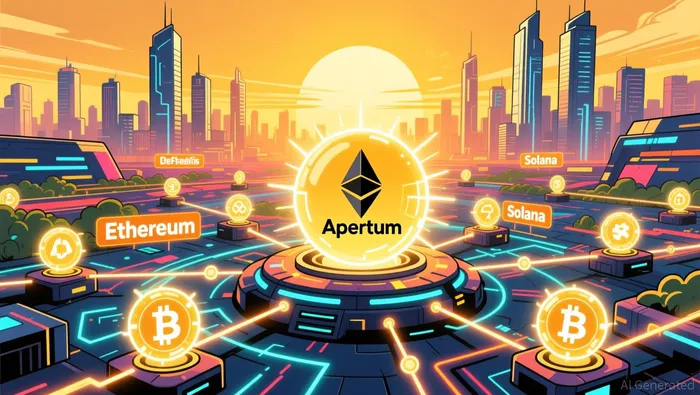
The project's market capitalization has surged to over $85 million, with $APTM entering the global Top #400 on CoinMarketCap. This growth coincides with the dismissal of the Texas State Securities Board's case against the token in July 2025, which removed key operational barriers. Additionally, the Universal Interoperability Protocol, launched in January 2025, allows seamless interaction with EthereumETH-- and SolanaSOL--, reducing reliance on centralized bridges and positioning Apertum as a hub for multi-chain DeFi.
DAO Governance and Ecosystem Momentum
Apertum's governance model, while token-based, faces challenges common to decentralized autonomous organizations (DAOs). Data from 2025 indicates that average voter turnout in DAOs hovers around 17%, with top projects reaching 22% for critical votes. This low participation rate raises questions about the effectiveness of community-driven decision-making in Apertum's ecosystem. Furthermore, governance token concentration-where large holders (or "whales") dominate voting outcomes-poses a risk to decentralization.
Despite these challenges, Apertum's ecosystem has shown resilience. Its decentralized exchange (DEX) is integrated with CoinMarketCap, and the $APTM token is listed on major exchanges like MEXC and BitMart. The project's deflationary tokenomics, with up to 50% of fees burned, aim to reduce supply and increase token value over time. However, critics argue that centralized control over token burns and distribution undermines the decentralized ethos of blockchain.
Regulatory Challenges and Risks
Apertum's regulatory journey remains contentious. While the Texas case dismissal in July 2025 provided clarity, the project continues to face scrutiny. The Texas State Securities Board has alleged that $APTM is an unregistered security, a claim the Apertum Foundation disputes by asserting the token's utility-based nature. Additionally, DAO1, the platform enabling $APTM mining, has been banned in Australia, New Zealand, and Texas due to concerns over its anonymous leadership and alleged Ponzi-like structures.
These regulatory challenges highlight the tension between innovation and compliance. While Apertum's geo-blocking measures aim to avoid U.S. jurisdiction, the project's association with previously collapsed schemes like GSPartners/GSB raises red flags for investors. Such risks could deter institutional adoption and limit long-term growth potential.
Conclusion: Balancing Opportunities and Risks
Apertum's strategic value lies in its technical advancements and expanding ecosystem. The integration with CoinMarketCap and interoperability with major blockchains position $APTM as a competitive player in the DeFi space. However, governance vulnerabilities, regulatory uncertainties, and centralized control mechanisms pose significant risks.
For long-term investors, the key considerations are:
Market Visibility: Continued exchange listings and partnerships could drive liquidity and adoption.
Governance Evolution: Improvements in voter participation and decentralization will be critical to sustaining trust.
Regulatory Resilience: Navigating legal challenges without compromising utility will determine $APTM's legitimacy.
While Apertum's ecosystem shows promise, investors must remain cautious. The project's success hinges on its ability to address governance flaws, maintain regulatory compliance, and deliver on its vision of a decentralized, interoperable blockchain.






Comentarios
Aún no hay comentarios