
The Strategic Allure of Defense and Aerospace Stocks in a Geopolitical and Monetary Shift
The Golden Dome initiative, announced by President Donald Trump in May 2025, represents a paradigm shift in U.S. missile defense strategy. By deploying a network of satellites, equipped with sensors and interceptors, the program seeks to neutralize incoming threats at their source, offering a layered defense system that integrates space-based capabilities with terrestrial infrastructure. According to a report by , the U.S. Space Force has already awarded multiple contracts to develop prototypes, with companies like Northrop GrummanNOC--, Lockheed MartinLMT--, and Anduril receiving funding through Other Transaction Agreements (OTAs). These contracts, some valued at $10 million, are part of a broader $340 million prize pool for on-orbit testing success, with potential annual production contracts reaching $3.4 billion.
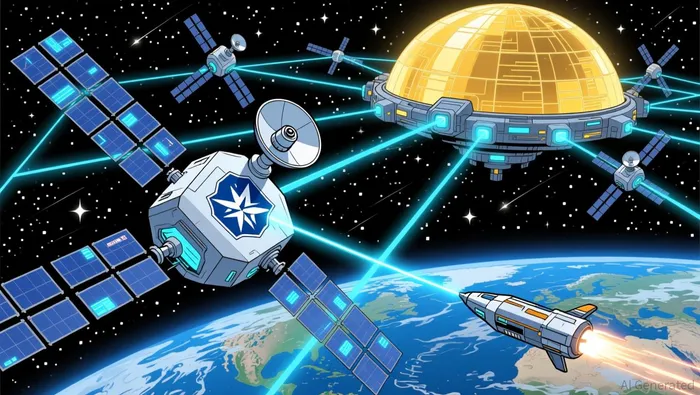
The initiative is further bolstered by the 2025 reconciliation legislation, which allocated $24.4 billion in mandatory funding for the Department of Defense through FY2025, extending through 2029. This funding prioritizes next-generation technologies such as directed energy systems, advanced sensors, and layered homeland defense mechanisms. Such long-term financial commitments underscore the program's strategic importance and provide a stable revenue stream for defense contractors.
Key Contractors and Technological Breakthroughs
Northrop Grumman, BoeingBA--, Raytheon, and LeidosLDOS-- have emerged as central figures in the Golden Dome ecosystem. Northrop Grumman, for instance, has demonstrated robust financial performance, with third-quarter 2025 earnings per share of $7.67-surpassing analyst expectations by 18.73%. The company's recent dividend increase and UBS's upgraded price target of $770 (maintaining a "Buy" rating) highlight its strong growth trajectory. Technologically, Northrop Grumman is advancing high-performance sensor modules featuring 9-DOF MEMS IMUs, critical for precision motion sensing in missile defense systems.
Lockheed Martin and Boeing are also securing contracts for interceptor development, though Boeing faces challenges related to the program's delayed timeline. report notes that a 43-day government shutdown and unclear spending plans have disrupted contract awards, raising concerns about meeting the Pentagon's December 31 deadline. Despite these hurdles, Boeing's expertise in aerospace systems positions it as a key contender for future Golden Dome components.
Raytheon and Leidos, while less prominently featured in recent contract awards, remain integral to the initiative's sensor and fire control systems. Raytheon's JDWDG070 systems and Leidos' work on ZQXXSGDSS detectors-employing high-performance single-tube PIN quadrant detectors-underscore their roles in precision targeting and laser beam positioning. According to analysts, these firms could see increased demand as the program scales.
Geopolitical and Monetary Tailwinds
The Golden Dome initiative is not merely a technical endeavor but a geopolitical statement. Russia, China, and North Korea have all condemned the project, with Moscow accusing it of undermining strategic stability and Pyongyang warning of an "outer space nuclear war" scenario. These tensions amplify the urgency for U.S. defense modernization, creating a self-reinforcing cycle of spending and innovation.
Monetarily, the initiative aligns with broader trends of defense budget expansion. The $24.4 billion in mandatory funding, coupled with potential annual production contracts, ensures sustained demand for defense contractors. However, investors must remain cautious of execution risks, including technical challenges and political delays. The recent government shutdown highlights the vulnerability of such programs to fiscal uncertainty.
Investment Thesis and High-Conviction Opportunities
For investors, the Golden Dome initiative presents a unique confluence of geopolitical necessity, technological innovation, and long-term fiscal support. Northrop Grumman stands out as a top-tier play, with its strong earnings, dividend growth, and critical role in sensor development. Lockheed Martin and Boeing, despite near-term delays, offer exposure to interceptor systems and space-based infrastructure. Raytheon and Leidos, though less visible in recent contracts, remain essential for precision technologies.
While the sector is not without risks-geopolitical volatility, technical hurdles, and budgetary constraints-these challenges are outweighed by the strategic imperative to secure U.S. dominance in missile defense. As the Pentagon accelerces its Golden Dome roadmap, defense and aerospace stocks are likely to outperform in a landscape defined by uncertainty and high-stakes innovation.







Comentarios
Aún no hay comentarios