
Strategic Allocation to Short-Duration Bonds in a Volatile Interest Rate Environment
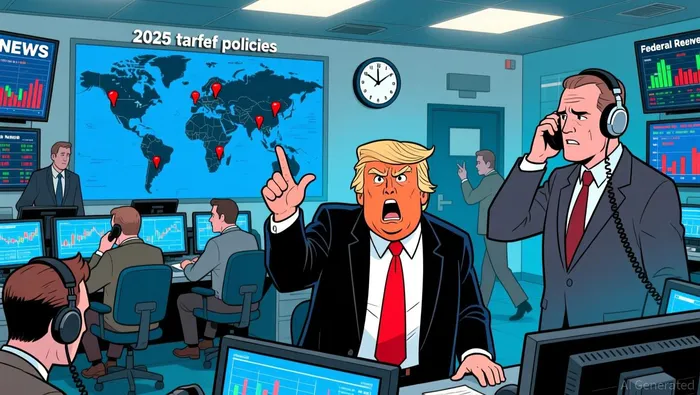
The U.S. bond market is navigating a complex landscape shaped by President Trump's 2025 trade policies, which have intensified volatility and redefined the interplay between fiscal and monetary strategies. With effective tariffs now at 15.8%-a sharp rise from previous levels-and retaliatory measures from global partners like China, investors face heightened uncertainty. This environment has driven a surge in demand for short-duration bonds as a tool for capital preservation and income generation, a strategy underscored by historical precedents and institutional recommendations.
Trade Policy Uncertainty and Interest Rate Volatility
Trump's tariff proposals, including a proposed 100% levy on Chinese goods, have directly influenced inflationary pressures and Federal Reserve decision-making. According to a report by J.P. Morgan, tariffs accounted for roughly 10.9% of headline PCE annual inflation through August 2025, pushing the Fed to cut rates three times in a row despite inflation remaining above its 2% target. The central bank's balancing act-managing trade-related inflation while addressing a slowing labor market-has created a volatile backdrop for fixed-income markets. Yields on 10-year Treasuries, for instance, surged to 4.5% from under 4% in a short span, reflecting investor concerns over fiscal risks and economic instability.
Historical Parallels: Lessons from the 2018–2019 Trade War
The 2018–2019 U.S.-China trade war offers a critical case study for understanding how short-duration bonds perform during periods of trade policy uncertainty. Research from the CFA Institute highlights that during tariff announcements, U.S. equities like the S&P 500 experienced immediate declines, while safe-haven assets such as 10-year Treasuries saw price increases. The VIX, a volatility index, spiked on these days but typically reverted to pre-tariff levels within a week, indicating short-lived but pronounced market reactions.
For short-duration bonds, the trade war demonstrated their role as a stabilizing force. A study by the New York Fed notes that investors flocked to high-quality, short-term fixed-income instruments to mitigate risk, with Treasury yields declining as trade tensions escalated. This pattern mirrors 2025 trends, where institutional investors are increasingly favoring short-duration strategies to hedge against Trump-era trade volatility.
Institutional Strategies for Capital Preservation and Income
Institutional recommendations for 2025 emphasize active management of bond portfolios to capitalize on short-duration opportunities. Morgan Stanley and J.P. Morgan highlight the appeal of sectors like corporate credit, securitized debt, and emerging-market bonds, which offer robust carry and reduced equity beta. These strategies align with broader themes of duration management and high-quality bond selection, particularly as yield curves steepen and longer-term bonds face repricing risks. The Federal Reserve's anticipated policy shifts further justify a focus on short-duration instruments. With Trump's influence over Fed appointments and the potential for non-traditional monetary interventions, investors are advised to prioritize liquidity and income stability. Short-term bonds, with their lower duration and reduced sensitivity to rate hikes, provide a buffer against sudden policy pivots.
Quantifying the Case for Short-Duration Bonds
While specific metrics for the Bloomberg Short-Term Treasury Index during the 2018–2019 trade war remain elusive, historical patterns confirm their efficacy. During that period, Treasury yields fell by up to 67 basis points in response to trade-war-related news, reflecting a global flight to safety. This dynamic suggests that short-duration bonds can serve as a reliable hedge in 2025, particularly as trade tensions and fiscal uncertainty persist.
Moreover, the 2018–2019 experience underscores the importance of diversification. As RBC Wealth Management notes, institutional investors moved into safe-haven assets during trade shocks, while retail investors faced greater exposure to equity-driven volatility. In 2025, a similar shift is evident, with gold and short-term bonds gaining traction as defensive allocations. The Treasury Department notes that institutional investors are increasingly allocating to short-term bonds during periods of trade uncertainty.
Conclusion
The convergence of Trump's trade policies, Fed rate cuts, and global retaliatory measures has created a volatile yet structured opportunity for bond investors. Short-duration bonds, supported by historical performance during past trade wars and reinforced by institutional strategies, offer a dual benefit of capital preservation and income generation. As the Fed navigates a delicate balance between inflation control and economic stability, a disciplined approach to fixed-income allocation will remain critical for mitigating risk in an unpredictable environment.







Comentarios
Aún no hay comentarios