
Strategic Allocation Opportunities in the Secondary Market for Private Assets: A 2025 Perspective
Drivers of Growth: Liquidity, Innovation, and Market Maturation
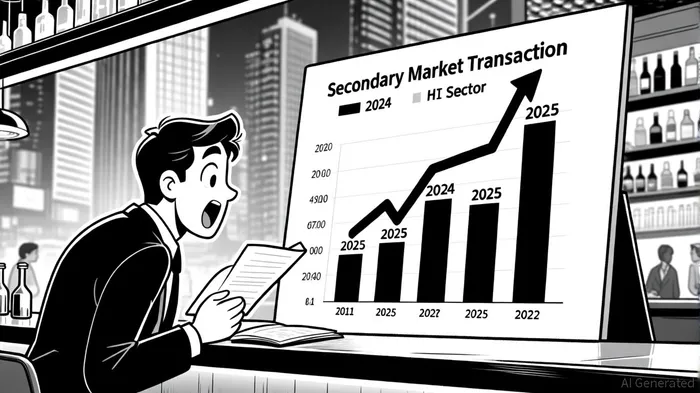
The surge in secondary transactions is underpinned by three key factors: liquidity needs, innovative transaction structures, and maturation of asset classes. According to a CAIS report, LP-led transactions accounted for $87 billion in 2024, while GP-led deals-particularly continuation vehicles (CVs)-reached $75 billion, the largest such volume on record (a CAIS report). These structures allow general partners to retain high-performing assets while offering limited partners exit options, a win-win that has become a mainstream tool for portfolio optimization.
The rise of CVs is particularly noteworthy. Single-asset CVs, which focus on high-quality, cash-generating assets, now trade at an average TEV/EBITDA multiple of 14.7x, reflecting strong investor confidence (Markets Group data). Meanwhile, the secondary market's expansion into non-traditional asset classes-such as private credit, infrastructure, and venture capital-has broadened its appeal. For instance, agriculture and timber strategies saw a 268.1% year-over-year increase in transaction volume, underscoring the market's appetite for diversified, risk-adjusted returns (Markets Group data).
Strategic Allocation Frameworks: Balancing Illiquidity and Return
Institutional investors are increasingly adopting tailored frameworks to integrate secondary market strategies into their broader private asset allocations. A 2025 framework from Wellington Management emphasizes three core considerations: capacity to take on illiquidity, demand for excess returns, and consistency in accessing quality investments (Wellington Management). Unlike traditional strategic asset allocation (SAA) models, which treat private assets as a monolithic category, these frameworks recognize the idiosyncrasies of secondary investments, such as their shorter fund cycles and reduced blind-pool risk.
For example, secondary strategies typically achieve breakeven in six to seven years-faster than primary investments or co-investments-making them attractive for institutions seeking to mitigate the J-curve effect, as BlackRockBLK-- notes (BlackRock). BlackRock highlights that secondaries also offer immediate diversification benefits, as they provide exposure to mature, well-funded assets with lower volatility compared to early-stage ventures. This aligns with the broader industry trend of blending public and private market strategies, where private assets are modeled as leveraged versions of their public counterparts but with less short-term price swings (Wellington framework).
Risk-Adjusted Returns: A Compelling Case for Institutional Investors
The secondary market's risk-adjusted return profile has further solidified its appeal. Canterbury Consulting notes that secondary strategies exhibit lower return dispersion than venture capital, with more predictable performance and a lower likelihood of underperforming (Canterbury Consulting). While specific Sharpe ratios for Q3 2025 are not yet available, historical data suggests that secondary investments generate early positive IRRs by purchasing assets at discounts to net asset value (NAV), as BlackRock has observed.
McKinsey's Global Private Markets Report 2025 underscores this point, noting that secondary strategies are particularly resilient in volatile environments. For instance, despite private equity's underperformance relative to public markets in 2025, sectors like credit and infrastructure-both prominent in secondary transactions-remain well-positioned due to their cash-flow stability and inflation-hedging properties (McKinsey's Global Private Markets Report). Evergreen fund structures, which allow for continuous capital deployment, are also expected to enhance risk-adjusted returns by reducing the need for forced asset sales (McKinsey's report).
Actionable Strategies for Institutional Investors
To capitalize on these opportunities, institutional investors should adopt a multi-pronged approach:
1. Diversify Across Transaction Types: Allocate capital to both LP-led and GP-led transactions, with a focus on high-quality continuation vehicles and direct secondaries in sectors like infrastructure and agriculture (Markets Group data).
2. Leverage Semi-Liquid Structures: Embrace semi-liquid private funds and evergreen vehicles to balance liquidity needs with long-term growth potential (Wellington framework).
3. Optimize Capital Efficiency: Prioritize secondary strategies that offer shorter breakeven periods and lower management fees compared to primary investments (BlackRock).
4. Stress-Test Portfolios: Use secondary markets to hedge against macroeconomic uncertainties, such as U.S. policy shifts, by diversifying geographically and across asset classes (a CAIS report).
Hamilton Lane's 2025 Market Overview recommends maintaining exposure to sectors like credit and infrastructure, which are less correlated to public markets and offer stable cash flows (McKinsey's report). Meanwhile, J.P. Morgan Asset Management emphasizes the role of securitized assets and alternatives in diversifying pension portfolios without excessive illiquidity (J.P. Morgan Asset Management).
Conclusion
The secondary market for private assets is entering a new era, characterized by rising volumes, improved pricing, and a broader range of participants. For institutional investors, this represents a unique opportunity to enhance portfolio resilience, optimize liquidity, and capture risk-adjusted returns. As the market continues to evolve, strategic allocation frameworks that prioritize flexibility, diversification, and manager expertise will be critical to unlocking value in this dynamic space.







Comentarios
Aún no hay comentarios