
Strategic Alliances and Tether's Expansion: How Latin America is Redefining Digital Currency Adoption
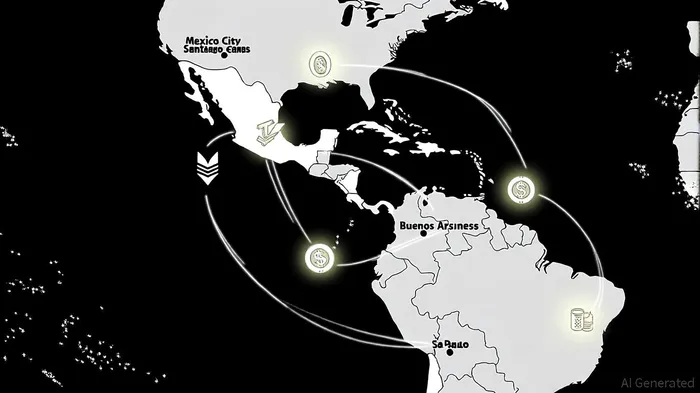
In an era of economic volatility and technological disruption, Latin America has emerged as a critical battleground for digital currency adoption. The region's unique blend of macroeconomic instability, underbanked populations, and regulatory experimentation has created fertile ground for stablecoins and strategic corporate alliances to reshape financial infrastructure. At the forefront of this transformation is TetherUSDT-- (USDT), whose recent investment in Orionx—a Chilean digital asset exchange—signals a broader strategy to cement its influence in emerging markets. This analysis explores how corporate partnerships and Tether's growing footprint are accelerating digital currency adoption, with implications for investors seeking opportunities in Latin America's evolving financial ecosystem.
Strategic Alliances: Bridging Legacy Systems and Digital Innovation
Latin America's digital currency revolution is being driven by partnerships between fintechs, crypto platforms, and traditional financial institutions. A prime example is the collaboration between Clara and Bitso Business, which launched stablecoin-backed corporate cards to streamline payments for mid-market and enterprise clients in Mexico and beyond[1]. By leveraging stablecoins like USDCUSDC-- and MXNB as collateral, the partnership enables businesses to access financial tools—such as smart corporate cards and AI-powered treasury management—without liquidating their crypto holdings. This innovation is particularly valuable in economies like Argentina, where inflation rates have exceeded 100% in recent years, eroding trust in local currencies[5].
Such alliances are notNOT-- isolated phenomena. The Pacific Alliance—a trade bloc spanning 230 million people—has prioritized creating unified digital payment systems, while Brazil's Pix platform has demonstrated the scalability of real-time, low-cost transactions[4]. These initiatives highlight a regional shift toward integrating digital solutions into legacy financial systems, addressing infrastructure gaps and fostering cross-border interoperability. For investors, this trend underscores the importance of supporting platforms that bridge traditional and digital finance, as they are likely to dominate the next phase of growth.
Tether's Strategic Investment in Orionx: A Catalyst for Regional Expansion
Tether's recent $Series A investment in Orionx—a Chilean exchange operating in Chile, Peru, Colombia, and Mexico—marks a pivotal moment in its strategy to expand stablecoin adoption in Latin America[1]. The investment, which exclusively funds Orionx's Series A round, aims to enhance the company's infrastructure for remittances, cross-border payments, and treasury services. Orionx's focus on B2B and retail integration positions it as a critical conduit for Tether's mission to promote financial inclusion in a region where nearly 40% of adults remain unbanked[1].
This move aligns with broader regional trends. Between July 2023 and June 2024, Latin America received nearly $415 billion in cryptocurrency inflows, with stablecoins accounting for over 60% of activity in Argentina and 70% in Brazil[1]. Tether's USDTUSDT-- alone represents 50% of crypto purchases on Bitso in Argentina, a country grappling with hyperinflation[4]. By embedding stablecoins into everyday transactions—such as remittances and retail payments—Tether is effectively creating a parallel financial system that bypasses traditional banking constraints. For investors, this signals a long-term bet on stablecoins as a cornerstone of financial infrastructure in emerging markets.
The Ripple Effect: Financial Inclusion and Economic Stability
Stablecoins are not merely a hedge against inflation; they are becoming a tool for economic empowerment. In Bolivia, for instance, major retailers like Toyota and BYD now accept USDT for vehicle purchases, reflecting a shift in consumer and corporate behavior[2]. Similarly, Bitso's data reveals that stablecoin transactions surged to 39% of all crypto activity in 2024, up from 30% in 2023, as users seek stable stores of value[4]. These trends are amplified by the region's fragmented regulatory environment, which has historically limited access to foreign currency and capital controls.
The unbanked population—estimated at over 100 million adults in Latin America—stands to benefit disproportionately from stablecoin adoption. Unlike traditional banking systems, stablecoins require minimal infrastructure, enabling peer-to-peer transactions and cross-border remittances at a fraction of the cost[1]. For example, Orionx's remittance solutions leverage stablecoins to reduce fees and processing times, directly addressing pain points for migrant workers sending money to family members. This democratization of financial services is not only economically transformative but also politically significant, as it challenges the dominance of legacy institutions in a region where trust in central banks is waning.
Conclusion: A New Paradigm for Emerging Market Finance
Latin America's embrace of digital currency is reshaping the global financial landscape. Strategic alliances between fintechs and crypto platforms are addressing systemic inefficiencies, while Tether's investments are accelerating the adoption of stablecoins as a viable alternative to volatile local currencies. For investors, the region presents a dual opportunity: capitalizing on the growth of digital infrastructure and supporting financial inclusion in one of the world's most underbanked regions.
However, risks remain. Regulatory uncertainty and potential central bank interventions could disrupt the current trajectory. Yet, given the region's economic realities and the demonstrated utility of stablecoins, the momentum is unlikely to abate. As Santiago Roque of Bitso notes, “In countries like Argentina, crypto dollars are not just a trend—they are a necessity[5].” For those willing to navigate the complexities of emerging markets, the rewards of this digital transformation are substantial.







Comentarios
Aún no hay comentarios