
Strategic Alliances in the Global Battery Supply Chain: Implications for LG Chem and South Korean Firms
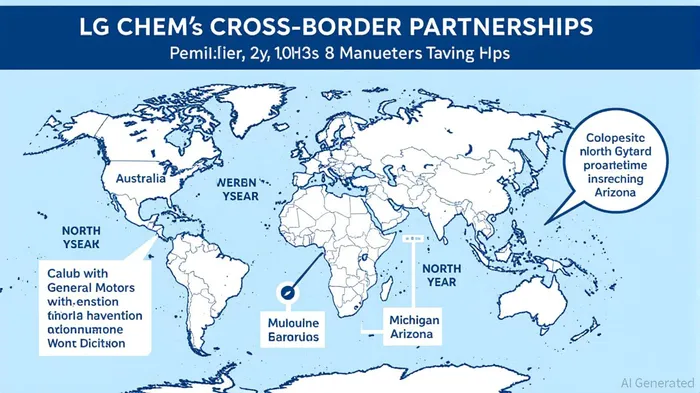
The global battery materials market is undergoing a seismic shift, driven by the rapid electrification of transportation and the urgent need for energy storage solutions. At the forefront of this transformation are South Korean firms like LG Chem and its subsidiaries, which are leveraging cross-border partnerships to secure raw materials, optimize production, and navigate geopolitical and regulatory challenges. For investors, understanding the long-term value creation potential of these alliances is critical to assessing the resilience and growth trajectories of South Korea’s battery industry.
Securing Supply Chains: A Strategic Imperative
LG Energy Solution, a subsidiary of LG Chem, has emerged as a key player in the global EV battery market, capturing 14.5% of the global market share as of 2023 [1]. This success is underpinned by strategic partnerships aimed at securing critical raw materials. For instance, LG Energy Solution’s collaboration with Wesfarmers Chemicals, Energy and Fertilisers (WesCEF) ensures access to up to 85,000 tons of lithium concentrate from Australia’s Mt. Holland project, which will be processed into battery-grade lithium hydroxide for North American production [1]. Similarly, its partnership with Chile’s SQM diversifies lithium sources, reducing reliance on China-controlled supply chains [1]. These alliances align with the U.S. Inflation Reduction Act (IRA), which incentivizes domestic battery production while indirectly pressuring firms to localize supply chains.
South Korean firms are also addressing nickel and cobalt dependencies through overseas investments. POSCOPKX-- Future M, for example, completed a precursor plant in Gwangyang, South Korea, to produce high-nickel materials for Ultium Cells (a GM–LG Energy joint venture), bypassing China’s dominance in cathode production [2]. Such moves not only mitigate supply risks but also position South Korean companies to meet IRA-compliant standards, which are expected to drive a 9.326% CAGR in the South Korea battery material market, projected to reach USD 4 billion by 2035 [4].
Financial and Strategic Payoffs
The financial implications of these partnerships are substantial. LG Energy Solution’s ambition to expand battery production capacity to 540 GWh by 2025 reflects its confidence in scaling operations to meet surging demand [1]. This expansion is supported by long-term contracts, such as the $19 billion cathode material supply deal with General MotorsGM--, which will power five million electric vehicles [2]. Such agreements provide revenue stability and cost efficiencies through economies of scale.
Moreover, cross-border collaborations are driving innovation. Amprius Technologies’ partnership with a South Korean battery maker to produce silicon anode cells exemplifies how joint ventures can enhance battery performance, critical for applications in aerospace and high-end EVs [2]. Similarly, LG Chem’s focus on second-life batteries—repurposing used EV batteries for stationary storage—positions it to capitalize on a market projected to grow from 25–30 GWh in 2025 to 330–350 GWh by 2030 [1]. While falling battery prices may challenge cost savings, the Asia Pacific region’s supportive policies and renewable energy integration create a unique value proposition for firms like LG Chem [1].
Challenges and Regulatory Headwinds
Despite these opportunities, cross-border partnerships face hurdles. The EU’s Battery Digital Product Passport (DBP) is pushing firms toward vertical integration, requiring stringent sustainability and traceability standards [3]. While this strengthens long-term sustainability goals, it also raises compliance costs for lower-tier suppliers, potentially limiting their participation in global value chains [3]. Additionally, geopolitical tensions, such as U.S.-China trade dynamics, complicate supply chain strategies. South Korean firms must balance localized production with global sourcing to avoid overexposure to any single region.
Market Growth and Investor Outlook
The financial rewards of these strategic bets are already materializing. South Korea’s battery contract manufacturing market, valued at USD 5.2 billion in 2024, is forecasted to grow to USD 9.8 billion by 2033 [2]. LG Energy Solution’s 32% year-on-year increase in EV component exports in 2025 underscores the effectiveness of its global partnerships [2]. For investors, the key metrics to monitor include market share gains (LG Energy Solution’s 14.5% global EV battery market share [1]), cost reductions from vertical integration, and revenue diversification through second-life battery applications.
Conclusion
South Korean battery firms are redefining the global supply chain through strategic alliances that combine resource diversification, technological innovation, and regulatory foresight. For LG Chem and its peers, cross-border partnerships are not just a response to market pressures but a proactive strategy to secure long-term value creation. As the EV and energy storage markets expand, firms that successfully navigate supply chain complexities and sustainability mandates will emerge as leaders—offering compelling investment opportunities for those attuned to the evolving dynamics of the battery industry.
**Source:[1] TeslaTSLA-- vs. CATL vs. LG Energy: Who's Leading the Battery Race? [https://patentpc.com/blog/tesla-vs-catl-vs-lg-energy-whos-leading-the-battery-race-market-share-stats][2] South Korea Battery Contract Manufacturing Market [https://www.linkedin.com/pulse/south-korea-battery-contract-manufacturing-market-fvasf][3] Digital Battery Passports Building Sustainability Paradigm [https://papers.ssrn.com/sol3/Delivery.cfm/5346556.pdf?abstractid=5346556&mirid=1][4] South Korea Battery Material Market [https://www.marketresearchfuture.com/reports/south-korea-battery-material-market-47550]





Comentarios
Aún no hay comentarios