
Strategic Alliances Drive Next-Gen XR Hardware: Vuzix and TCL CSOT's MicroLED Breakthrough
The extended reality (XR) hardware market is undergoing a seismic shift, driven by strategic partnerships that are accelerating the commercialization of next-generation optical technologies. At the forefront of this transformation is the collaboration between Vuzix CorporationVUZI-- and TCL CSOT, whose joint development of microLED and waveguide optics is redefining the scalability, brightness, and cost-efficiency of augmented reality (AR) smart glasses. As the AR/VR market surges toward a projected $62.0 billion in revenue by 2029 [2], such alliances are proving critical to overcoming longstanding technical barriers and unlocking mass-market adoption.
Vuzix and TCL CSOT: A Blueprint for Scalable Optical Solutions
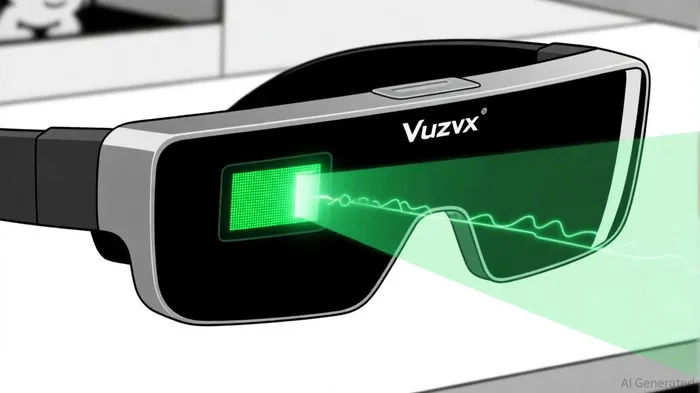
Vuzix and TCL CSOT have expanded their partnership to deliver a “total optical solution” that combines TCL's microLED displays with Vuzix's proprietary waveguide technology. At the China International Optoelectronic Exposition (CIOE) in September 2025, the companies showcased a mono-green microLED engine integrated with Vuzix's waveguides, positioning it as an off-the-shelf solution for OEMs and ODMs [1]. This rapid deployment underscores their focus on production readiness, with a full-color microLED and waveguide solution slated for early 2026 [1].
TCL CSOT's advancements in microLED manufacturing further bolster this collaboration. The company has demonstrated a 0.05-inch monochrome green microLED display—the world's smallest of its kind—as well as a 219-inch tiled microLED display, showcasing its ability to scale production across form factors [4]. Meanwhile, Vuzix's waveguide optics are engineered for high transparency and minimal light leakage, ensuring superior image quality while maintaining a lightweight design [1]. Together, these innovations address key pain points in AR hardware: brightness, compactness, and cost.
Market Dynamics and Strategic Synergy
The AR/VR market's projected 7.42% CAGR from 2025 to 2029 [2] hinges on overcoming technical hurdles such as limited outdoor visibility and bulky form factors. MicroLED technology, with its potential for millions of nits of brightness, offers a compelling solution. However, manufacturing challenges—particularly in color uniformity at micro-pixel scales—have historically hindered commercialization. VuzixVUZI-- and TCL CSOT's partnership leverages TCL's microLED expertise and Vuzix's waveguide optimization to mitigate these issues. For instance, TCL's quantum dot-enhanced microLEDs improve color consistency, while Vuzix's waveguides maximize light efficiency [1].
This synergy mirrors broader industry trends. For example, Saphlux and Vuzix have similarly collaborated to integrate Saphlux's T1-0.13” mono-green microLED with Vuzix's waveguides, aiming to deliver high-brightness, low-power AR modules by late 2025 [5]. Such partnerships reflect a shift toward vertically integrated collaborations, which streamline supply chains and accelerate time-to-market [5].
Investment Implications and Market Projections
The XR hardware market's explosive growth—from $135.57 billion in 2024 to $192.8 billion in 2025 [1]—highlights the urgency for scalable, cost-effective solutions. Vuzix and TCL CSOT's joint efforts align with this demand, particularly in enterprise and consumer AR applications. By 2029, the AR/VR market is expected to reach $780.42 billion, driven by AI-powered glasses, spatial computing, and immersive training tools [1].
Investors should note that strategic partnerships are not just accelerating innovation but also reshaping competitive dynamics. For instance, Apple's Vision Pro and Meta's Quest headsets have set benchmarks for resolution and interactivity, but their success hinges on optical components like microLEDs and waveguides. Vuzix and TCL CSOT's production-ready solutions could enable third-party OEMs to compete in this high-margin segment.
Challenges and the Path Forward
Despite progress, challenges remain. MicroLED manufacturing still faces yield and cost issues, while waveguide efficiency varies by design (e.g., reflective vs. diffractive). However, partnerships like Vuzix-TCL CSOT are addressing these through iterative R&D and shared IP. For example, TCL's ability to produce both monochrome and full-color microLEDs at scale could reduce costs, while Vuzix's focus on optical efficiency ensures compatibility with AI-driven AR applications [1].
Conclusion
The Vuzix-TCL CSOT collaboration exemplifies how strategic alliances are catalyzing the next phase of XR hardware innovation. By combining cutting-edge microLED displays with production-ready waveguide optics, the partnership is poised to deliver scalable, high-brightness solutions that align with the AR/VR market's explosive growth. For investors, this represents a pivotal opportunity to capitalize on a sector where optical innovation and strategic collaboration are the twin engines of disruption.





Comentarios
Aún no hay comentarios