
Strategic Alliances in Autonomous Vehicle Ecosystems: The Cornerstone of AI-Driven Mobility Dominance
The autonomous vehicle (AV) industry is at a pivotal inflection point, where the integration of advanced sensor technologies and AI-driven platforms is no longer a theoretical aspiration but a strategic imperative. As the sector transitions from niche experimentation to scalable deployment, strategic partnerships between AV companies, sensor manufacturers, and AI platform providers are emerging as the linchpin for long-term dominance. These alliances are not merely transactional but foundational, enabling the creation of interoperable ecosystems that accelerate innovation, reduce redundancy, and establish competitive moats in a capital-intensive industry.
The Sensor-AI Synergy: A New Paradigm for Mobility
Autonomous vehicles rely on a fusion of LiDAR, radar, cameras, and ultrasonic sensors to perceive their environment, while AI platforms process this data in real time to make navigation decisions. However, the complexity of integrating these components-each with distinct technical requirements and data formats-demands collaboration beyond the capabilities of any single entity. For instance, Luminar Technologies' partnership with Waymo in 2020 exemplifies this synergy, combining Luminar's high-resolution LiDAR with Waymo's AI algorithms to enhance object detection and decision-making accuracy. Such collaborations are critical for overcoming the "sensor-AI gap," where hardware and software must evolve in tandem to achieve Level 4 autonomy.
According to a 2021 industry report by Bloomberg, partnerships between AV companies and sensor providers have accelerated the development of Level 4 autonomy by reducing R&D timelines by up to 30%. This efficiency stems from shared data pools and co-engineered architectures, allowing sensor manufacturers to tailor their outputs to AI platforms' needs. For example, NVIDIA's DRIVE platform, which powers AVs for companies like Cruise and Aurora, is designed to ingest and process data from multiple sensor types, creating a unified perception stack. This integration not only improves system reliability but also lowers costs, a key barrier to mass adoption.
Ecosystem Dominance: The Network Effect of Strategic Alliances
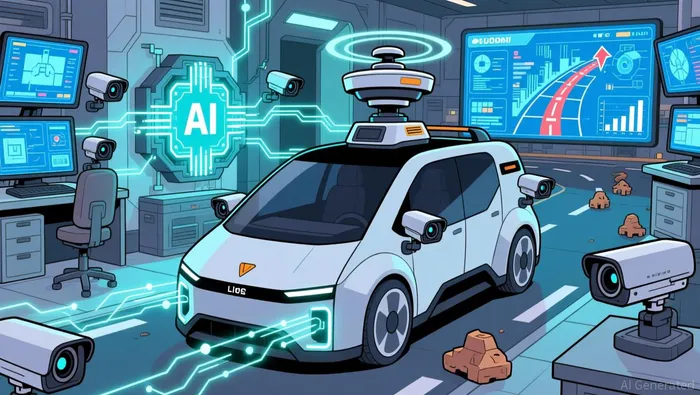
The AV industry is rapidly consolidating around a handful of AI platform providers and sensor specialists, creating a network effect where early partnerships translate into long-term market control. NVIDIANVDA--, for instance, has secured alliances with over 20 AV companies, including Baidu and Toyota, to embed its AI compute solutions into their fleets. This ecosystem approach mirrors the dominance of operating systems in the smartphone era, where control over the underlying platform dictates the trajectory of the entire industry.
A case in point is Waymo's collaboration with Fiat Chrysler Automobiles (FCA) to develop the Jaguar I-PACE as a purpose-built autonomous vehicle. By integrating FCA's vehicle architecture with Waymo's AI and sensor suite, the partnership created a scalable platform for Waymo One, its ride-hailing service in Phoenix. This model-where AV companies leverage automotive OEMs for hardware and sensor partners for perception-has become a blueprint for the industry. Similarly, Cruise's alliance with General MotorsGM-- (GM) has enabled the production of its Origin vehicle, combining GM's manufacturing scale with Cruise's AI and sensor integration.
These alliances are not limited to technical integration but extend to data sharing. Sensor providers like Velodyne and Quanergy have partnered with AV firms to create proprietary datasets that train AI models more effectively. As stated by a 2022 analysis from Reuters, "The quality of an AV's AI is directly proportional to the diversity and volume of sensor data it can access, making partnerships a strategic asset." This dynamic creates a flywheel effect: better sensors generate higher-quality data, which improves AI performance, which in turn justifies further investment in sensor upgrades.
Challenges and the Path Forward
Despite these advancements, challenges persist. Regulatory fragmentation, cybersecurity risks, and the high cost of sensor hardware remain significant hurdles. Moreover, the lack of standardized protocols for sensor-AI integration complicates interoperability between ecosystems. For example, while NVIDIA's platform dominates in North America, companies like Huawei and Baidu are building competing ecosystems in China, creating a bifurcated global market.
Investors must also consider the risk of over-reliance on a single partner. The collapse of Argo AI in 2022, which had partnerships with FordF-- and Volkswagen, underscores the volatility of AV ventures without diversified revenue streams or robust platform independence. To mitigate this, successful players are adopting multi-partner strategies. For instance, Aptiv's collaboration with BMW and Intel's Mobileye has allowed it to hedge against technological obsolescence by leveraging multiple AI and sensor architectures.
Investment Implications: Prioritizing Ecosystem Resilience
For investors, the key takeaway is clear: strategic partnerships are not just enablers of innovation but determinants of market survival. Companies that position themselves at the intersection of sensor integration and AI platform ecosystems-such as NVIDIA, Luminar, and Waymo-are best positioned to capture long-term value. These firms benefit from network effects, economies of scale, and first-mover advantages in data accumulation.
However, the path to dominance requires careful scrutiny. Investors should prioritize companies with: 1. Deep, multi-year partnerships that ensure continuous R&D collaboration. 2. Interoperable architectures that reduce dependency on a single ecosystem. 3. Data-centric strategies that leverage partnerships to build proprietary training datasets.
As the AV industry matures, the winners will be those who recognize that autonomy is not a solo journey but a collective endeavor. The companies that master the art of strategic alliance-balancing technical integration with ecosystem flexibility-will define the future of AI-driven mobility.





Comentarios
Aún no hay comentarios