
Strategic Advantages and Investment Potential of Early-Mover CBDC Banks in 2025
The global race to adopt Central Bank Digital Currencies (CBDCs) has entered a critical phase, with early-mover nations securing significant strategic and financial advantages. As of 2025, 134 countries-covering 98% of global GDP-are actively developing CBDCs, with China, India, and the Bahamas leading in implementation, according to a CoinLedger report. These pioneers are not only reshaping monetary policy but also creating a new asset class with profound implications for investors.
The Early-Mover Edge: Technical Standards and Cross-Border Dominance
China's digital yuan (e-CNY) exemplifies the power of early adoption. With 260 million users and ¥7 trillion in transactions by June 2024, according to a Forbes overview, the e-CNY has become a cornerstone of Beijing's strategy to modernize payments and challenge the U.S. dollar's global dominance. Its 1:1 backing by the People's Bank of China (PBOC) ensures stability, while offline peer-to-peer functionality and cross-border trials with Hong Kong, Thailand, and the UAE position it as a geopolitical tool, per a Clyde & Co analysis. Similarly, India's e-₹, with ₹10.16 billion in circulation by March 2025, as reported by Analytics Insight, is leveraging its 1:1 reserve backing to curb unregulated crypto adoption and expand financial inclusion.
Early adopters are also setting technical standards. The Bahamas' Sand Dollar, Jamaica's JAM-DEX, and Nigeria's eNaira have demonstrated retail CBDC viability, albeit with limited adoption rates, according to a Kansas City Fed briefing. However, their role in testing interoperability frameworks-such as the BIS-led Project mBridge-has positioned these nations as key players in cross-border settlements. For instance, China's collaboration with Hong Kong and Thailand has reduced transaction costs by 40% in pilot trials, according to The Payments Association, a metric that could redefine global remittance markets.
Financial Performance: Stability Over Immediate Profit
While concrete financial metrics for individual banks remain scarce, macroeconomic indicators suggest long-term resilience. A 2025 study found that CBDC adoption correlates with improved financial stability for banks, particularly in reducing agency costs and enhancing transparency. In China, corporate cash holdings in e-CNY pilot areas dropped by 15% due to streamlined access to government subsidies and loans, according to a ScienceDirect paper. Meanwhile, India's expansion of e-₹ services from 4 to 17 banks by 2025, per CoinLaw statistics, signals a shift toward scalable infrastructure, with commercial banks likely to capture a growing share of the projected $10 billion CBDC technology market by 2030, in the Currency Insider forecast.
Challenges persist, however. Nigeria's eNaira, despite 10 million users in 2024, according to Social Capital Markets data, constitutes only 0.36% of total currency in circulation, highlighting the slow pace of behavioral change. Yet, early adopters are prioritizing systemic advantages over short-term gains. For example, the European Central Bank's digital euro project, though delayed until post-October 2025, is already shaping privacy frameworks that could influence global standards, as noted in a Hogan Lovells note.
Investment Implications: Infrastructure and Partnerships
The CBDC market's projected 35–45% CAGR through 2030 is highlighted in a GlobeNewswire report, underscoring the importance of infrastructure providers and early-adopting banks. Chinese banks involved in e-CNY pilots, for instance, have seen a 23.8% year-on-year increase in inclusive loans to SMEs, according to a Deloitte analysis, aligning with Beijing's push for high-quality growth. Similarly, India's RBI-backed e-₹ is attracting fintech partnerships, with 17 commercial banks now offering digital rupee services, as described in a Quick Market Pitch post.
Investors should focus on three areas:
1. Cross-Border CBDC Platforms: Projects like mBridge and Swift's CBDC connector are creating interoperability networks with $1 trillion in potential transaction value, according to a Currency Insider piece.
2. Privacy-Enhanced Systems: The EU's digital euro and Sweden's e-Krona trials highlight demand for privacy-focused solutions, as discussed in the GlobeNewswire report.
3. Emerging Market Infrastructure: Nigeria's eNaira and Jamaica's JAM-DEX are testing social welfare and remittance use cases, with $2.38 billion in circulation for the latter, per Social Capital Markets data.
Conclusion: A New Monetary Paradigm
The strategic advantages of early CBDC adopters-technical leadership, cross-border influence, and systemic stability-position them as linchpins in the digital currency revolution. While immediate financial returns for banks remain muted, the long-term potential to reshape global payments, reduce reliance on foreign networks, and drive financial inclusion is undeniable. For investors, the key lies in identifying infrastructure providers and regional leaders poised to capitalize on this $10 billion market, as noted in the Currency Insider forecast. 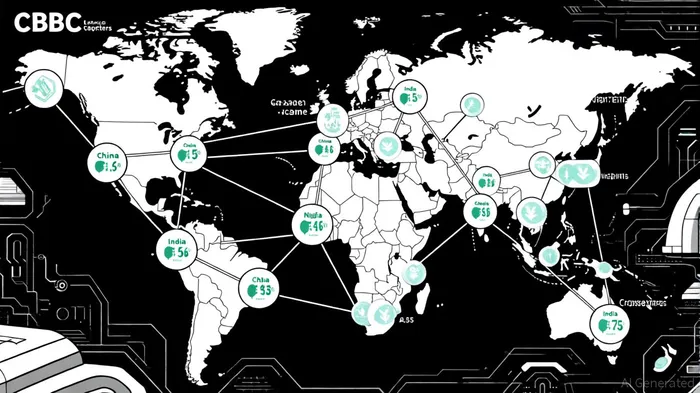







Comentarios
Aún no hay comentarios