
Strategic Acquisitions as Growth Levers in the AI Assistant Space
Strategic Acquisitions as Growth Levers in the AI Assistant Space
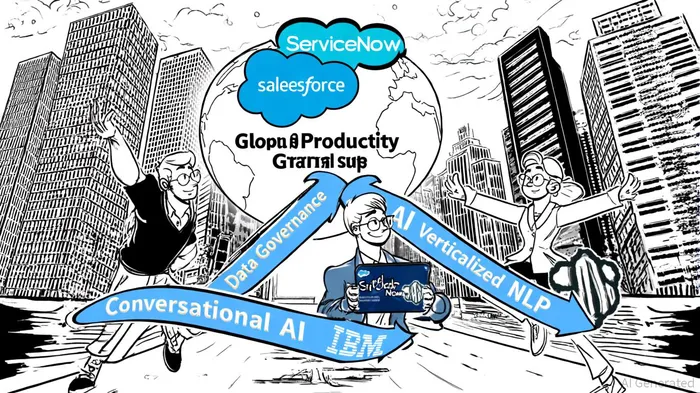
The enterprise software landscape in 2025 is defined by a seismic shift: AI is no longer a speculative add-on but a foundational infrastructure layer. Strategic acquisitions have emerged as the primary vehicle for scaling AI-driven productivity, with companies prioritizing domain-specific capabilities over broad experimentation. According to Dileep Mishra's LinkedIn post, the most significant AI acquisitions of 2025 reflect a focus on "infrastructure and operational necessity," with deals like Meta's $14.8 billion stake in Scale AI and Salesforce's $8 billion purchase of InformaticaINFA-- redefining competitive dynamics.
Case Study 1: SalesforceCRM-- Acquires Informatica to Close the AI Trust Gap
Salesforce's acquisition of Informatica represents a masterstroke in addressing the "AI trust gap"-a critical barrier to enterprise adoption. By integrating Informatica's data catalog, governance tools, and metadata management into its Einstein AI and Agentforce platforms, Salesforce is enabling autonomous AI agents to operate with unprecedented transparency and reliability, as argued in Sagie's Crunchbase piece. This synergy ensures that AI-driven decisions are grounded in clean, contextualized data, a prerequisite for industries like healthcare and finance where regulatory compliance is non-negotiable, according to Salesforce's press release.
The deal's strategic value extends beyond data hygiene. Informatica's pipelines will enhance Salesforce's Data Cloud, transforming it into a trusted Customer Data Platform (CDP) capable of unifying fragmented datasets. As Steve Fisher, Salesforce's CTO, noted, this integration allows AI agents to trace data lineage and quality metrics, fostering "intelligent and confident decision-making" across workflows. Analysts project that this move will solidify Salesforce's position against rivals like Microsoft Dynamics and Oracle, particularly as AI governance becomes a differentiator.
Case Study 2: ServiceNow's Moveworks Acquisition and the Rise of Conversational AI
ServiceNow's $2.85 billion acquisition of Moveworks underscores a parallel trend: the democratization of AI through conversational interfaces. Moveworks' natural language processing (NLP) engine and AI assistant have already proven their mettle in automating tasks across HR, finance, and IT. By embedding these capabilities into its platform, ServiceNow is addressing a key limitation of its rule-based automation, creating a more intuitive user experience, as noted in ServiceNow's announcement.
The acquisition also strengthens ServiceNow's competitive edge in enterprise search. Moveworks' perceptive search technology enables employees to retrieve actionable insights from unstructured data, streamlining operations in sectors like retail and manufacturing. An Everest Group analysis highlights that this move positions ServiceNow to rival Salesforce and Microsoft in AI-driven CRMCRM--, particularly as conversational AI becomes a standard for employee engagement. However, integration challenges-such as aligning Moveworks' unstructured data models with ServiceNow's structured architecture-remain a risk.
Broader Implications: AI as Infrastructure, Not a Novelty
The Salesforce and ServiceNow deals are emblematic of a broader industry shift. As stated by Sagie in Crunchbase, AI is now a "strategic, not speculative" lever for growth, with companies prioritizing infrastructure over hype. IBM's acquisition of Seek AI, for instance, has expanded its watsonx platform with verticalized natural language-to-data agents tailored for finance and retail, and OpenAI's foray into hardware via Jony Ive's io signals a recognition that AI's scalability depends on physical and digital ecosystems working in tandem.
The productivity gains from these acquisitions are already materializing. IBM's internal AI and automation initiatives, for example, generated $4.5 billion in productivity improvements by 2025, while the McKinsey report estimates AI could add $4.4 trillion in global productivity growth through corporate use cases. These figures align with IDC's projection of a $22.3 trillion cumulative impact by 2030, driven by AI's ability to automate complex workflows, as noted in a Microsoft blog post.
Conclusion: The Future of Enterprise Software is Agentic and Acquired
For investors, the takeaway is clear: strategic acquisitions are the new growth engines in AI-driven enterprise software. Companies that prioritize data governance, conversational AI, and vertical-specific capabilities-like Salesforce, ServiceNow, and IBM-are outpacing peers reliant on fragmented, speculative bets. As AI transitions from a "novelty" to a "necessity," the ability to integrate and scale AI infrastructure through acquisitions will determine market leadership.
The next phase of this evolution will likely see further consolidation, particularly in cybersecurity and hardware, as AI's operational demands intensify. For now, the 2025 acquisition wave offers a blueprint for how enterprises can transform AI from a buzzword into a productivity multiplier.





Comentarios
Aún no hay comentarios