
StraitsX's 2026 Solana Stablecoin Launch: A Strategic Inflection Point for Real-Time Global Payments
The convergence of regulated stablecoins, AI-driven microtransactions, and high-performance blockchain infrastructure is reshaping the financial landscape. At the center of this transformation is StraitsX, a Singapore-based fintech firm poised to launch its Singapore dollar (XSGD) and U.S. dollar (XUSD) stablecoins on the Solana blockchain by early 2026. This move represents a strategic inflection point for real-time global paymentsGPN--, combining institutional-grade compliance, AI-native transaction frameworks, and Solana's unmatched scalability.
Regulated Stablecoins as Trust Infrastructure
StraitsX's XSGD and XUSDXUSD-- are already operational on EthereumETH--, Polygon, and BNBBNB-- Smart Chain, having processed over $18 billion in on-chain transaction volume. These stablecoins are fully backed by fiat reserves and regulated under Singapore's Single-Currency Stablecoin (SCS) framework, a regulatory regime designed to ensure transparency and stability. As a Major Payment Institution licensed by Singapore's Monetary Authority of Singapore (MAS), StraitsX has positioned itself as a bridge between traditional finance and blockchain, offering institutional and enterprise clients a trusted settlement layer.
The 2026 SolanaSOL-- launch will deepen this infrastructure by enabling on-chain foreign exchange between XSGD and XUSD, as well as liquidity pools and lending markets on decentralized exchanges. This aligns with Singapore's broader vision to become a global hub for digital payments, where regulated stablecoins can facilitate cross-border commerce without intermediaries.
AI-Driven Microtransactions: The x402 Standard and Programmable Money
The true innovation lies in how StraitsX is leveraging x402, an interoperability standard for automated machine-to-machine (M2M) and AI-agent micropayments. This protocol allows AI systems, IoT devices, and autonomous agents to execute real-time transactions with minimal friction-a critical enabler for applications like AI-driven content monetization, decentralized marketplaces, and smart contracts.
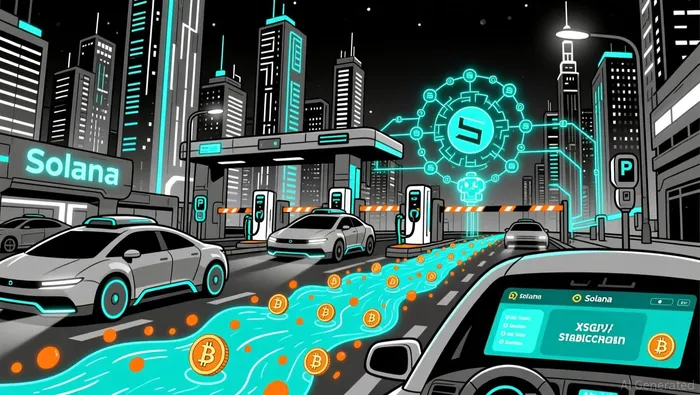
For example, imagine an AI agent negotiating a microtransaction for cloud computing resources or a self-driving car paying tolls in real time. These use cases require low-cost, high-speed settlements, which Solana's infrastructure delivers. Solana's Proof of History (PoH) and Tower BFT consensus mechanisms enable 65,000 transactions per second (TPS) during peak loads, making it ideal for AI-native workflows.
StraitsX's CEO, Liu Tianwei, has emphasized that stablecoins are the "fuel" for these AI-driven systems. By anchoring microtransactions to XSGD and XUSD, StraitsX ensures that these payments remain FX-transparent and regulatory-compliant, even as they scale globally.
Solana's High-Performance Infrastructure: The Backbone of the Future
Solana's technical architecture is a key enabler of this vision. Unlike Ethereum's energy-intensive proof-of-work model, Solana's Proof of History timestamps transactions in a verifiable order, while Tower BFT optimizes consensus efficiency. This allows Solana to process 2,000–4,000 TPS under normal conditions, with the capacity to surge to 65,000 TPS during peak demand.
For StraitsX, this means real-time cross-border settlements without the latency or cost of traditional SWIFT transfers. The partnership with Grab, Southeast Asia's largest superapp, exemplifies this potential: users could soon hold and spend XSGD/XUSD directly within Grab's ecosystem, from ride-hailing to food delivery. Such integrations could unlock $1 trillion in cross-border transaction value annually, according to industry estimates.
Strategic Implications and Investment Thesis
The 2026 launch is not just a technical upgrade-it's a strategic repositioning for StraitsX. By combining regulatory compliance, AI-native infrastructure, and Solana's scalability, the firm is creating a multi-chain settlement layer that appeals to both institutional and consumer markets.
For investors, this convergence presents three key opportunities:
1. Cross-Border Payments: XSGD/XUSD on Solana could capture a significant share of the $250 billion global remittance market.
2. DeFi Liquidity: On-chain FX and lending markets could attract institutional capital, given the stablecoins' 100% reserve backing.
3. AI Ecosystems: x402-based microtransactions could become the default payment model for AI agents, positioning StraitsX as a foundational infrastructure provider.
Conclusion
StraitsX's 2026 Solana stablecoin launch is a masterstroke of regulatory foresight, technical innovation, and ecosystem-building. By anchoring AI-driven microtransactions to a high-performance blockchain and a trusted regulatory framework, the firm is not just solving today's payment challenges-it's laying the rails for tomorrow's financial systems. For investors, this is a rare opportunity to bet on the convergence of three megatrends: AI, blockchain, and global finance.





Comentarios
Aún no hay comentarios