
Story Protocol's 50% Decline: A Deep Dive into Fundamental Weaknesses and Market Sentiment
The Disparity Between Valuation and Fundamentals
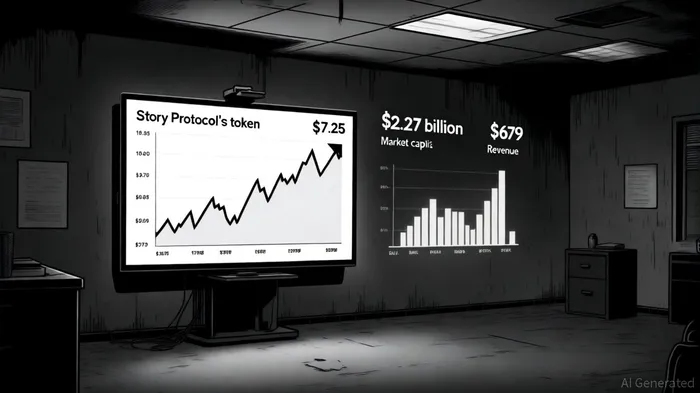
Story Protocol's 50% decline from its all-time high of $14.99 to $7.25 in Q2 2025 underscores a critical misalignment between its market capitalization and operational performance. Despite securing $193 million in funding and launching a dedicated IP-focused blockchain, the project generates just $679 in daily revenue—a figure dwarfed by its $2.27 billion market cap[1]. This disconnect raises questions about the sustainability of its valuation, particularly as competitors in the Web3 IP space demonstrate higher revenue generation and user adoption[3].
The tokenomics of the $IP token further exacerbate these concerns. While 25% of the total supply was unlocked at launch, the token's utility—limited to transaction fees, governance, and staking—has not yet driven sufficient demand to justify its price. Critics argue that the protocol's reliance on speculative trading, rather than organic adoption, has inflated its valuation beyond its intrinsic value[4].
Market Sentiment: Institutional Optimism vs. Retail Skepticism
Institutional confidence in Story Protocol has been bolstered by strategic moves such as the $82 million token buyback program, funded by Heritage Distilling, a Nasdaq-listed firm[6]. This initiative aims to reduce circulating supply and stabilize the token price, signaling institutional backing for its long-term potential. Additionally, technical indicators suggest short-term bullish momentum: the price surged past $12.67, breaking key Fibonacci resistance levels, while the RSI14 reached 83.26, indicating strong upward pressure[1].
However, retail sentiment remains fragmented. Upbit's dominance in 30% of trading volume highlights regional enthusiasm, but this speculative activity also increases the risk of abrupt corrections[1]. The co-founder's departure in Q3 2025 further polarized the community. While supporters view the transition as a strategic pivot, critics interpret it as a red flag, with the token dropping 6.3% immediately following the announcement[2]. A -5.48K sentiment score on analysis platforms places Story Protocol among the most negatively viewed crypto projects, reflecting widespread skepticism about its ability to deliver on its vision[5].
ESG and Financial Sustainability: A Double-Edged Sword
Story Protocol's ESG performance in 2025 aligns with broader trends in corporate sustainability but faces unique challenges. Research from the Center for Sustainability and Excellence (CSE) highlights a 92% correlation between strong ESG ratings and profitability, a metric Story Protocol must address to attract ESG-focused investors[5]. The project's integration of AI-driven ESG reporting and alignment with global standards like GRI and TCFD could enhance transparency, but its current operational focus on IP management lacks clear ESG metrics tied to financial outcomes[6].
Leadership changes also complicate ESG commitments. A 2025 UN Global Compact-Accenture study emphasizes that 90% of CEOs prioritize maintaining sustainability initiatives during transitions[1]. For Story Protocol, this means ensuring that ESG goals—such as decarbonization and ethical IP licensing—are embedded in its roadmap. Failure to do so risks alienating investors who increasingly demand a direct link between ESG performance and financial returns[3].
Conclusion: A Project at a Crossroads
Story Protocol's 50% decline reflects both inherent weaknesses in its business model and the volatile nature of the crypto market. While institutional buybacks and technical indicators suggest short-term resilience, the project must address its revenue shortfall and demonstrate tangible utility to justify its valuation. The integration of ESG frameworks and strategic leadership continuity will be critical in 2025, as the global IP market evolves and regulatory scrutiny intensifies. For now, investors face a high-risk, high-reward proposition: a bullish case anticipates $5.00 by 2025 if adoption accelerates, while bearish scenarios project a return to $3.00 amid prolonged skepticism[3].







Comentarios
Aún no hay comentarios