
Three Stocks That Could Wipe Out a $100,000 Nest Egg: A Value Investor's Warning
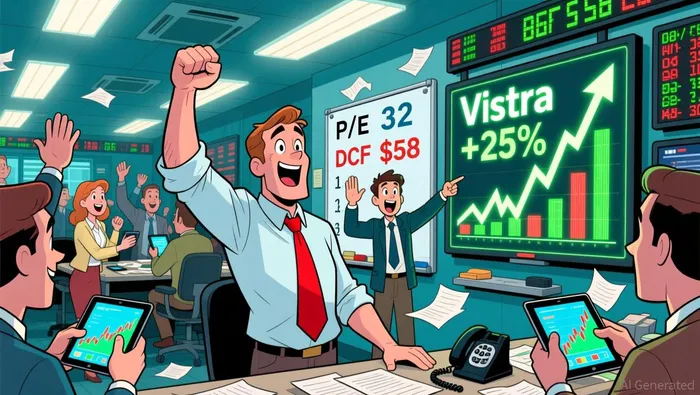
The central risk in these high-profile stocks is that their prices have detached from any reasonable estimate of intrinsic value. They trade at levels that demand near-perfect execution of a high-growth narrative, leaving no margin of safety for the disciplined investor. For VistraVST--, this tension is stark. The stock has surged 321% since the start of 2024 as investors bet heavily on its role in powering artificial intelligence. Yet its current valuation tells a different story. On a simple check of undervaluation, Vistra scores just 2 out of 6, a clear signal that sentiment, not fundamentals, is driving the price.
This disconnect is visible across valuation methods. A Discounted Cash Flow model suggests the stock is deeply undervalued, implying a fair value around $360 per share. But that projection hinges on a massive leap in future cash flows, from about $1.3 billion today to an estimated $7.9 billion by 2035. More telling is the Price-to-Earnings ratio. Vistra trades at a P/E of about 57.5x, a premium that sits well above both its industry and peer group averages. When adjusted for its specific growth profile and risks, a more reasonable "Fair Ratio" is calculated at 42.2x. The gap between the current price and that fair multiple indicates the market is pricing in a level of optimism that is difficult to sustain.
Viewed through a value investing lens, this setup is classic. The price is not a reflection of today's earnings or assets, but a bet on a future that is both uncertain and highly leveraged. The company's business model-hedging most of its 2026 output while keeping some 2027 volumes open for upside-shows management is aware of volatility. Yet the stock's valuation assumes that volatility will be consistently favorable. For a value investor, that's a dangerous assumption. When a stock's price demands flawless execution, the margin of safety vanishes, and the risk of a painful correction rises significantly.
Take-Two Interactive presents a parallel case. The stock has delivered a 40.4% return over the last year, a powerful rally fueled by anticipation for blockbuster releases. Yet its valuation score tells a sobering story: 0 out of 6. This zero score is a stark warning. It means the market has fully priced in the success of franchises like GTA 6, offering no buffer against disappointment. The numbers back this up. A Discounted Cash Flow model suggests the stock is overvalued by roughly 20%, with an intrinsic value around $210 per share against a recent price near $250. More broadly, its Price-to-Sales ratio of about 7.6x is a rich multiple, sitting well above both its industry and peer averages. A more tailored "Fair Ratio" is estimated at just 4.6x, highlighting the gap between current pricing and a conservative, risk-adjusted multiple.
The bottom line for a value investor is clear. When a stock's price is set by a narrative of flawless execution, the margin of safety is gone. Take-Two's valuation score of zero is a red flag that the market has left no room for error. For all the promise of its pipeline, the current price demands that every project hit a bullseye. That is a high bar, and history shows that even the most anticipated products can face delays or mixed reception. In such a setup, the stock becomes a bet on a future that is already priced in, leaving investors exposed to the volatility of reality.
United Airlines presents a final, cautionary note. The stock has delivered a 167.3% return over 5 years, a powerful move that has left many investors satisfied. Yet even here, the value proposition is strained. TD Cowen recently named United its "Best Idea for 2026," citing what it believes is "the most attractive long-term story" among airline stocks. The firm raised its price target to $138, a move that signals strong conviction in the company's fundamentals. However, the analyst firm also noted that shares appear "fully valued in the short term." This is a critical distinction. It acknowledges that the stock's recent run has compressed its margin of safety, even for a company with a compelling narrative. For the value investor, a "Best Idea" that is already fully valued is not a buy. It is a reminder that even the most attractive long-term businesses can become poor short-term investments when their price reflects all the good news.
Margin of Safety Check: The Width of the Moat
For the value investor, the width of a company's competitive moat is the primary determinant of its long-term durability. It is the economic fortress that protects earnings from competitors and market cycles. In this light, Vistra's recent moves are a study in building that fortress. The company is actively expanding its generation footprint, as evidenced by the acquisition of seven natural gas plants and the planned purchase of Cogentrix, which adds approximately 5,500 MW of modern natural gas capacity. The Cogentrix deal, priced at roughly $730 per kilowatt of capacity, appears to be a disciplined, value-oriented expansion. Management expects it to deliver accretion to earnings per share, a key signal that the acquisition is not dilutive but rather enhances shareholder returns.
This growth strategy is backed by a clear capital allocation plan, a hallmark of a durable business. The company has authorized an additional $1.0 billion of share repurchases, a commitment to return capital to shareholders that signals confidence in its own prospects. This plan, combined with a stated long-term net leverage target of less than 3x, provides a framework for financial discipline. The company is not overextending itself; it is using its strong cash flow to buy assets and buy back stock, a classic compounding mechanism.
Yet, the moat's width does not automatically translate to a sufficient margin of safety at today's price. The stock's premium valuation-its valuation score of just 2 out of 6-means the market is already pricing in a smooth execution of this entire growth narrative. The recent surge of 321% since the start of 2024 reflects immense optimism about Vistra's role in powering AI and meeting grid demand. This optimism leaves little room for error. Any misstep in integrating the Cogentrix assets, a delay in the new West Texas gas units, or a shift in the power price environment could quickly erode the premium.
The bottom line is that Vistra is building a wide moat through strategic acquisitions and disciplined capital allocation. That is the foundation for long-term value. But for the investor paying today's price, that foundation is already reflected in the share value. The margin of safety-the buffer against downside risk-has been compressed. The stock's current setup demands that the company's growth story unfolds perfectly, leaving the patient investor exposed to the volatility of reality. In value investing terms, a wide moat is necessary but not sufficient; the price must still offer a reasonable discount to intrinsic value. Vistra, at its current level, does not.
Take-Two Interactive presents a parallel case, but with a moat built on a different foundation. Its fortress is its portfolio of hit franchises, which generate recurring revenue through in-game purchases and expansions. This creates a powerful, durable business model. Yet, the valuation leaves no room for the execution risk inherent in such a model. The stock's valuation score of 0 out of 6 is a stark warning. It means the market has fully priced in the success of franchises like GTA 6, offering no buffer against disappointment. The numbers back this up. A Discounted Cash Flow model suggests the stock is overvalued by roughly 20%, with an intrinsic value around $210 per share against a recent price near $250. More broadly, its Price-to-Sales ratio of about 7.6x is a rich multiple, sitting well above both its industry and peer averages. A more tailored "Fair Ratio" is estimated at just 4.6x, highlighting the gap between current pricing and a conservative, risk-adjusted multiple.
Viewed through a value lens, this is a classic problem. The company's competitive advantages are real and valuable. But the price has already captured the best-case scenario. For the patient investor, the margin of safety vanishes when the stock's price demands flawless execution of a high-growth narrative. The setup leaves no room for a slowdown in recurrent spending, a delay in a major release, or simply the natural ebb and flow of consumer interest. In such a case, the moat protects the business, but it does not protect the investor's capital from a valuation correction.
United Airlines presents a final, cautionary note. The stock has delivered a 167.3% return over 5 years, a powerful move that has left many investors satisfied. Yet even here, the value proposition is strained. TD Cowen recently named United its "Best Idea for 2026," citing what it believes is "the most attractive long-term story" among airline stocks. The firm raised its price target to $138, a move that signals strong conviction in the company's fundamentals. However, the analyst firm also noted that shares appear "fully valued in the short term." This is a critical distinction. It acknowledges that the stock's recent run has compressed its margin of safety, even for a company with a compelling narrative.
For the value investor, a "Best Idea" that is already fully valued is not a buy. It is a reminder that even the most attractive long-term businesses can become poor short-term investments when their price reflects all the good news. United's competitive advantages-its focus on efficient long-haul routes and a modern fleet-have driven strong margins in a recovering industry. But the company faces a key risk that tests the durability of its recovery story: a recession. Management has stated that a downturn would cut its earnings per share outlook for 2025 by roughly 35%. This sensitivity to economic cycles is a material vulnerability. It means the company's financial strength, while improved, is not immune to a broader economic shock. In a value framework, a wide moat must be able to withstand such headwinds. For United, the recent price run suggests the market is betting on continued strength, leaving little room for the volatility of a potential downturn.
Catalysts and Scenarios: What Could Wipe Out the Nest Egg?
For the value investor, the path to a significant drawdown is rarely a single event, but a sequence of failures that invalidate the premium narrative. In Vistra's case, the primary catalyst for a sharp re-rating would be a slowdown in the AI data center buildout that is the central pillar of its growth story. The company's own guidance shows a powerful ramp: its midpoint opportunity for 2027 Ongoing Operations Adjusted EBITDA is projected to hit $7.4 billion, up from about $1.6 billion in Q3 2025. This trajectory assumes sustained, high-level demand for power from tech giants. If that demand softens, even temporarily, the entire future cash flow projection would come under pressure. The stock's current valuation is built on that assumption; any deviation would force a painful reassessment.
A more immediate and tangible risk is execution failure on its major capital commitments. The company has authorized an additional $1.0 billion of share repurchases and is executing a disciplined capital allocation plan. Yet the scale of its recent moves introduces complexity. The acquisition of Cogentrix, valued at roughly $730 per kilowatt of capacity, is a significant step. While management expects it to deliver accretion to earnings per share, the integration of 10 modern gas facilities across multiple regions is a major operational undertaking. A delay, cost overrun, or failure to realize the projected synergies would directly challenge the growth thesis and the stock's premium valuation.
Viewed through a long-term compounding lens, these are the scenarios that matter. The patient investor must ask: does the business have the operational fortitude to deliver on its ambitious plans? The company's track record of executing on its core competency-operating a diverse fleet-is a positive. But the current price demands flawless execution on a much larger scale. The margin of safety has been compressed by the 321% surge since the start of 2024. For a value investor, that leaves no room for error. The catalysts that could wipe out a nest egg are not market-wide crashes, but the specific, sequential failures that expose the gap between today's price and tomorrow's reality.
Take-Two Interactive presents a parallel but distinct risk profile. Its entire valuation is a bet on the flawless execution of its creative pipeline. The key catalyst here is the reception of its major game releases, most notably the upcoming GTA 6. The stock's premium valuation-its valuation score of 0 out of 6 and a Discounted Cash Flow model suggesting it is overvalued by roughly 20%-implies the market has already priced in blockbuster success. Any miss on launch timing, technical issues, or a more muted-than-expected reception could rapidly deflate that narrative. The stock's recent 40.4% return over the last year reflects immense optimism; a reversal would be swift.
From a value investing perspective, this is a classic case of a strong business facing a stretched price. The company's portfolio of hit franchises creates a durable, recurring revenue stream-a wide moat. Yet the current price offers no margin of safety. It demands that every project hit a bullseye. For the long-term compounding investor, the risk is not that the business will fail, but that the stock's price will reset to a level that better reflects the inherent execution risk of the gaming industry. In such a setup, the nest egg is not wiped out by bankruptcy, but by the painful realization that the premium paid for a perfect future was never justified.
United Airlines presents a final, cautionary note. The stock has delivered a 167.3% return over 5 years, a powerful move that has left many investors satisfied. TD Cowen recently named United its "Best Idea for 2026," citing what it believes is "the most attractive long-term story" among airline stocks. The firm raised its price target to $138, a move that signals strong conviction in the company's fundamentals. However, the analyst firm also noted that shares appear "fully valued in the short term." This is a critical distinction. It acknowledges that the stock's recent run has compressed its margin of safety, even for a company with a compelling narrative.
For the value investor, a "Best Idea" that is already fully valued is not a buy. It is a reminder that even the most attractive long-term businesses can become poor short-term investments when their price reflects all the good news. United's competitive advantages-its focus on efficient long-haul routes and a modern fleet-have driven strong margins in a recovering industry. But the company faces a key risk that tests the durability of its recovery story: a recession. Management has stated that a downturn would cut its earnings per share outlook for 2025 by roughly 35%. This sensitivity to economic cycles is a material vulnerability. It means the company's financial strength, while improved, is not immune to a broader economic shock. In a value framework, a wide moat must be able to withstand such headwinds. For United, the recent price run suggests the market is betting on continued strength, leaving little room for the volatility of a potential downturn. The catalyst here is not a single event, but the erosion of the macroeconomic conditions that have powered its recent outperformance.
The Value Investor's Takeaway: Protecting the Nest Egg
The conclusion for the disciplined investor is straightforward. Protecting a nest egg is not about timing the market or chasing the next hot stock. It is about constructing a portfolio where each holding offers a clear margin of safety-a significant discount between price and intrinsic value. The stocks we've examined-Vistra, Take-Two Interactive, and United Airlines-fail this test. They are priced for perfection, leaving no buffer for the inevitable volatility of reality.
A true margin of safety requires a substantial discount. When a company's valuation score is zero or just two out of six, it signals the market has already priced in the best-case scenario. For Take-Two, a score of 0 out of 6 means the stock's price assumes blockbuster success for every major release. For Vistra, a score of 2 out of 6 indicates the market is paying a premium for a high-growth AI narrative, leaving no room for execution risk. In both cases, the price is not a reflection of today's earnings or assets, but a bet on a flawless future. That is a speculative bet, not an investment.
The value investing lens is clear. Focus on companies with durable competitive moats and predictable cash flows, not those priced for a high-growth narrative. The goal is to buy a piece of a business at a price that provides a margin of safety, regardless of short-term market noise. When a stock's price demands near-perfect execution, the margin vanishes. The risk of a painful correction rises significantly.
Practically, this means protecting your nest egg by avoiding these stretched valuations. It means looking past the powerful returns these stocks have delivered over the past year or five years and focusing instead on whether the current price offers a reasonable discount to what the business is actually worth. For a value investor, that discount is the essential ingredient for long-term compounding. Without it, you are simply paying for hope.
The classic value framework offers a simple guide: seek businesses that compound earnings over long cycles, not those priced for a single, perfect year. For Vistra, that means evaluating whether its wide moat in power generation justifies a price that already embeds a massive AI-driven growth story. For Take-Two, it means assessing if its portfolio of franchises can deliver the flawless execution required to support a price that leaves no room for error. The answer for both, based on current valuations, is likely no. The prudent investor protects capital not by predicting the future, but by ensuring the price paid today leaves a margin for it to be wrong. Diversification and a long-term horizon are essential, but they cannot compensate for a lack of margin of safety in any single holding.







Comentarios
Aún no hay comentarios