
Three Stocks with Valuation Gaps That Challenge a Value Investor's Circle of Competence
The core principle of value investing is straightforward: risk is defined by the gap between a stock's price and its intrinsic value. When that gap is wide, the investor has little room for error. This is the danger with three high-flying names where premium valuations have left no margin of safety. These are not necessarily poor businesses, but their current prices demand near-perfect execution, leaving them vulnerable when growth expectations inevitably meet reality.
Consider the case of exceptional businesses. They often command high prices because the market believes in their future. Yet, as the saying goes, "When you pay a premium for a great company, you are paying for the future." That future is already baked into the share price, leaving no buffer for a stumble. This is precisely the setup for stocks like Lam ResearchLRCX-- and TeslaTSLA--, where Morningstar's analysis and discounted cash flow models point to significant downside.
Morningstar's latest screening identified Lam Research as a new 1-star overvalued name, a designation that signals a wide gap between price and fair value. The firm's analysts estimate the stock's intrinsic worth at $115 per share. With the stock trading well above that level, the margin of safety is absent. The same principle applies to Tesla. A recent intrinsic value calculation, based on a discounted cash flow model, places the company's fair value at $169.73. At a recent market price near $435, that implies a potential downside of over 61%. For a value investor, this is not a buying opportunity; it is a warning sign that the price offers no protection against a correction.
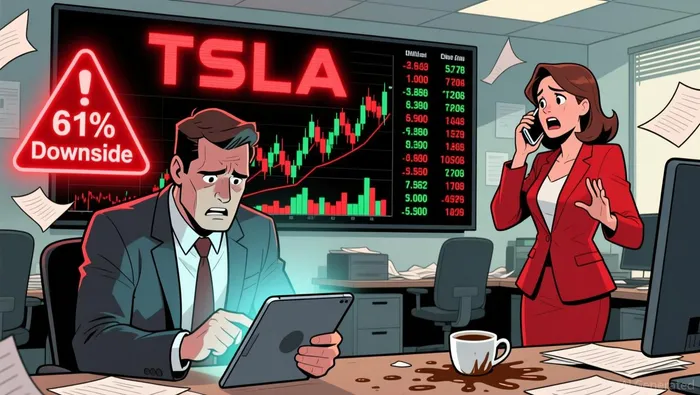
The thesis here is not about the quality of the business models themselves. It is about the price paid for them. When a stock's valuation leaves no room for error, the investor's circle of competence must draw a line. These three names-Lam Research, Tesla, and others like them-present a classic value trap: the potential for a large loss if the high expectations embedded in the price are not met.
Analyzing the Business Quality vs. Price Paid
The value investor's circle of competence is defined by a clear-eyed assessment of two things: the durability of a business's economic moat and the quality of its earnings. When a premium price is paid, the moat must be wide and the earnings must be reliable and scalable. Let's examine each of these three names through that lens.
National Vision presents a classic case where the price paid does not match the quality of the business. The company's stock trades at a forward P/E of 29.3x, a multiple that implies strong future growth. Yet the underlying business shows signs of erosion. Sales have tumbled by 1.6% annually over the last three years, and recent store closures signal a retreat from its footprint. Most concerning is the lack of capital efficiency; the company exhibits low returns on capital, a red flag that management is struggling to deploy funds profitably. In this setup, the premium valuation is betting on a turnaround that isn't yet visible. The moat appears narrow, and the earnings quality is under pressure, making the current price a risky bet.
Walmart, by contrast, commands a premium valuation at 40.6 times forward earnings. This price is justified by its immense scale and a successful diversification into higher-margin digital businesses. The company's e-commerce growth of 25% globally and a rapidly expanding advertising platform are creating new profit engines. Its moat is wide, built on logistics, pricing power, and a massive customer base. However, the premium price demands flawless execution. The recent report of lower-than-expected earnings due to tariff impacts is a reminder that even the strongest businesses face headwinds. For a value investor, Walmart's price is a bet on the sustainability of its growth trajectory and its ability to navigate these challenges without a stumble.
Oracle's premium valuation is anchored in its recognized leadership in a critical future market. The company has been named a Leader in the Gartner® Magic Quadrant™ for Strategic Cloud Platform Services for three consecutive years. This recognition supports its premium, as it signals a competitive advantage in cloud and AI infrastructure. The moat here is technological and strategic, built on a distributed cloud architecture that meets sovereign and performance needs. The quality of earnings must be assessed against the long-term cash flows generated from this infrastructure. The challenge is to determine if the current price adequately discounts the multi-year investment required to build out this AI and cloud platform and the competitive pressures that will inevitably follow. The premium is justified only if Oracle can convert its leadership position into durable, high-return capital.
The bottom line is that a high price demands a high-quality business with a wide and sustainable moat. National Vision's premium appears disconnected from its weakening fundamentals. Walmart's premium is supported by scale and diversification but requires sustained execution. Oracle's premium is backed by leadership in a growth sector, but the investment thesis hinges on converting that position into long-term cash flows. For the disciplined investor, the gap between price and quality is the true measure of risk.
Valuation Scenarios and the Need for a Margin of Safety
For the value investor, the path to a sound decision is not through a single forecast, but through a range of plausible outcomes. The current valuations of these three stocks create a scenario where the margin of safety is absent, leaving little room for error. The wide dispersion in intrinsic value estimates for Tesla alone underscores this high uncertainty. The discounted cash flow model shows a range from $102.89 to $643.60 per share. That staggering spread-over 500%-is not a sign of analyst disagreement, but a clear signal of how sensitive the math is to assumptions about growth, margins, and discount rates. When a model's output can swing from deep value to extreme overvaluation based on slight changes in those inputs, it reveals a business whose future cash flows are exceptionally hard to predict. For a disciplined investor, such volatility in the intrinsic value calculation is a red flag that the price offers no reliable buffer.
This uncertainty is mirrored in the market's own assessment. Lam Research's 1-star Morningstar rating is a formal designation of overvaluation, but it is paired with a high uncertainty rating. This combination suggests the market is pricing in near-perfect execution, a scenario that is rarely sustainable. The company's strong position in semiconductor equipment is undeniable, but the premium price demands flawless growth, margin expansion, and capital allocation for years to come. Any stumble in that trajectory would be punished severely, as there is no margin of safety to absorb the disappointment. The high uncertainty rating means the potential outcomes are wide, and the current price does not adequately discount the downside.
The bottom line for a value investor is that a substantial discount to intrinsic value is required to justify a position in any of these stocks. The principle is simple: you must pay less than what you believe the business is worth, and the gap should be large enough to cover the risk of being wrong. With Tesla trading at a -61.10% upside to its intrinsic value estimate, and Lam Research's price well above its fair value, that gap is not just narrow-it is absent. The same logic applies to the others. A value investor's circle of competence must extend to recognizing when the price leaves no room for error. In these cases, the prudent course is not to bet on a perfect future, but to wait for a price that offers a meaningful margin of safety.
Catalysts and What to Watch for a Thesis Break
For a disciplined investor, the thesis of overvaluation is not a static judgment but a hypothesis to be tested by future events. The specific catalysts and metrics that will confirm or contradict the setup are clear. Monitoring these will provide the evidence needed to adjust the investment thesis.
For Lam Research, the immediate watchpoint is its quarterly earnings report. The company's premium valuation demands flawless execution in a cyclical industry. The investor must look for signs of semiconductor demand weakness or margin pressure. Any stumble in these areas would directly challenge the high price, as the stock's 1-star Morningstar rating suggests the market is pricing in perfection. The high uncertainty rating paired with overvaluation means the stock is vulnerable to any disappointment in the growth or profitability trajectory.
Tesla presents a different set of metrics. The core question is whether execution can support its price. The investor must track two key areas: vehicle deliveries to gauge traditional automotive momentum, and the growth of AI revenue streams to assess the transition to a technology company. The recent discounted cash flow model showing a potential downside of over 61% underscores the sensitivity of the valuation to these outcomes. Consistent beats on both fronts are required to justify the current premium; a miss on either would likely trigger a sharp re-rating.
For Walmart and Oracle, the watchpoints are more specific to their premium valuations. With Walmart trading at 40.6 times forward earnings, the investor must track the sustainability of its e-commerce and advertising growth. The 25% global e-commerce growth and 46% advertising revenue growth are the engines justifying the multiple. Any deceleration in these rates would challenge the premium. Similarly, Oracle's leadership in cloud and AI is reflected in its Gartner Magic Quadrant recognition. The investor must monitor the growth rates of its cloud and AI infrastructure revenue. The premium valuation hinges on converting this leadership into durable, high-return capital. Slowing growth in these segments would make the current price difficult to defend.
The bottom line is that for each of these stocks, the current price leaves no room for error. The catalysts are not distant hopes but near-term, measurable outcomes. A value investor's circle of competence includes knowing when to wait for a clearer signal. In these cases, the signal is a tangible step toward a more reasonable valuation.







Comentarios
Aún no hay comentarios