
U.S. Stocks Slip at the Open After Tepid Jobs Report Underscores Cooling Labor Market
U.S. stocks opened modestly lower Tuesday as investors weighed a softer-than-expected jobs report alongside signs of corporate and structural economic adjustment. At the opening bell, the Dow Jones Industrial Average fell 13.88 points, or 0.03%, to 48,402.7. The S&P 500 slipped 8.11 points, or 0.12%, to 6,808.40, while the Nasdaq Composite declined 45.14 points, or 0.20%, to 23,012.3. The Russell 2000 dropped 1.04 points, or 0.41%, to 250.89, reflecting early pressure on small-cap and growth-oriented stocks.
The initial move followed the release of the November employment report which showed payroll growth slowing sharply. Total nonfarm payrolls rose by 64,000 in November, extending a period of little net job growth since April, according to the U.S. Bureau of Labor Statistics. The unemployment rate held at 4.6%, little changed from September, while average hourly earnings edged up 0.1% on the month and were up 3.5% from a year earlier .
Job gains were concentrated in health care and construction, while federal government employment continued to decline, following earlier workforce reductions tied to deferred resignation programs. Labor-force participation and the employment-population ratio were little changed, suggesting cooling demand for labor without a sharp deterioration—an outcome that investors said complicates expectations for the pace and timing of future monetary-policy easing.
Beyond the immediate data, longer-term economic forces were also in focus. Torsten Slok, chief economist at Apollo Global Management, highlighted shifting U.S. demographics as a structural headwind, noting that the number of families with children under 18 has fallen meaningfully from its 2007 peak, even as overall population growth continues.
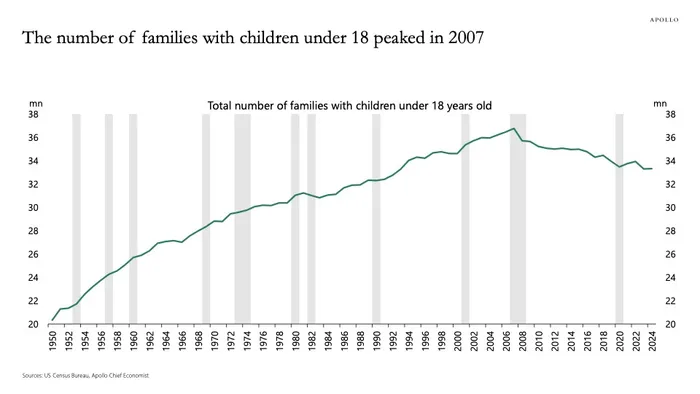
The trend, he said, reflects lower birth rates and an aging population, dynamics that could weigh on labor-force growth, housing demand, and consumption over time, reinforcing concerns about the economy’s longer-run growth potential.
In corporate news, Ford Motor added to the cautious tone by announcing a sweeping reset of its electric-vehicle strategy, taking a $19.5 billion charge tied primarily to EV investments and canceled programs. Chief Executive Jim Farley said the decision reflects how quickly “the market really changed,” citing weaker-than-expected demand, high costs, and regulatory shifts that undermined the business case for large EVs. The automaker plans to pivot toward hybrids and extended-range EVs, scrap several large-EV projects, and redeploy capital toward trucks, commercial vehicles, and a new battery energy storage business, while reaffirming adjusted earnings and free-cash-flow guidance.
Together, the softer labor data, demographic headwinds, and high-profile corporate recalibration set a measured tone at the open, with investors balancing signs of slowing growth against efforts by companies to protect cash flow and adapt to changing demand conditions.







Comentarios
Aún no hay comentarios