
The U.S. Stock Market Rally: A Strategic Entry Point for Long-Term Investors?
The U.S. stock market's 2025 rally has ignited a fierce debate among investors: Is this a golden opportunity to capitalize on momentum, or a cautionary tale of overvaluation? With the S&P 500 closing at a record 6,664 on September 19, 2025, and trading volume surging on rate-cut optimism, the question of sustainability looms large. For long-term investors, the answer hinges on dissecting the interplay between market momentum and valuation metrics.
Momentum: A Rally Fueled by Policy and Sector Rotation
The S&P 500's ascent in 2025 has been driven by a confluence of factors. The Federal Reserve's 25-basis-point rate cut in September 2025 acted as a catalyst, pushing the index to a 0.49% daily gain and an all-time high [2]. This follows a broader trend: the index gained 5.0% in June 2025 alone, buoyed by delayed U.S. tariffs and a shift in investor sentiment from panic to optimism [1].
Sector rotation has further amplified momentum. The technology sector, a perennial powerhouse, has surged on AI infrastructure demand, with companies like NvidiaNVDA-- and BroadcomAVGO-- posting double-digit gains [1]. Meanwhile, small-cap stocks and rate-sensitive industries have benefited from lower borrowing costs, as evidenced by the Russell 2000's record-breaking performance [2]. This broad-based participation suggests a more resilient rally than in previous cycles, where megacap dominance skewed market dynamics.
Valuation: Overvaluation Metrics Raise Red Flags
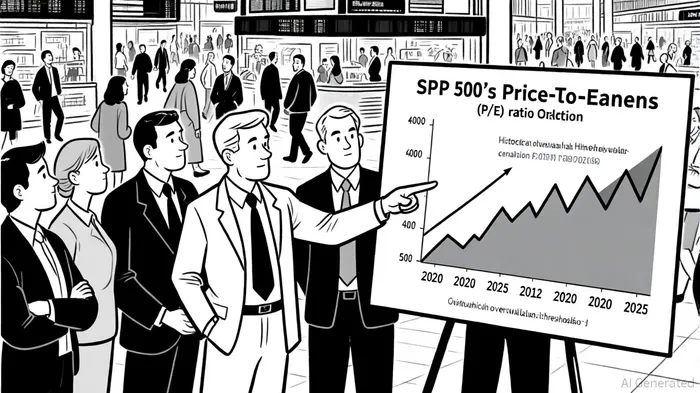
Despite the bullish momentum, valuation metrics paint a cautionary picture. As of September 19, 2025, the S&P 500's P/E ratio stands at 27.35, far exceeding its 5-year average of 22.17 and 10-year average of 19.18 [1]. This places the index in overvalued territory, defined as more than one standard deviation above its historical mean (24.84) [1]. While Goldman SachsGS-- projects a 11% rise in 12 months, such optimism relies on forward-looking assumptions about earnings growth and rate cuts that may not materialize [1].
The disconnect between price and fundamentals is stark. Analysts have cut Q2 2025 earnings expectations, yet the P/E ratio remains stubbornly elevated [4]. This suggests that investors are pricing in future growth rather than current performance—a risky proposition if earnings fail to meet lofty expectations. Morgan StanleyMS-- warns that uneven corporate earnings and inflationary pressures from tariffs could erode this optimism, creating volatility for long-term investors [2].
Risks to Sustainability: Earnings, Inflation, and Policy Uncertainty
Three key risks threaten the rally's longevity. First, the labor market's cooling trend—evidenced by slowing wage growth and rising unemployment in early 2025—could dampen consumer spending, a critical driver of corporate profits [2]. Second, while the tech sector's AI-driven growth is real, it remains concentrated in a handful of companies, leaving the broader market vulnerable to sector-specific corrections. Third, trade policy uncertainties persist. Although delayed tariffs provided short-term relief, their eventual implementation could reignite inflationary pressures, forcing the Fed into a tighter policy stance [4].
Strategic Entry Points: Balancing Momentum and Valuation
For long-term investors, the rally presents a paradox: a market driven by momentum but priced for perfection. A strategic entry requires a nuanced approach.
- Sector Diversification: While technology remains a growth engine, allocating to undervalued sectors like consumer staples (which declined 2.21% in June 2025 [1]) could hedge against volatility.
- Quality Over Speculation: Prioritize companies with strong balance sheets and consistent earnings, even if they trade at a premium. The current P/B ratio (though not publicly cited) likely reflects this trend, as investors favor assets with durable cash flows.
- Dollar-Cost Averaging: Given the overvaluation, gradual entry into the market—rather than a lump-sum approach—can mitigate downside risk while capturing compounding benefits.
Conclusion: A Tenuous Equilibrium
The U.S. stock market's 2025 rally is a testament to the power of policy-driven momentum and sector innovation. However, the S&P 500's overvaluation metrics and macroeconomic headwinds suggest that this equilibrium is tenuous. For long-term investors, the rally offers opportunities—but only for those who approach it with discipline, diversification, and a clear-eyed view of the risks. As history shows, markets do not remain in bubbles forever. The key is to position for both growth and correction.





Comentarios
Aún no hay comentarios