
Stock Market Hours & Investor Behavior Around Major Holidays
Holiday Schedules and Liquidity Shifts
The U.S. stock market will observe its customary closure on Thanksgiving Day, November 27, 2025, with no trading on the NYSE or Nasdaq. Trading resumes on Black Friday but with abbreviated hours, closing at 1:00 p.m. ET for stocks and 2:00 p.m. ET for bonds. This pattern aligns with historical trends, during which liquidity typically declines and trading volumes drop significantly. For instance, equity volumes often fall to 80% of normal levels the day before Thanksgiving and as low as 45% the day after. Such liquidity constraints amplify bid-ask spreads and increase transaction costs, particularly for active traders and algorithmic systems reliant on precise execution timelines. 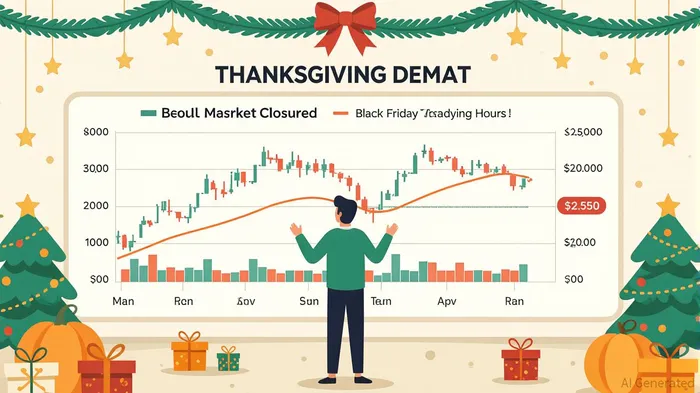
Retail Investor Behavior: Caution and Diversification
Retail investors, who now account for roughly one-quarter of U.S. equity trading volume, exhibit distinct patterns during holiday periods. Historical data suggests that retail activity tends to wane as liquidity tightens, with many investors adopting a wait-and-see approach. A 2025 analysis highlights that while retail investors increasingly favor diversified ETFs and long-term strategies, a significant portion remains hesitant to invest beyond their 401(k) plans, particularly during periods of market uncertainty. This hesitancy is compounded by the indirect influence of holiday consumer behavior, such as Gen Z's preference for early bird deals, which may divert attention from equity markets according to research.
Institutional Investor Strategies: Proactive Liquidity Management
In contrast, institutional investors often proactively adjust their strategies to mitigate liquidity risks during holidays. By identifying key dates with potential for reduced trading activity-such as Thanksgiving, Christmas, and New Year's-they coordinate trades to avoid liquidity-constrained periods. For example, during the 2025 holiday season, institutions may front-load trades before Thanksgiving or employ limit orders to navigate the shortened Black Friday session as research indicates. Russell Investments notes that global equity volumes during end-of-year holidays typically fall to 45-70% of normal levels, necessitating careful execution to minimize slippage. Additionally, fixed-income markets, such as U.S. dollar-denominated securities, may close entirely on holidays like Labor Day, further underscoring the need for institutional liquidity planning.
Broader Implications for Market Dynamics
The divergent behaviors of retail and institutional investors during holidays highlight broader market dynamics. Reduced liquidity and uneven participation can lead to temporary price dislocations, particularly in less liquid assets. For instance, the shortened Black Friday session may delay settlement processes, affecting arbitrage opportunities and portfolio rebalancing. Meanwhile, the growing retail investor presence - driven by platforms democratizing access to markets - introduces new variables into holiday trading patterns, such as increased ETF activity and retail-driven momentum in specific sectors.
Conclusion
As the 2025 holiday season approaches, both retail and institutional investors must navigate the unique challenges posed by market closures and liquidity shifts. While retail investors often adopt a cautious stance, institutions leverage historical insights and strategic adjustments to optimize execution. Understanding these patterns is critical for managing risk and capitalizing on opportunities in a market shaped by seasonal rhythms. For investors, the lesson is clear: holiday schedules are not merely logistical hurdles but pivotal factors in crafting resilient investment strategies.







Comentarios
Aún no hay comentarios