
Stock Market Holiday Schedule and Seasonal Performance Trends Around Thanksgiving and Black Friday
Market Closures and Liquidity Constraints
The U.S. equity markets will be closed on Thanksgiving Day, while Black Friday trading will end at 1:00 p.m. Eastern Time, as confirmed by the NYSE and Nasdaq schedules. These adjustments reduce trading volumes, particularly on Black Friday, when liquidity is historically lighter. According to a report by , such shortened sessions can amplify price movements in certain securities, as fewer participants may lead to exaggerated reactions to news or order imbalances. This dynamic is especially relevant for retail stocks, which often experience heightened volatility during the holiday season due to their direct exposure to consumer spending patterns as data shows.
Seasonal Performance Trends
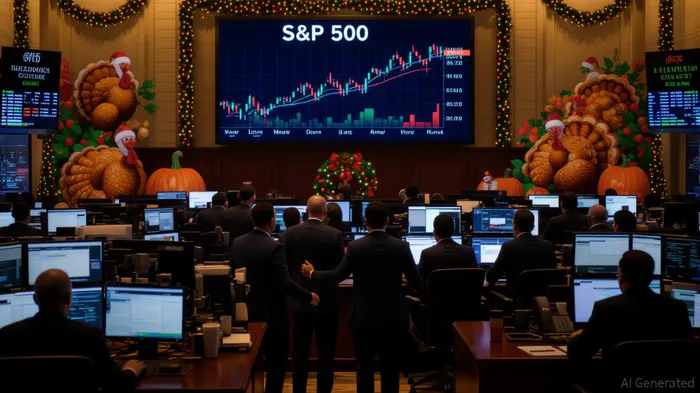 Historical data reveals a consistent positive bias for the S&P 500 during Thanksgiving week. Backtests indicate an average gain of 0.64% for the index during this period, with a 60% to 70% probability of a positive close for the week. Retail stocks, in particular, tend to outperform, posting an average gain of 1.26% per trade during the same timeframe. This outperformance is driven by anticipation of the holiday shopping season and the "Santa rally," a phenomenon where investor optimism about year-end and early-year prospects lifts equities. The potential for a Federal Reserve rate cut in early 2026 further amplifies this optimism, as investors may begin positioning portfolios ahead of anticipated monetary easing as noted by financial analysts.
Retail Investor Behavior and Economic Signals
Retail investor behavior plays a pivotal role in shaping market dynamics during this period. Black Friday sales, traditionally a barometer of consumer confidence, have evolved into a broader "Black November" event, with retailers extending promotions to capture price-sensitive shoppers amid persistent inflation. This shift reflects a broader trend of value-conscious spending, as households prioritize affordability over discretionary purchases. According to , the rise of e-commerce and AI-driven personalization-led by firms like AmazonAMZN-- and Walmart-has further transformed retail demand forecasting, enabling more agile inventory management.
These changes have macroeconomic implications. The holiday season acts as a microcosm of industry trends, highlighting the integration of artificial intelligence in retail and the resilience of consumer demand. As noted by , financial markets closely monitor Black Friday performance for early signals about the health of the broader economy. A strong showing could reinforce expectations of a "soft landing," while weak sales might reignite concerns about a potential slowdown.
Strategic Implications for Investors
For investors, the Thanksgiving week presents both opportunities and risks. The combination of reduced liquidity and heightened retail sector volatility necessitates caution, particularly for those engaging in short-term trading. However, the historical bullish bias and Santa rally momentum offer compelling reasons to maintain a defensive or slightly overweight position in consumer discretionary and retail stocks.
Moreover, the evolving nature of Black Friday-shifting from in-store frenzies to extended digital promotions-underscores the importance of adapting investment strategies to reflect structural changes in consumer behavior. Retailers that leverage AI and omnichannel strategies, as highlighted by Refinitiv, are likely to outperform peers, offering a lens through which investors can identify resilient businesses.
Conclusion
The interplay between market closures, seasonal trends, and retail investor behavior around Thanksgiving and Black Friday creates a complex but navigable landscape for investors. While structural factors like reduced liquidity amplify short-term volatility, historical patterns and evolving consumer dynamics provide a framework for informed decision-making. As the 2025 holiday season unfolds, investors must balance caution with opportunism, recognizing that the week's market movements may offer early insights into the broader economic trajectory.





Comentarios
Aún no hay comentarios