
Is STMicroelectronics' €1 Billion EIB Credit Line a Catalyst for Undervalued Growth?
The European Investment Bank's (EIB) €1 billion credit line to STMicroelectronicsSTM-- represents a pivotal moment in the semiconductor industry's strategic evolution. This funding, the ninth agreement between the EIB and the French-Italian chipmaker, brings total EIB financing to €4.2 billion since 1994. , the deal underscores Europe's commitment to semiconductor sovereignty and technological leadership. For investors, the question remains: does this funding reshape STMicroelectronics' investment narrative by mitigating execution risks and accelerating margin/earnings recovery, ?
Strengthening European Semiconductor Leadership
The EIB's support aligns with the EU's 2025 semiconductor strategy, which prioritizes innovation, sustainability, and energy efficiency. , Agrate, , STMicroelectronics is directly addressing Europe's need for scalable production and cutting-edge R&D. This dual focus not only bolsters the company's operational resilience but also reinforces its role in securing critical technologies for the bloc. As noted by EIB officials, the agreement "reinforces Europe's competitiveness in the global semiconductor market while advancing green and digital transitions."
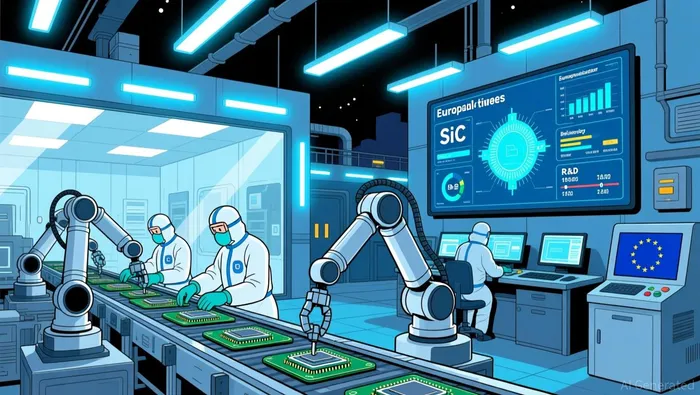 The strategic alignment extends to geopolitical goals. With China's competitive pressures intensifying, the EU's push for is critical. STMicroelectronics' ability to leverage EIB funding for advanced manufacturing-particularly in -positions it as a linchpin in Europe's semiconductor ecosystem.
SiC Value Chain Control: A Strategic Edge
A key component of the EIB agreement is its emphasis on Silicon Carbide (SiC) value chain control. STMicroelectronics' Catania facility, which spans the entire SiC production chain, has been highlighted as a cornerstone of the funding's impact. . Analysts argue that STMicroelectronics' dominance in SiC positions it to capture long-term growth in like automotive and renewable energy.
This vertical integration, supported by EIB financing, reduces exposure to external volatility and accelerates time-to-market for next-generation products.
Margin and Earnings Acceleration: A Path to Recovery
The EIB funding's financial implications are equally compelling. Analysts project that STMicroelectronics' gross margin , driven by increased production volumes, reduced inefficiencies, and a favorable product mix. . Moreover, the EIB's support mitigates near-term execution risks. By reducing reliance on volatile capital markets, the funding provides STMicroelectronics with stable, long-term liquidity to navigate cyclical downturns and invest in R&D without compromising operational flexibility. This stability is critical for a company that has faced margin pressures from inventory corrections and competitive pricing dynamics.
Fair Value Target: Justifying the €24.62 Estimate
, derived from adjusted discount rates and growth assumptions, reflects a measured optimism about STMicroelectronics' long-term prospects. While near-term revenue growth expectations have been tempered, the EIB funding's alignment with structural trends-such as the and industrial automation-supports a constructive medium-term outlook. Analysts argue that the market may be underestimating the company's recovery trajectory. With EIB-backed investments in SiC and energy-efficient manufacturing, STMicroelectronics is well-positioned to outperform peers in high-growth sectors. , therefore, .
Risks and Considerations
Despite these positives, challenges persist. Intensifying competition from Chinese manufacturers and potential restructuring costs could pressure margins. Additionally, the success of the EIB-funded initiatives hinges on execution-particularly in scaling and maintaining R&D momentum. Investors must also consider macroeconomic headwinds, such as interest rate volatility and global demand fluctuations, which could impact the company's ability to capitalize on its strategic advantages.
Conclusion
STMicroelectronics' €1 billion EIB credit line is more than a financial transaction; it is a strategic catalyst for reshaping the company's investment narrative. By mitigating execution risks, accelerating margin/earnings recovery, and solidifying control over the SiC value chain, the funding aligns with both European policy objectives and long-term growth imperatives. , . For investors, the current entry point appears compelling, provided they remain cognizant of the sector's inherent risks.





Comentarios
Aún no hay comentarios