
Stitch Fix's FY 2026 Revenue Outlook and AI-Driven Personalization Strategy: Assessing AI's Potential to Drive Scalable Margin Expansion and Customer Retention in Retail Tech
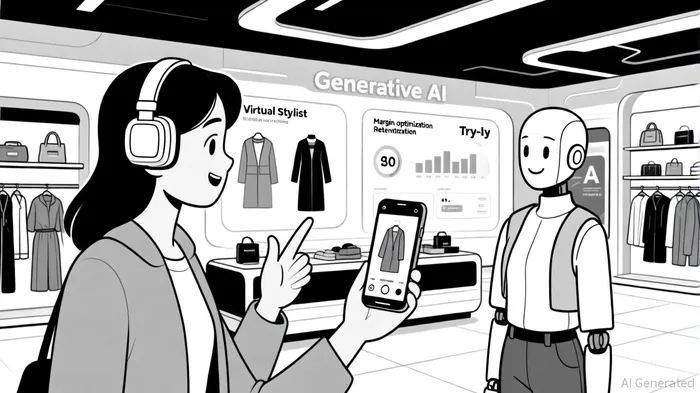
In the evolving retail tech landscape, Stitch Fix's ability to leverage artificial intelligence (AI) will be pivotal in determining its FY 2026 revenue trajectory. While the company has yet to disclose granular details on its AI roadmap, broader industry trends and its existing personalization framework suggest a compelling case for AI-driven margin expansion and customer retention.
The Current State of Stitch Fix's Personalization Model
Stitch Fix's hybrid model—combining human stylists with algorithmic insights—has long been its differentiator. Customers complete a detailed style quiz, and stylists refine selections based on feedback, returns, and direct notes from users [3]. This iterative process, however, remains labor-intensive, with a $20 styling fee per order that is partially credited toward retained items. While this model has fostered loyalty, scaling it sustainably requires reducing reliance on human labor without compromising personalization quality.
AI Trends Reshaping Retail: Efficiency and Innovation
Recent advancements in AI, particularly generative models and hybrid architectures, offer a blueprint for Stitch Fix's next phase. For instance, generative AI has enabled researchers to design novel compounds for drug-resistant infections, demonstrating its capacity to navigate complex datasets and generate actionable insights [2]. Similarly, Stitch FixSFIX-- could deploy generative AI to predict style preferences or optimize inventory by analyzing vast customer feedback loops.
Hybrid models, such as the HART (Hybrid Autoregressive Transformer) tool, further underscore AI's efficiency gains. By merging autoregressive and diffusion techniques, HART generates high-quality images in a fraction of the time required by traditional methods . For Stitch Fix, this could translate to faster virtual try-on simulations or dynamic visual recommendations, enhancing the user experience while reducing operational latency.
AI's Potential to Expand Margins and Retain Customers
- Cost Optimization: Automating stylist workflows with AI could reduce labor costs. For example, AI could pre-screen customer preferences, flagging high-priority cases for human stylists while handling routine selections algorithmically. This would lower the effective cost per Fix without sacrificing personalization.
- Reduced Returns: AI-driven fit algorithms, trained on historical return data, could improve accuracy in size and style recommendations. Even a marginal reduction in return rates would directly boost gross margins, as returns incur logistics and inventory costs.
- Enhanced Retention: Personalization is a key driver of customer loyalty. By leveraging AI to anticipate evolving preferences—such as seasonal trends or micro-trends—Stitch Fix could deepen engagement. The “periodic table of machine learning” framework, which unifies classical algorithms into a cohesive system [4], suggests that Stitch Fix could develop proprietary models to recombine strategies like collaborative filtering and deep learning for hyper-personalization.
Challenges and Risks
Despite these opportunities, challenges persist. Data privacy concerns, algorithmic bias, and the high cost of AI infrastructure could hinder adoption. Additionally, competitors like Amazon's AI-powered styling tools or emerging startups may erode Stitch Fix's first-mover advantage if it delays scaling its AI capabilities.
A Forward-Looking Perspective
While Stitch Fix has not yet released FY 2026 financial projections, the company's FY 2024 10-K filing noted a strategic focus on “technology-led personalization” to drive profitability [3]. Coupled with industry-wide AI efficiency gains, this signals a plausible path to margin expansion. For investors, the key will be monitoring how effectively Stitch Fix integrates AI into its core workflows without diluting the human touch that defines its brand.





Comentarios
Aún no hay comentarios