
Stem's Strategic Turnaround: A Software-Driven Path to EBITDA Positivity and Sustainable Growth
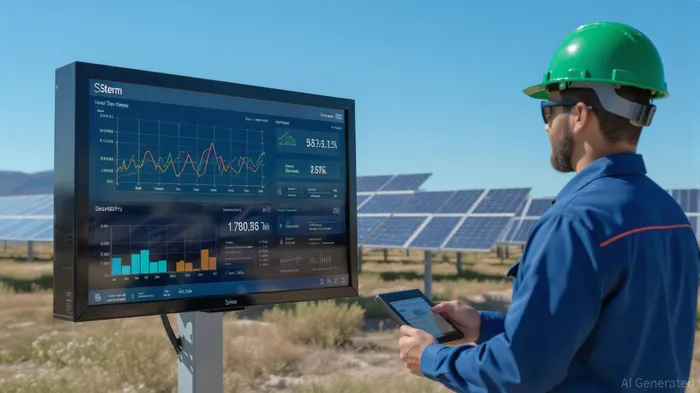
In the rapidly evolving clean energy sector, companies must adapt or risk obsolescence. StemSTEM-- Inc. (STEM), a pioneer in AI-driven energy solutions, has embarked on a transformative journey that underscores the power of software-centric innovation. After years of financial turbulence, the company's second-quarter 2025 results reveal a compelling narrative of operational discipline, strategic debt restructuring, and a renewed focus on high-margin software offerings. For investors, the question is no longer whether Stem can survive but whether it can capitalize on its newfound momentum to dominate a market primed for disruption.
Financial Turnaround: From EBITDA Deficits to Positivity
Stem's Q2 2025 financials tell a story of resilience. Revenue rose 13% year-over-year to $38.4 million, driven by a 22% increase in Annual Recurring Revenue (ARR) to $58.5 million. More strikingly, the company achieved positive adjusted EBITDA of $3.8 million, reversing a $11.3 million loss in the same period in 2024. This turnaround was fueled by a shift toward software and services, which now account for over 40% of gross profit. GAAP gross margins expanded to 33% of revenue, while non-GAAP margins hit 49%, reflecting the scalability of software-driven solutions compared to hardware-centric models.
The company's balance sheet also shows signs of stabilization. A $195 million debt exchange in June 2025 extended maturities to 2030, reducing near-term liquidity risks. While cash reserves fell to $40.8 million from $58.6 million in Q1 2025, this was attributed to one-time costs from a workforce reduction and working capital adjustments. The 1-for-20 reverse stock split, mandated by NYSE compliance rules, has further streamlined the company's capital structure, potentially attracting new institutional investors.
Software-Centric Strategy: The New Engine of Growth
Stem's pivot to software is not just a cost-saving measure—it's a strategic repositioning. Its PowerTrack™ platform, an AI-powered suite for solar and storage project management, has become a cornerstone of its value proposition. By standardizing this software with partners like Norbut Solar Farms in the New York ISO market, Stem is creating a recurring revenue stream while reducing project-specific overhead. The deployment of its advanced energy system at Avangrid's Camino Solar project in California further demonstrates the scalability of its solutions.
The financial implications are clear: software and services now drive 80% of Stem's gross profit. This shift has allowed the company to maintain non-GAAP gross margins above 40%, a stark contrast to the sub-30% margins typical of hardware-heavy competitors. With operating assets under management (AUM) for storage growing 42% year-over-year to 1.7 GWh and solar AUM rising 22% to 32.7 GW, Stem is leveraging its software to scale without proportionally increasing costs.
Market Positioning: Navigating Headwinds with Agility
The clean energy sector faces headwinds, including supply chain bottlenecks, regulatory uncertainty, and geopolitical tensions. Yet Stem's software-centric model offers a unique advantage. Unlike traditional energy firms, which are vulnerable to hardware price swings and project delays, Stem's AI-driven solutions optimize project design, reduce operational complexity, and enhance grid integration. This agility is critical in a market where U.S. commercial and industrial solar demand is projected to grow 15% annually through 2030.
Geographically, Stem is expanding its footprint. The Green River Energy Center in Utah—a 400 MW solar and 1,600 MWh storage project—highlights its ability to secure large-scale contracts. Internationally, the company's regulatory expertise positions it to navigate policy shifts in markets like Europe and Asia, where green energy mandates are accelerating. CEO Arun Narayanan has emphasized that Stem's AI-driven approach allows it to “future-proof” projects against tariffs and policy volatility, a key differentiator in a fragmented industry.
Investment Implications: A High-Conviction Play
For investors, Stem's transformation presents both risks and rewards. The company's reaffirmed 2025 guidance—$125–$175 million in revenue, $55–$65 million in ARR, and adjusted EBITDA of $(10)–$5 million—suggests cautious optimism. While near-term EBITDA breakeven remains a stretch, the path to profitability is clearer than ever. The debt restructuring provides a multi-year runway, and the software backlog is growing at a healthy clip.
However, execution risks persist. The clean energy sector is highly competitive, and Stem's reliance on software margins could be tested if rivals replicate its AI-driven model. Additionally, macroeconomic factors like interest rates and commodity prices could impact project financing. That said, the company's leadership changes—most notably the return of Brian Musfeldt as CFO—signal a commitment to financial prudence.
Conclusion: A Software-Driven Renaissance
Stem's journey from EBITDA deficits to positivity is a testament to the power of strategic reinvention. By pivoting to software, restructuring its debt, and securing high-impact projects, the company has positioned itself as a leader in the AI-driven clean energy revolution. For investors willing to tolerate near-term volatility, Stem offers a compelling long-term opportunity: a firm with a scalable, high-margin model and a clear vision for dominating the next phase of the energy transition.
As the world races toward decarbonization, companies that can marry technology with sustainability will thrive. Stem, with its software-centric playbook and proven operational agility, is well on its way to becoming one of them.





Comentarios
Aún no hay comentarios