
Stellar (XLM) and the Wyckoff Market Setup: A 2017 Parallel Suggesting a High-Probability Breakout
The 2017 Wyckoff Blueprint: Accumulation and Institutional Catalysts
In 2017, Stellar's price trajectory was a textbook example of a Wyckoff markup phase. Starting from a negligible $0.005, XLMXLM-- surged to $0.75 by year-end, driven by strategic partnerships with IBMIBM-- and KlickEx. These collaborations positioned Stellar as a blockchain solution for cross-border payments, leveraging its sub-5-second transaction speed and smart contract capabilities, as discussed in a 2017 Fool piece. The Wyckoff model identifies such phases as periods of controlled accumulation, where institutional players quietly build positions before a public rally. By October 2017, XLM's price action showed a consolidation pattern followed by a sharp upward breakout, a hallmark of a well-orchestrated markup, as a Coinotag analysis showed.
2025's Wyckoff Reaccumulation: A Mirror to History
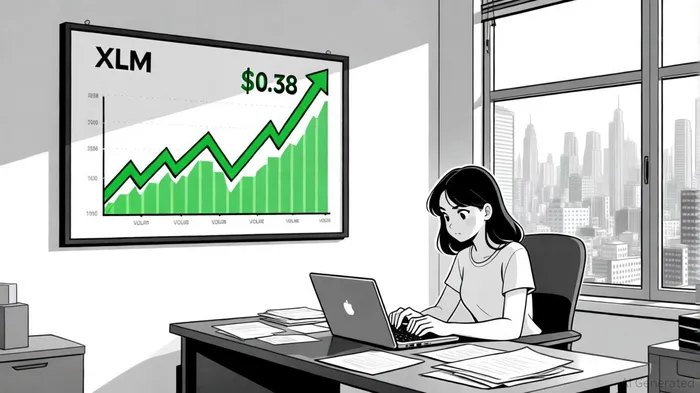
Fast forward to 2025, and XLM is exhibiting a nearly identical setup. The token is currently consolidating near $0.33, forming a reaccumulation phase that mirrors its 2017 base. Technical analysts note a 150% surge in trading volume over the past month, a critical sign of institutional accumulation rather than speculative retail activity, as reported in a Bankless Times report. This volume spike aligns with the Wyckoff principle that controlled buying pressure precedes a breakout. Additionally, XLM is forming a bullish flag pattern within a descending channel, with key resistance levels at $0.38 and $0.40. If these levels are breached, the price could retrace to the 2017 peak of $0.75, assuming similar market conditions, as noted in a Coinotag piece.
Fundamental Catalysts: RWAs and Institutional Adoption
While technical patterns are compelling, fundamentals are the bedrock of any bullish case. Stellar's ecosystem has evolved significantly since 2017, with real-world asset (RWA) adoption becoming a key driver. As of Q3 2025, the total value locked (TVL) in Stellar's RWA sector has surged by 26.5% to $638.8 million, positioning it as the eighth-largest chain in this space, according to a CoinDesk report. This growth is fueled by partnerships with major players like Franklin Templeton, Circle, and WisdomTree, which are tokenizing real-world assets (e.g., real estate, commodities) on the Stellar network.
A notable catalyst emerged in October 2025 when SwissCustody announced a 1 billion XLM treasury, valued at over $320 million at current prices. While skepticism persists due to the lack of official confirmation, this move signals growing institutional confidence in XLM as a store of value. Additionally, stablecoin adoption on Stellar has increased by 8.2% in the same period, reaching $269 million, further solidifying its role in global finance, as CoinDesk reported.
Institutional Accumulation and the Death Cross Dilemma
Despite the bullish setup, XLM faces a critical juncture. The token is on the verge of a "death cross," where the 50-day and 200-day exponential moving averages (EMA) converge, often signaling bearish momentum. However, the recent 134% surge in trading volume suggests that institutional buyers are accumulating at these levels, potentially negating the bearish signal. This divergence between technical indicators and volume patterns is a classic Wyckoff scenario, where controlled accumulation precedes a breakout.
The Bull Case: A 2017 Revisited
The alignment of technical and fundamental factors creates a high-probability scenario for XLM. If the $0.38 resistance is breached, the price could target $0.40 and eventually retrace to the 2017 peak of $0.75. This trajectory would require sustained institutional buying, a continuation of RWA growth, and a favorable macroeconomic environment for risk assets. While risks remain-particularly around SwissCustody's transparency and broader crypto market sentiment-the current setup mirrors the conditions that propelled XLM to 10,400% gains in 2017.
For investors, the key takeaway is clear: Stellar's Wyckoff Market Setup, combined with its evolving RWA ecosystem, presents a compelling case for a breakout. As with any high-risk, high-reward trade, patience and discipline are paramount. But for those who recognize the parallels between 2017 and 2025, the potential rewards could be transformative.





Comentarios
Aún no hay comentarios