
Stellar (XLM) and the Case for a Post-Crash Rebound: Technical and Fundamental Drivers of a Bull Market Resurgence
Stellar (XLM) has emerged as a compelling case study in post-crash resilience, with both technical and fundamental indicators suggesting a potential bull market resurgence. After a sharp decline in late 2025 that saw the token dip to $0.16, XLMXLM-- has staged a partial recovery, trading near $0.37 as of October 15, 2025. This analysis examines the interplay of technical patterns and foundational strengths that could propel XLM into a sustained upward trend.
Technical Indicators: A Confluence of Bullish and Bearish Signals
The technical landscape for XLM is nuanced. While the Relative Strength Index (RSI) dipped below 50 during the crash and the Moving Average Convergence/Divergence (MACD) formed a bearish cross, recent price action has shown signs of stabilization. XLM has been trading within a descending parallel channel since July 2025, and a breakout above the diagonal resistance line could signal a shift in momentum. Analysts have identified an inverse head-and-shoulders pattern on the daily chart, which, if confirmed, could target a rally to $0.50, a Coingabbar prediction.
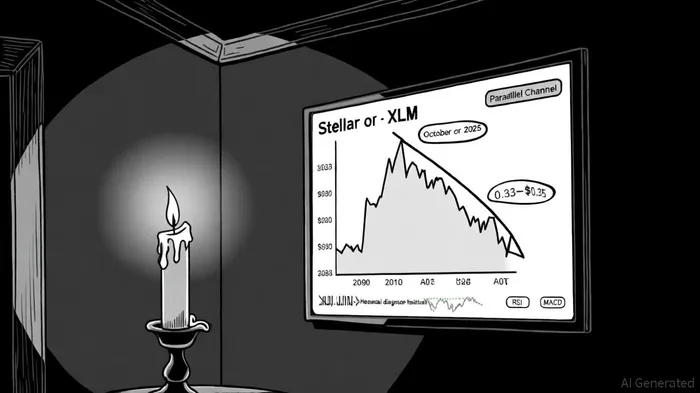
The 50-day moving average remains above the 200-day moving average—a bullish "golden cross" that supports the long-term uptrend, according to an OnTheNode analysis. However, on-chain metrics and social dominance data present mixed signals. Stellar's social dominance fell to 0.16% by October 2025, according to The Currency Analytics. Meanwhile, Wyckoff volume bars indicate weakening buying pressure, suggesting caution for short-term traders. That said, XLM's ability to transform a former resistance level into a robust support zone—a classic bullish reversal sign—has bolstered optimism among technical analysts, according to a Currency Analytics analysis.
Fundamental Drivers: Cross-Border Payments and Institutional Adoption
While technical indicators offer a roadmap for price action, Stellar's fundamentals provide the bedrock for sustained growth. The platform's role in cross-border payments has solidified its relevance in 2025, with partnerships with MoneyGram, Franklin Templeton, and PayPal driving utility. The StellarXLM-- Consensus Protocol (SCP) enables transactions to settle in 5–10 seconds while maintaining energy efficiency, a critical advantage in a market prioritizing scalability and sustainability, per a CoinCryptoRank guide.
Institutional adoption has surged, with Franklin Templeton tokenizing $445 million in U.S. Treasuries on Stellar and PayPal planning to launch its PYUSD stablecoin on the network, as reported in a Blockchain.News report. XLM's inclusion in the S&P Digital Markets 50 Index has further attracted regulated capital, offering institutional investors a gateway to digital assets, according to Coingabbar. These developments are not merely speculative; they reflect a growing institutional trust in Stellar's infrastructure.
The ecosystem's technical evolution has also been pivotal. Protocol 23 upgrades introduced parallel transaction processing and enhanced smart contract functionality, while Protocol 24, slated for 2026, will integrate zero-knowledge proofs to bolster privacy without compromising regulatory compliance, according to Blockchain.News. These upgrades have already spurred a 22% 24-hour increase in DeFi Total Value Locked (TVL), reaching $120.25 million, according to Blockchain.News.
Strategic Partnerships and Real-World Utility
Stellar's utility extends beyond payments. The platform now supports tokenized real-world assets (RWAs), including carbon credits and fiat-backed stablecoins like USDCUSDC-- and EURC. For instance, Societe Generale-FORGE's euro-backed stablecoin on Stellar underscores its growing role in institutional finance, according to The Currency Analytics. Additionally, the U.S. Department of Commerce's use of Stellar to post quarterly GDP data has added a layer of institutional legitimacy, according to CoinCryptoRank.
The network's user base has expanded to 9.7 million accounts, with 264.6 million payments processed in July–August 2025 alone, according to CoinCryptoRank. This growth is underpinned by Stellar's Soroban smart contracts, which enable micropayments and streaming payments—use cases critical for IoT and digital content monetization.
Institutional Confidence and Market Projections
Corporate volume for XLM has exceeded 71 million tokens in October 2025, signaling strong accumulation by institutional accounts, according to CoinCryptoRank. Analysts project that XLM could reach $1.00 as adoption in enterprise and micropayment ecosystems accelerates, according to CoinCryptoRank. Short-term targets, such as breaking through the $0.33–$0.35 resistance zone, could validate a broader bullish narrative.
Risks and Considerations
Despite the optimism, risks persist. The decline in social dominance and mixed on-chain metrics highlight potential volatility. Regulatory scrutiny of stablecoins and cross-border transactions could also pose challenges. However, Stellar's focus on real-world integration and institutional partnerships positions it to navigate these headwinds.
Conclusion: A Case for Strategic Investment
Stellar (XLM) presents a compelling case for a post-crash rebound, driven by a confluence of technical catalysts and fundamental strengths.
While the path to $0.50 or higher is not without risks, the platform's role in cross-border finance, institutional adoption, and technological innovation provides a robust foundation. For investors, the key lies in monitoring the breakout above $0.35 and the broader macroeconomic trends shaping digital asset adoption.






Comentarios
Aún no hay comentarios