
Stellantis' Q3 Shipment Surge and Its Implications for Global Auto Market Recovery
Stellantis' Q3 Shipment Surge and Its Implications for Global Auto Market Recovery
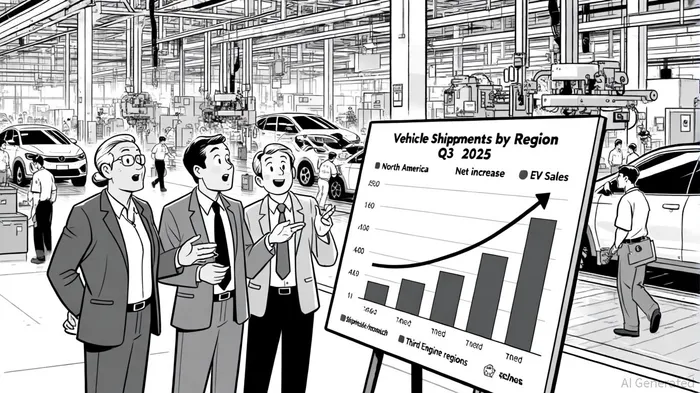
Stellantis' Q3 2025 performance has ignited optimism about the global auto market's recovery, with the automaker reporting 1.3 million consolidated shipments, a 13% year-over-year increase driven by a 35% surge in North America, according to its Q3 2025 shipments report. This growth, however, masks a complex interplay of supply chain recalibrations and electric vehicle (EV) transition challenges. As the company navigates U.S. tariffs and shifting consumer preferences, its strategies offer critical insights into the auto industry's path forward.
Supply Chain Resilience: A Balancing Act
Stellantis' Q3 success is underpinned by aggressive supply chain adjustments. The automaker temporarily halted production at Canadian and Mexican plants in 2025 to mitigate the impact of 25% U.S. tariffs on imported vehicles, resulting in 900 layoffs at U.S. parts facilities, according to a Drive Into Future analysis. These measures, while costly-contributing to a €2.3 billion net loss in H1 2025-have enabled StellantisSTLA-- to realign production with localized demand.
The company is now prioritizing North American component manufacturing and deepening supplier relationships to reduce exposure to trade policies, as noted in an ElectricVehiclesHQ report. For instance, it has stockpiled models like the Jeep Compass and Ram Heavy Duty trucks in anticipation of tariff enforcement, stabilizing pricing and delivery timelines, according to a Logistic News report. Additionally, Stellantis is lobbying policymakers for a nuanced tariff framework that differentiates vehicles based on U.S. content, signaling a strategic shift from reactive to proactive trade engagement, as a MarkLines analysis notes.
EV Transition Momentum: Progress Amid Uncertainty
While Stellantis' EV production figures for Q3 2025 remain undisclosed, its sales data reveals a mixed picture. U.S. EV sales, including the Jeep Wagoneer S, surged by 5,378% in Q3 2025, according to Mopar Insiders figures, driven by incentives like a $7,500 cash bonus to offset the expired federal tax credit, as reported in a Free Press report. However, broader EV adoption faces headwinds: the company suspended its 2025 financial guidance due to tariff-related uncertainties and a €300 million Q2 loss from import duties, according to a Silicon Review piece.
Stellantis is countering these challenges through a multi-energy strategy, expanding its portfolio to include plug-in hybrids (PHEVs) and mild hybrids (MHVs) alongside battery-electric vehicles (BEVs), as outlined in a PredictStreet analysis. This approach aligns with its "Dare Forward 2030" plan, which aims for 5 million BEV sales by 2030 and carbon neutrality by 2038, per a Manufacturing Dive report. To support this, the automaker is investing in five new gigafactories across North America and Europe and securing raw material partnerships with firms like Vulcan Energy and CATL, as reported in an EV Magazine article.
Implications for the Global Auto Market
Stellantis' Q3 performance underscores two key trends shaping the industry:
1. Localization as a Survival Strategy: By shifting production to North America and diversifying suppliers, Stellantis is setting a precedent for mitigating trade risks. Competitors may follow suit, accelerating regional manufacturing hubs but potentially fragmenting global supply chains, as described in a CBT News article.
2. Flexibility in EV Transitions: The automaker's pivot to a xEV (extended electrification) model-balancing BEVs, PHEVs, and MHVs-reflects a pragmatic response to fluctuating demand. This could pressure rivals to adopt similar hybrid strategies, particularly in markets like Europe, where BEV adoption has plateaued, as shown in Stellantis' first-half results.
However, Stellantis' reliance on short-term incentives (e.g., absorbing EV tax credit costs) raises questions about long-term profitability. Investors must monitor whether these tactics translate into sustainable market share gains or merely delay structural challenges.
Conclusion
Stellantis' Q3 shipment surge demonstrates resilience in the face of trade and EV transition hurdles. Its supply chain adaptations and multi-energy strategy position it as a bellwether for the industry's recovery. Yet, the path forward remains fraught with risks, from tariff volatility to the high costs of electrification. For the global auto market, Stellantis' journey offers a blueprint for navigating uncertainty-but also a cautionary tale about the limits of short-term fixes in a rapidly evolving landscape.





Comentarios
Aún no hay comentarios