
Stellantis Q3 Shipment Growth and the Broader EV Transition Play
Stellantis' third-quarter 2023 performance was a mixed bag of optimism and caution. The automaker reported a 11% year-over-year increase in global shipments, totaling 1.43 million units, driven by robust demand in the Middle East & Africa (up 102%) and North America, according to the Stellantis shipments release. However, its Chinese market contracted by 33%, underscoring regional volatility, according to Automotive World. Meanwhile, its EV sales surged 37% compared to Q3 2022, buoyed by models like the Jeep® Avenger and Citroën ë-Berlingo, per that release. This duality-strong traditional vehicle demand paired with electrification progress-raises critical questions about Stellantis' long-term positioning in an industry undergoing seismic shifts.
The EV Transition: From Ambition to Pragmatism
Stellantis' original "Dare Forward 2030" strategy aimed for 5 million EVs sold by 2030 and full electrification in Europe by that year, according to a MarkLines report. By late 2024, however, the company had pivoted to a "multi-energy" approach, acknowledging waning European EV demand and regulatory uncertainties, as the MarkLines report also explains. This shift reflects a broader industry recalibration: StellantisSTLA-- now prioritizes flexibility, integrating internal combustion engines (ICE), plug-in hybrids (PHEVs), and mild hybrids (MHVs) alongside EVs, a trend highlighted in the MarkLines report. The STLA platform, initially designed for EVs, has been reconfigured to support multiple powertrains, reducing costs and accelerating time-to-market, per the same MarkLines analysis.
This pivot is not without risks. While Stellantis' operating margin hit 14.4% in 2025-surpassing expectations-its EV models, such as the Dodge Charger Daytona and Jeep Wagoneer S, have struggled to gain traction, a point noted in the MarkLines report. Competitors like Tesla, GM, and Ford are outpacing it in U.S. market share projections. Bank of America's "Car Wars" report projects Tesla's dominance will erode from 78% in 2018 to 18% by 2026, with GM and Ford each capturing 14% and Stellantis 8%, as covered by Electrek. Stellantis' 2025 RAM 1500 REV and upcoming Jeep Recon EVs aim to close this gap, but execution remains unproven.
Industry-Wide Rebalancing: Supply Chains, Regulations, and Geopolitics
The EV transition is no longer just about product innovation-it's a battle for supply chain resilience and regulatory favor. China's 60% share of global EV sales in 2024 has triggered trade tensions, with the EU imposing 45% tariffs on Chinese-made EVs, according to a Forbes analysis. For Stellantis, which relies on global manufacturing hubs, this complicates cost structures and export strategies. Meanwhile, U.S. policy uncertainty-such as potential rollbacks of the Inflation Reduction Act (IRA) incentives-adds another layer of risk, as discussed in the Forbes analysis.
Stellantis has responded by securing raw material partnerships and investing in in-house battery production, but these measures lag behind Tesla's vertical integration and GM's $36 billion EV investment, as noted in Electrek coverage. Ford's struggles with EV profitability (reporting losses on models like the F-150 Lightning) also highlight the sector's financial challenges, a theme explored in the Forbes piece. Stellantis' 14.4% operating margin in 2025 is impressive, but sustaining it amid rising R&D and production costs will test its cost-cutting discipline, per the MarkLines analysis.
Strategic Implications for Investors
Stellantis' Q3 results demonstrate its ability to navigate short-term volatility, but its EV strategy's long-term viability hinges on three factors:
1. Execution of the RAM 1500 REV and Jeep EVs: These models must resonate with U.S. buyers to challenge Tesla and Ford.
2. Adaptability to regulatory shifts: The EU's emissions targets and U.S. policy changes could force further strategic pivots.
3. Supply chain resilience: Securing battery materials and mitigating trade barriers will determine cost competitiveness.
While Stellantis' multi-energy approach offers flexibility, it also dilutes its commitment to full electrification-a risk in markets like Europe, where regulators are tightening emissions rules. For now, its shipment growth and profitability position it as a "middle-tier" EV contender, but investors should monitor its ability to scale EV sales without sacrificing margins.
Conclusion
Stellantis' Q3 performance underscores its resilience in a fragmented market, but the EV transition remains a high-stakes gamble. Its pivot to a multi-energy strategy buys time, but without a breakthrough in EV adoption or cost efficiency, it risks falling behind Tesla and its U.S. peers. For investors, the key will be balancing optimism about its shipment growth with skepticism about its EV roadmap-a delicate act in an industry where only the agile will survive.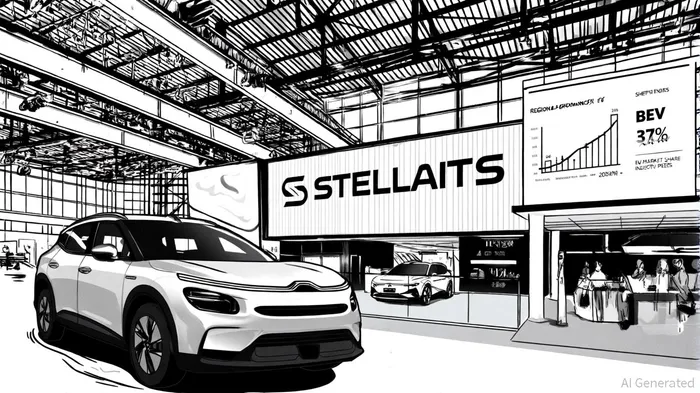





Comentarios
Aún no hay comentarios