
Stellantis and Mistral AI: Pioneering AI-Driven Transformation in the Automotive Industry
The automotive industry is undergoing a seismic shift as artificial intelligence (AI) redefines operational paradigms and customer expectations. At the forefront of this transformation is StellantisSTLA--, the global automaker behind brands like Jeep, Dodge, and Peugeot, which has deepened its strategic partnership with Mistral AI in 2025 to embed generative AI across its value chain. This collaboration, now spanning enterprise-wide deployment, marks a pivotal step in scaling AI from experimental pilots to transformative, industry-leading applications. For investors, the partnership offers a compelling case study of how AI can catalyze scalable innovation in both automotive and broader enterprise sectors.
Strategic Initiatives: From Pilots to Enterprise-Wide Adoption
Stellantis and Mistral AI have launched two flagship platforms to accelerate AI integration: the Innovation Lab and the Transformation Academy. The Innovation Lab focuses on co-developing customized AI solutions for complex use cases, particularly in sales and aftersales, while the Transformation Academy aims to bridge the gap between prototyping and production, ensuring rapid scaling of AI tools across the organization, as announced in Stellantis' expanded collaboration. According to Stellantis, these initiatives are designed to turn AI from a "disruptive force" into a "core operational capability," aligning with the company's Dare Forward 2030 strategic plan.
This structured approach contrasts with many competitors' fragmented AI experiments, positioning Stellantis to achieve a first-mover advantage in enterprise-wide AI adoption. By centralizing AI development and deployment, the automaker reduces redundancy and accelerates time-to-market for innovations, a critical edge in an industry where agility often determines competitive success.
Technical Focus: Enhancing Customer Experience and Operational Efficiency
The partnership's technical focus areas highlight its dual emphasis on customer-centricity and operational rigor. A standout example is the AI-powered in-car assistant, which allows drivers to interact with their vehicles using natural language for troubleshooting, feature guidance, and warning interpretation, as described in Stellantis' February announcement. This tool functions as a "voice-enabled user manual," providing real-time support and reducing reliance on traditional customer service channels. For investors, this innovation underscores Stellantis' ability to leverage AI for tangible customer value-a key differentiator in an increasingly saturated market.
Operational efficiency gains are equally significant. Mistral AI's large language models (LLMs) are streamlining data analysis, enabling faster decision-making and product development. In manufacturing, AI-driven anomaly detection systems are being tested to improve real-time quality control, while the BOM Data Intelligence tool helps engineers optimize part selection, reducing costs and improving global supply chain efficiency. These applications align with broader industry trends, where AI is projected to unlock $1.5 trillion in value across the automotive sector by 2035, per McKinsey estimates.
Broader Implications for the Enterprise Sector
Stellantis' collaboration with Mistral AI extends beyond automotive, offering a blueprint for AI adoption in other enterprise sectors. The Club Stellantis virtual assistant, for instance, supports employees with purchasing company vehicles and is slated for expansion across Europe, as reported by Thomasnet. This employee-facing AI tool demonstrates how generative AI can enhance internal workflows, a use case with cross-industry relevance for enterprises seeking to boost productivity.
Moreover, the partnership's focus on scaling AI from prototypes to production mirrors challenges faced by enterprises in sectors like healthcare, logistics, and retail. By institutionalizing AI through platforms like the Transformation Academy, Stellantis is setting a benchmark for how organizations can systematically integrate AI into their operations, mitigating risks of "AI fatigue" and ensuring sustainable returns on investment.
Conclusion: A Catalyst for Intelligent Transformation
For investors, Stellantis' partnership with Mistral AI represents more than a technological upgrade-it signals a strategic repositioning in a rapidly evolving market. By embedding AI into its operations, the automaker is not only enhancing customer experience and operational efficiency but also creating a scalable framework for innovation. As AI becomes a cornerstone of competitive advantage, Stellantis' enterprise-wide approach positions it to outpace rivals and deliver long-term value.
The automotive industry's AI journey is far from complete, but Stellantis' collaboration with Mistral AI illustrates the transformative potential of a well-structured, ambitious partnership. For enterprises across sectors, the lessons are clear: AI's value lies not in isolated experiments but in its ability to drive intelligent, systemic transformation.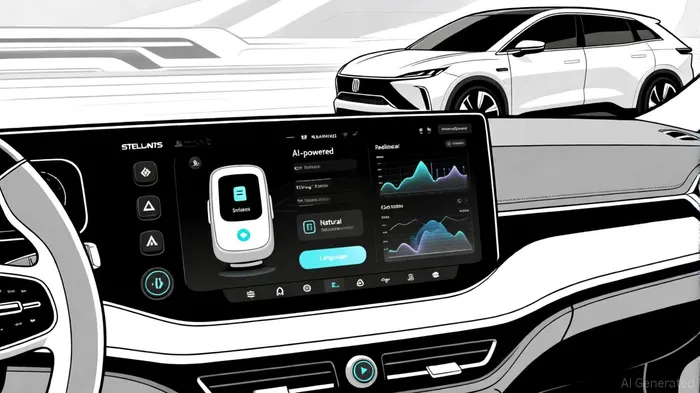







Comentarios
Aún no hay comentarios