
Stellantis' 2026 Detroit Show: Assessing the Scalability of a High-Margin, Niche Growth Strategy
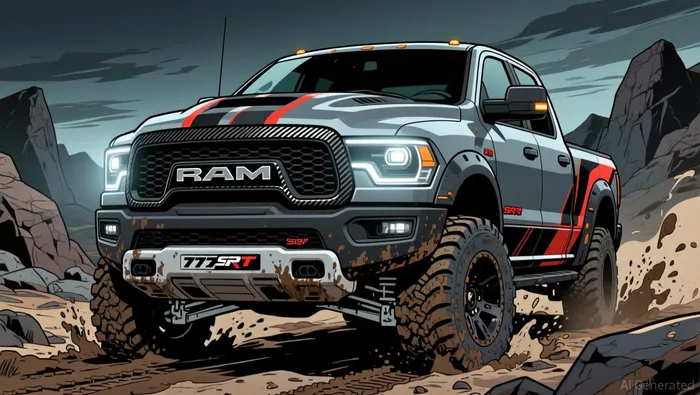
The 2026 Detroit Auto Show is a clear statement of intent. StellantisSTLA-- is showcasing a concentrated lineup of high-margin performance and off-road vehicles, targeting niche but profitable customer segments. The event features the return of the legendary 5.7L HEMI V-8 in the Ram 1500, the public debut of the 777-horsepower 2027 Ram 1500 SRT TRX, and a full display of Dodge's modern muscle, from the 420-horsepower Charger R/T to the 670-horsepower Charger Daytona. This is a focused bet on the enduring appeal of powerful internal combustion engines and premium capability.
This product strategy is backed by a significant commitment to domestic manufacturing. The company is highlighting a $13 billion investment in the U.S. over four years and plans to add 5,000+ new jobs. This capital deployment signals a scalable push to capture market share in key segments like trucks and SUVs, where Stellantis has strong brand equity. The investment is not merely about new models; it's about securing the production capacity to support a growth trajectory in these high-demand, high-margin categories.
Yet, viewed through a growth investor's lens, the event's overall impact on the company's total addressable market is constrained. The core of the showcase remains firmly rooted in internal combustion. The return of the HEMI V-8 and the focus on high-horsepower ICE trucks represent a bet against the long-term secular trend toward electrification. While the company is also launching electric models like the Jeep Recon, the dominant narrative at the show is one of gas-powered performance. This creates a vulnerability: the strategy is highly scalable within its current niche, but it risks leaving ground in the broader, faster-growing EV segment. The scalability is real, but the market it's scaling into is narrowing.
Total Addressable Market (TAM) Assessment
Stellantis' 2026 show lineup presents a classic growth investor's dilemma: high-margin niche bets versus capturing the broader, secular shift. The strategy is to scale within defined segments, but the total addressable market for each is a critical constraint.
The ultra-performance truck and SUV segment, epitomized by the 777-horsepower 2027 Ram 1500 SRT TRX, offers a clear path to high margins and brand loyalty. However, this is a niche market. These vehicles represent a tiny fraction of the overall light vehicle market, with high barriers to entry that protect profitability but limit total volume. The scalability here is real, but the ceiling is low. The company is betting that a dedicated, passionate customer base will consistently pay a premium, which is a proven model but one that won't drive massive top-line expansion.
The much larger and faster-growing opportunity lies in the electric vehicle segment. This is the fastest-growing part of the TAM, driven by long-term regulatory trends and consumer adoption. Yet, Stellantis' current electric offering is limited. The Ram 1500 REV and the Jeep Recon are steps in the right direction, but they are single models in a crowded field. The company faces intense competition from established EV leaders and agile new entrants. Its ability to capture significant share in this massive, growing market hinges on a far more aggressive and diverse electrification roadmap than what is currently on display. The show's focus on ICE performance risks appearing out of step with this critical growth trajectory.
This brings us to the strategic tension. The return of iconic ICE performance models, like the HEMI V-8, appeals to a specific, loyal customer base and supports the high-margin, scalable production plans. But it also introduces a risk of cannibalizing future EV sales, as customers who might have chosen an electric model instead opt for a powerful gas vehicle. More fundamentally, this strategy exposes the company to potential regulatory headwinds as emissions standards tighten globally. While the immediate market for these vehicles is robust, the long-term TAM for pure ICE performance vehicles is likely to contract.
The bottom line is that Stellantis is choosing to scale in a profitable but constrained niche while the broader market moves elsewhere. The company's investment in U.S. manufacturing capacity is a scalable bet, but its payoff depends on whether the niche segments can grow fast enough to offset the risk of missing the dominant EV trend. For a growth investor, the question is whether the high-margin niche is large enough to sustain the company's ambitions, or if it's a temporary fortress in a changing landscape.
Market Penetration and Scalability Analysis
The scalability of Stellantis' showcased products hinges on their ability to capture share in segments with fundamentally different growth profiles. The company is attempting to scale in two distinct arenas: ultra-performance ICE vehicles and the emerging EV market. The path to significant market penetration differs dramatically between them.
The ultra-performance segment, targeted by the 777-horsepower 2027 Ram 1500 SRT TRX and the Jeep Recon (650 hp), has high barriers to entry that protect margins but inherently limit total addressable market. These vehicles are niche products built for a passionate, performance-driven customer base. Their scalability is constrained by volume; even strong sales figures for these models will represent a tiny fraction of the overall light vehicle market. The strategy here is to dominate a profitable, high-margin corner, not to capture broad market share. The company's $13 billion U.S. investment supports this scalable production plan, but the ceiling is set by the niche itself.
In contrast, scaling electrification faces a different set of hurdles. The Ram 1500 REV and the all-electric Dodge Charger Daytona are Stellantis' attempts to enter the faster-growing EV segment. Their success depends on overcoming persistent consumer concerns around range and charging infrastructure. The Jeep Recon's estimated all-electric range of up to 250 miles is a competitive starting point, but it must be matched by a robust charging network to drive mass adoption. This is a scalability challenge of a different order: it requires not just manufacturing capacity, but also ecosystem development and significant investment to build consumer confidence. The company's current lineup is a single model per brand in a crowded field, making it difficult to capture meaningful share quickly.
A critical tension exists between these two strategies. The return of the 5.7-liter HEMI® V-8 and other ICE performance models is a powerful appeal to a specific customer base. However, this focus risks cannibalizing future EV sales, as customers who might have chosen an electric model instead opt for a powerful gas vehicle. More broadly, this strategy exposes the company to regulatory headwinds as emissions standards tighten globally. While the immediate market for these vehicles is robust, the long-term scalability of a pure ICE performance portfolio is questionable.
The bottom line is that Stellantis is pursuing a dual-track growth strategy with asymmetric scalability. The ultra-performance ICE segment offers a clear, high-margin path to volume growth within a constrained market. Electrification offers the potential for much larger market capture but requires overcoming significant infrastructure and competitive barriers. The company's ability to scale both simultaneously will determine its future growth trajectory. For now, the path to significant market penetration in the dominant EV segment remains the more challenging and uncertain bet.
Financial Impact and Valuation Implications
The financial story of Stellantis' 2026 strategy is one of immediate margin strength versus a longer-term growth question. The company's focus on high-performance ICE vehicles is a direct lever for near-term profitability. These niche models command premium pricing, which can boost both revenue per unit and gross margins. The return of the 5.7-liter HEMI V-8 and the 777-horsepower 2027 Ram 1500 SRT TRX are classic examples of products designed to maximize per-unit profitability, a key driver for investors focused on earnings quality.
This premium pricing is supported by a significant capital commitment. The $13 billion investment in the U.S. over four years is a multi-year bet on scaling production for these high-margin models, as well as for new products like the Ram 1500 REV. The financial impact here is twofold: it secures the capacity to meet demand for profitable vehicles, but it also locks in substantial fixed costs. The return on this capital will depend heavily on the adoption rates of these new launches, particularly the Ram 1500 REV. If these models capture share quickly, the investment will pay off handsomely. If adoption is slow, the high fixed costs could pressure margins over time.
The valuation premium for growth is justified only if these product launches lead to sustained market share gains in their respective segments. For the ultra-performance ICE segment, the path to share gain is clear but constrained by volume. The strategy is to dominate a profitable niche, which can support a premium valuation if growth in that niche remains robust. The real challenge for valuation, however, is in the broader market. The company's electric offerings, like the Jeep Recon and the all-electric Dodge Charger Daytona, are steps into a much larger and faster-growing TAM. Their success is critical for long-term growth, but they face intense competition and consumer adoption hurdles.
Viewed through a growth lens, the current strategy presents a tension. The high-margin ICE bets provide a strong near-term earnings foundation, but they may be seen as expensive niche bets if they do not translate into broader market leadership. For the company to command a premium valuation, it needs to demonstrate that its product pipeline can drive not just high margins, but also significant, scalable top-line growth across the entire vehicle market. The $13 billion investment is a clear signal of intent, but the market will judge its success by the revenue growth and market share that materializes over the next several years.
Catalysts, Risks, and What to Watch
The growth thesis for Stellantis' 2026 strategy now hinges on a few key near-term catalysts and the management of a clear, mounting risk. The company is setting up a classic test: can its high-margin ICE bets scale fast enough to justify the capital, while its EV ambitions gain real traction?
The first major data point to watch is initial sales demand for the new ICE performance lineup. The public debut of the 2027 Ram 1500 SRT TRX and the return of the 5.7-liter HEMI V-8 are designed to drive excitement and reservations. Early adoption figures for these models, particularly the ultra-high-performance TRX, will be a direct gauge of whether the niche market is as robust as management assumes. Strong initial numbers would validate the scalability of the premium ICE strategy and support the $13 billion investment narrative. Weak starts, however, would signal that even passionate customers are hesitant to pay a premium in a tightening regulatory environment.
Equally critical is the progress on the electrification front. The success of the Ram 1500 REV is pivotal for the company's broader growth story. Investors must watch for updates on its production timeline and, more importantly, any partnerships with charging networks. The vehicle's estimated range of up to 250 miles is competitive, but its scalability depends on solving the charging anxiety that persists for many consumers. Any news of expanded fast-charging alliances or accelerated production ramp would be a positive signal. Conversely, delays or a lack of infrastructure commitments would reinforce concerns about the EV strategy's execution risk.
The primary risk to the entire growth setup is regulatory pressure. The strategy's heavy reliance on powerful internal combustion engines is a direct vulnerability. As emissions standards tighten globally, the long-term value of the company's significant investment in performance ICE platforms could be eroded. This isn't a distant threat; it's a trend that is accelerating. The company's ability to navigate this headwind will determine whether its current focus on ICE performance is a profitable, short-term play or a stranded asset in the making. For now, the show's roar is loud, but the regulatory winds are shifting.





Comentarios
Aún no hay comentarios