
Stellantis' $13 Billion U.S. Manufacturing Push and Its Implications for the EV Transition
The automotive sector is at a crossroads, and Stellantis' $13 billion U.S. investment-its largest in a century-has sent shockwaves through the industry. This bold move isn't just about expanding production; it's a calculated bet on the future of mobility. By allocating capital to reopen plants, retool for EVs, and secure battery supply chains, StellantisSTLA-- is positioning itself to outmaneuver rivals like General MotorsGM-- and FordF-- in the race to dominate the EV transition. Let's break down how this capital allocation strategy could reshape the sector's valuation landscape.
Strategic Allocation: From Plants to Batteries
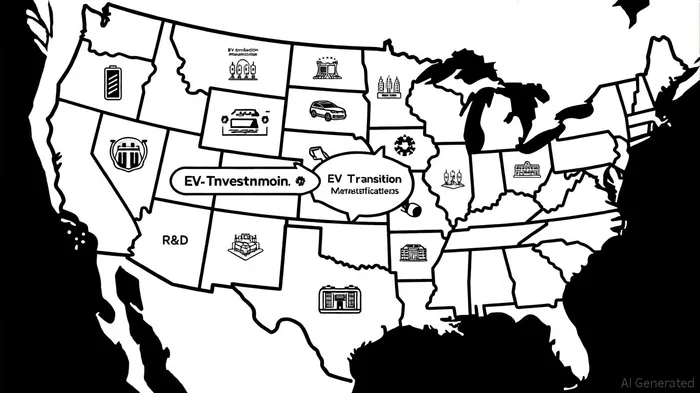
Stellantis' investment is a masterclass in targeted capital deployment. The company is funneling $600 million to reopen the Belvidere, Illinois, plant for two new Jeep models and $400 million to retool the Toledo, Ohio, plant for a midsize truck. These moves signal a focus on high-demand segments like SUVs and pickups, which remain cash cows for automakers[1]. Meanwhile, $100 million is earmarked for the Warren Truck Assembly Plant in Michigan to produce a range-extended EV and SUV, blending electrification with cost-effective hybrid technology[1].
But the real game-changer is Stellantis' battery strategy. The company is doubling down on joint ventures, including a $2.5 billion battery plant in Kokomo, Indiana, with Samsung SDI, and plans for a second facility with 34 gigawatt-hour capacity by 2027[2]. This vertical integration ensures secure access to critical components while reducing reliance on volatile global supply chains-a stark contrast to Ford and GM's struggles with battery production delays[3].
Peer Comparison: Stellantis vs. GMGM-- and Ford
When compared to its peers, Stellantis' approach appears more disciplined. General Motors, for instance, has poured billions into EVs but remains unprofitable in the segment through 2025[4]. Ford's EV losses are even starker, with a projected $5.5 billion deficit in 2025[5]. Both automakers are grappling with high R&D costs and underperforming models like the F-150 Lightning and Chevrolet Bolt.
Stellantis, however, is already profitable in its EV segment in the U.S. and Europe, a feat CEO Carlos Tavares attributes to its "capital-efficient" strategy[6]. By leveraging existing plants for hybrid and EV production-rather than building greenfield facilities-the company minimizes upfront costs. For example, the $235.5 million investment to retool the Sterling Heights plant for battery-electric Ram 1500 models is a fraction of what GM spent on its own EV facilities[7].
Valuation metrics further highlight this divide. Stellantis trades at an EV/EBITDA of 10.3x, while Ford's multiple stands at 13.73x[8]. GM's P/E ratio of 8.3x suggests undervaluation relative to its earnings power, but Stellantis' forward-looking strategy-75 EVs planned by 2030-could justify a premium as it scales[9]. Analysts have set a 12-month price target of $12.65 for Stellantis, implying a 27.65% upside, compared to Ford's "Reduce" consensus and GM's cautious outlook[10].
Valuation Implications and Sector-Wide Shifts
The automotive sector's valuation is increasingly tied to EV transition success. Stellantis' $13 billion push aligns with broader trends: analysts project EVs to account for 25% of U.S. sales by 2030, but growth hinges on cost parity with ICE vehicles[11]. Stellantis' focus on range-extended and hybrid models bridges this gap, addressing consumer concerns about range and charging infrastructure while maintaining profitability.
Meanwhile, Ford and GM are pivoting to hybrid platforms. Ford's recent $1.9 billion strategy shift prioritizes smaller EVs and hybrids, cutting capital expenditure on pure EVs from 40% to 30%[12]. GM, too, is hedging its bets with a $500 million DOE grant to convert a Michigan plant to EV production[13]. Yet neither has matched Stellantis' agility in securing battery supply chains or leveraging U.S. tax credits.
The Bottom Line
Stellantis' $13 billion bet is more than a manufacturing play-it's a strategic repositioning for an EV-dominated future. By balancing plant retooling, battery partnerships, and hybrid innovation, the company is avoiding the "all-in" EV pitfalls that have plagued GM and Ford. For investors, this translates to a stock that's undervalued today but primed for outperformance as EV margins expand and U.S. policy tailwinds strengthen.
As the sector grapples with tariffs, supply chain bottlenecks, and shifting consumer preferences, Stellantis' disciplined capital allocation offers a blueprint for success. The question isn't whether EVs will win-it's who will win the transition. Based on the numbers, Stellantis is moving faster than its peers.





Comentarios
Aún no hay comentarios