
Steel Dynamics (STLD): Assessing Earnings Outlook and Valuation Amid a Challenging Steel Sector
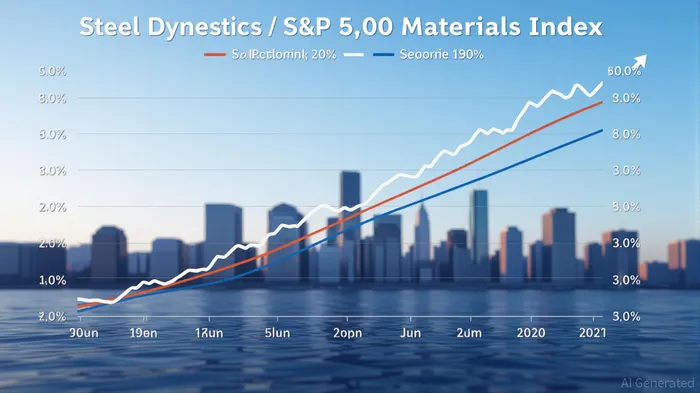
The steel sector in 2025 is mired in a perfect storm of macroeconomic headwinds, trade policy uncertainty, and margin compression. Global crude steel production is projected to fall to 1.846 billion tonnes, a 12% decline from 2024, as demand weakens across construction, automotive, and industrial markets[2]. In the U.S., capacity utilization for domestic steelmakers has dipped to 74.6%, below the Biden administration's 80% target, while 25% tariffs on imports have created a fragile equilibrium of protection and demand suppression[1]. Against this backdrop, Steel DynamicsSTLD-- (STLD) has delivered a mixed performance, raising questions about its valuation and long-term resilience. For contrarian investors, the company's strategic investments, improving operational efficiency, and undervalued metrics may present an opportunity to capitalize on a sector in transition.
Earnings Outlook: A Tale of Two Quarters
Steel Dynamics' Q2 2025 results underscored the sector's struggles. Revenue fell 1.5% year-over-year to $4.57 billion, missing analyst estimates by $130 million. Net income plummeted 30% to $298.7 million, or $2.01 per diluted share, as operating margins contracted to 6.5% from 9.2% in 2024[1]. The decline was driven by higher scrap costs—up $22 per ton to $408—and margin compression in its steel fabrication segment[3]. However, the company reported a 39% sequential improvement in consolidated operating income and a 19% rise in adjusted EBITDA compared to Q1 2025[1]. This suggests that while the broader industry faces headwinds, STLD's operational adjustments—such as expanding value-added coating lines and ramping up aluminum production—are beginning to bear fruit.
The aluminum segment, though still unprofitable (a $41 million loss in Q2 2025), is a strategic bet on long-term growth. Steel Dynamics' Mississippi-based Aluminum Dynamics facility, which shipped its first flat-rolled product coils in June 2025, is expected to offset losses as demand for lightweight materials in automotive and construction sectors grows[3]. Meanwhile, the Sinton mill expansion, which increased long-product steel capacity by 20%, has already contributed to stronger shipments and pricing power[1].
Valuation Metrics: A Contrarian Lens
Steel Dynamics' valuation appears unattractive at first glance. The stock trades at a trailing P/E of 19.3x[4], above the S&P 500's 16x, and a P/B ratio of 2.27[1], suggesting investors are paying a premium for tangible assets. However, these metrics mask a more nuanced picture. The company's debt-to-equity ratio of 42.8x[4] is indeed high, but liquidity remains robust, with $1.9 billion in cash and equivalents as of June 30, 2025[1]. This provides a buffer against cyclical downturns and allows for continued shareholder returns—$120 million in dividends and share repurchases in Q2 2025[3].
Free cash flow, while negative at -$542 million trailing twelve months[4], is improving. Sequentially, operating cash flow rose 15% in Q2 2025, driven by higher steel prices and cost discipline[1]. For contrarian investors, the key question is whether STLD's capital structure can support its aluminum expansion and Sinton mill projects without overleveraging. The company's conservative leverage profile and $1.9 billion liquidity cushion suggest it can weather near-term volatility[3].
Industry Challenges and Strategic Tailwinds
The steel sector's pain points are well-documented: weak demand, excess global capacity, and volatile raw material prices. Yet, STLD's strategic positioning offers a counterpoint. The company benefits from U.S. trade policies that shield domestic producers—such as the 50% tariffs on steel imports—which have allowed it to raise prices on hot-rolled coil and other products[3]. Analysts at J.P. Morgan note that while these tariffs create short-term demand uncertainty, they also reduce exposure to subsidized Chinese and Indian steel, which has historically undercut U.S. producers[4].
Long-term catalysts include infrastructure spending under the Inflation Reduction Act and the American Rescue Plan, which are expected to drive steel consumption in construction and manufacturing[1]. Steel Dynamics' electric-arc-furnace (EAF) technology, which reduces emissions by 70% compared to traditional methods[3], also positions it to benefit from decarbonization trends.
Analyst Sentiment and the Contrarian Case
Despite the bearish near-term outlook, analyst sentiment is cautiously optimistic. Ten analysts rate STLDSTLD-- as a “hold,” with an average price target of $132.92—9.5% above its recent closing price of $121.41[2]. This suggests the market is pricing in a return to profitability but not yet rewarding it. Retail investors on platforms like Stocktwits have turned “extremely bullish,” citing the company's infrastructure tailwinds and aluminum expansion[2].
The contrarian case hinges on three pillars:
1. Margin Expansion: STLD's sequential improvement in operating income and EBITDA indicates that cost discipline and pricing power can offset sector-wide headwinds[1].
2. Aluminum Synergy: The Mississippi facility, once fully ramped, could become a profit center by 2026, diversifying revenue streams[3].
3. Valuation Discount: At a P/E of 19.3x and P/B of 2.27, STLD trades at a discount to peers like NucorNUE-- (P/E of 22x) and Cleveland-CliffsCLF-- (P/B of 3.5x), despite stronger liquidity and a more diversified product mix[4].
Risks and Caution
No contrarian opportunity is without risk. STLD's high debt load, while manageable today, could become a liability if interest rates rise or demand collapses. The aluminum segment's losses, though expected to narrow, remain a drag on earnings. Additionally, trade policy shifts—such as a potential rollback of tariffs under a new administration—could erode pricing power[4].
For investors with a 3–5 year horizon, however, these risks appear manageable. Steel Dynamics' strategic investments, improving margins, and alignment with onshoring trends suggest it is well-positioned to outperform a sector still reeling from cyclical and structural challenges.





Comentarios
Aún no hay comentarios