
How STBL and Ondo Finance Are Revolutionizing Trust in Digital Assets
The digital asset ecosystem has long grappled with trust-specifically, the need for transparent reserve management and robust security in decentralized finance (DeFi). In 2025, two projects, STBL and Ondo Finance, are redefining these pillars by merging institutional-grade infrastructure with decentralized innovation. Their collaboration, which leverages tokenized U.S. Treasuries and a novel yield-splitting model, is setting a new standard for stablecoin reserves and DeFi security.
The STBL-Ondo Partnership: A New Era for Stablecoin Reserves
STBL's recent integration of Ondo Finance's USDY-a tokenized U.S. Treasury yield product-as its primary collateral marks a pivotal shift in stablecoin design. USDY, fully backed by short-term U.S. Treasuries and bank deposits, offers institutional-grade yield and investor protections, including a first-priority security interest over underlying assets, according to an Invezz report. By allocating $50 million in USST minting capacity to USDY, STBL ensures its stablecoin is notNOT-- only fully collateralized but also generates yield without compromising regulatory alignment, according to a Blockonomi report.
This partnership introduces a dual-token model: USST, a non-yield-bearing stablecoin for payments, and YLD, which captures yield from the underlying assets, as outlined in STBL research. This separation allows institutions to retain liquidity while earning returns, addressing a critical pain point in traditional stablecoin models. For example, a user depositing USDY into STBL receives USST for immediate use and YLD to claim future yield-a structure that mirrors the best aspects of both centralized and decentralized finance, as reported in an Oak Park Journal article.
Ondo Finance: Bridging Traditional Finance and DeFi Security
Ondo Finance's role in this ecosystem is equally transformative. As a hybrid protocol, it bridges traditional finance (TradFi) and DeFi by tokenizing real-world assets (RWAs) like U.S. Treasuries. Its KYC/AML-compliant framework requires users to be whitelisted, mitigating unauthorized access and custodial risks, as explained in a ChainTerms article. ChainTerms also notes that assets are held by regulated custodians such as Clear Street and Coinbase Custody, ensuring transparency and institutional trust. ChainTerms further describes Ondo's use of bankruptcy-remote special purpose vehicles (SPVs), which isolate tokenized assets from operational risks, protecting investors from counterparty failures. This design is critical in a DeFi landscape where smart contract vulnerabilities and liquidity crises have historically eroded confidence. Additionally, Ondo has undergone third-party audits, including a Code4rena audit in 2024 that identified and resolved 5 vulnerabilities (1 high, 4 medium severity), demonstrating a commitment to security.
Market Performance and Regulatory Tailwinds
Despite a 33% drop in ONDO token value since January 2025, Ondo Finance's Total Value Locked (TVL) has surged past $1 billion, reflecting strong institutional adoption, according to a LinkedIn post. That post credits initiatives like the $250 million Ondo Catalyst Fund, which accelerates RWA tokenization, and the acquisition of Oasis Pro, an SEC-registered broker-dealer, enabling compliance with U.S. securities laws.
STBL, meanwhile, has navigated volatility with a structured approach to tokenomics. A 278% weekly surge in September 2025 was followed by a 13.77% 24-hour drop, but the project has initiated monthly buybacks and commissioned third-party audits to address speculation about inorganic activity, as detailed in a CryptoTimes article. Regulatory clarity from the GENIUS Act of 2025 further bolsters STBL's position by distinguishing payment stablecoins from securities, reducing legal ambiguity for issuers, according to an STBL blog post.
Risks and the Path Forward
While both projects are pioneering innovation, challenges remain. The LinkedIn post also notes Ondo's funding rate for ONDO has plummeted to -60%, signaling extreme bearish sentiment, while Blockonomi estimates STBL's Loss Reserve Pool default risks at 0.20%–0.33% for tokenized RWAs. However, their governance models-STBL's Treasury Reserve governed by USST holders and Ondo's SPVs-provide community-driven risk mitigation strategies, as Blockonomi highlights.
Conclusion: Trust as a Competitive Advantage
STBL and Ondo Finance are not merely addressing gaps in DeFi-they are redefining what trust means in a digital asset context. By combining institutional-grade collateral, transparent governance, and hybrid TradFi-DeFi infrastructure, they are building a foundation for the next wave of stablecoin innovation. For investors, this represents an opportunity to participate in a system where yield, compliance, and security are no longer mutually exclusive.
As the lines between traditional and decentralized finance blurBLUR--, projects that prioritize trust through transparency and institutional alignment will lead the charge. STBL and Ondo Finance are proving that the future of digital assets isn't just about code-it's about confidence. 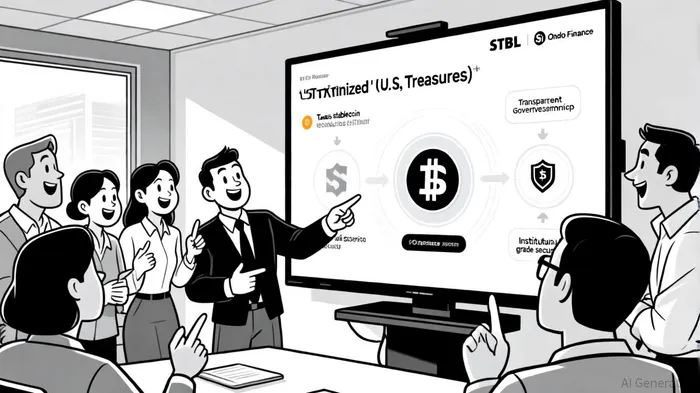







Comentarios
Aún no hay comentarios