
State-Sponsored Sport as a Geopolitical and Soft-Power Asset: Investment Opportunities in Authoritarian Regimes' Sports Strategies
In an era where global attention is increasingly captured by spectacle and symbolism, authoritarian regimes have mastered the art of leveraging sports as a dual-purpose tool: a vehicle for soft power and a conduit for geopolitical influence. From North Korea's dominance in women's youth soccer to Saudi Arabia's high-profile sports acquisitions, these regimes are investing heavily in athletic success to bypass sanctions, enhance their international image, and mobilize domestic support. For investors, this trend opens a unique window into emerging markets where strategic investments in sportswashing, media, and diplomacy-linked ventures can yield both economic and diplomatic returns.
North Korea's Youth Soccer Dominance: A Model of State-Sponsored Success
North Korea's recent triumphs in women's youth soccer exemplify the efficacy of state-led sports strategies. The country's U-17 team secured its fourth World Cup title in 2025 with a 3-0 victory over the Netherlands, while the U-20 team added a third World Cup win in 2024. These achievements are underpinned by a rigorous, state-mandated training system that begins as early as age 13 or 14, emphasizing discipline and professionalization. 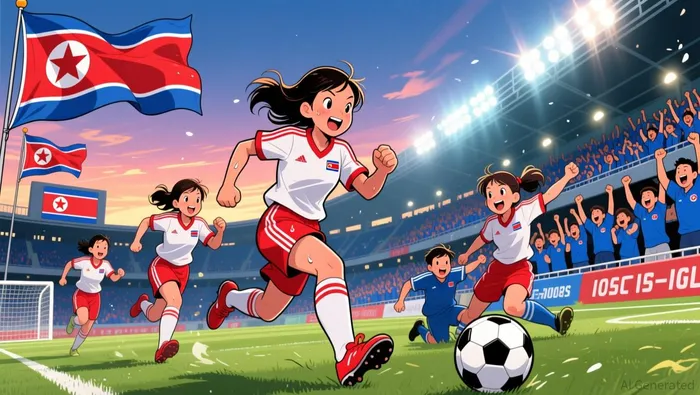 Such success is not merely athletic; it is a propaganda tool. North Korean state media frames these victories as proof of the superiority of its communist system, fostering national pride in a nation otherwise isolated from global discourse. For investors, this case study highlights how authoritarian regimes can transform sports into a narrative of resilience and ideological legitimacy, creating a template for similar investments in other closed societies.
Sportswashing and the Gulf States: Economic Diversification Through Global Sports
The Gulf states-particularly Saudi Arabia, the UAE, and Qatar-have emerged as pioneers in sportswashing, using sports to diversify their economies and enhance their global standing. Saudi Arabia's Public Investment Fund has acquired Premier League club Newcastle United and partnered with LIV Golf, while also hosting Formula 1 races and high-profile boxing events. Similarly, Qatar's sovereign wealth fund has invested in Paris Saint-Germain and leveraged the 2022 FIFA World Cup to attract $29.8 billion in foreign direct investment (FDI) in 2022 alone. These investments align with broader Vision 2030 and Vision 2034 initiatives aimed at reducing hydrocarbon dependence. While critics accuse these regimes of using sports to deflect attention from human rights concerns, the economic returns are undeniable. The global sports market, projected to grow at a 16.5% compound annual growth rate from 2023 to 2030, offers lucrative opportunities for investors willing to navigate the ethical complexities of sportswashing.
Diplomatic Outcomes and Image Metrics: Measuring the Soft Power Payoff
The diplomatic dividends of sports investments are equally compelling. Qatar's 2022 World Cup not only boosted FDI but also positioned the country as a mediator in international conflicts, such as the U.S.-Taliban Doha Agreement. Similarly, the 2018 Winter Olympics in PyeongChang saw North Korea and South Korea walk under a unified flag, temporarily easing tensions. While these outcomes are often short-lived, they underscore sports' role in fostering dialogue and softening geopolitical hostilities. For investors, the key lies in identifying regimes where sports investments align with broader diplomatic goals. For example, Saudi Arabia's relaxed FIFA stadium requirements for the 2034 World Cup are part of a strategy to attract global investment and enhance its brand.
Investment Opportunities: Media, Events, and Infrastructure
The intersection of sports, media, and diplomacy presents three primary investment avenues:
1. Media Campaigns: Authoritarian regimes increasingly use sports events to craft favorable narratives. China's 2022 Winter Olympics, for instance, featured 45 official sponsors, including Audi and JD.com, who leveraged the event to promote themes of unity and cultural pride. While geopolitical tensions muted global enthusiasm, the sheer scale of investment-up to $100 million for top-tier sponsorships-demonstrates the potential for high returns.
2. Event Hosting: Hosting major tournaments like the FIFA World Cup or the Asian Games requires massive infrastructure spending, creating opportunities in construction, hospitality, and technology. Qatar's $220 billion investment in the 2022 World Cup and Saudi Arabia's $100 billion sports-related projects by 2034 highlight the long-term economic value of such ventures.
3. Sports Ownership: Acquiring football clubs or golf leagues allows regimes to project influence while generating revenue. Qatar's PSG and Saudi Arabia's LIV Golf are prime examples. For investors, these assets offer exposure to global fanbases and media rights, though they require careful navigation of reputational risks.
Conclusion: Balancing Risk and Reward in Authoritarian Sports Markets
While the economic and diplomatic potential of state-sponsored sports is clear, investors must weigh these opportunities against the ethical and political risks. Authoritarian regimes often use sports to deflect criticism, and global scrutiny of human rights abuses can undermine returns. However, for those willing to engage strategically-focusing on infrastructure, media, and event hosting-authoritarian sports markets offer a unique blend of geopolitical influence and financial gain. As the world becomes increasingly interconnected, the ability to harness sports as a tool of soft power will remain a critical asset for both regimes and investors alike.







Comentarios
Aún no hay comentarios