
State-Political Tensions and Their Economic Ripple Effects: Analyzing Risks and Opportunities in Infrastructure and Defense Contractors (2023-2025)
The intersection of state-level political tensions and economic infrastructure has become a defining feature of the 2023–2025 landscape. From the U.S. federal government's abrupt pause on Infrastructure Investment and Jobs Act (IIJA) disbursements to NATO allies' surging defense budgets, the ripple effects are reshaping risk profiles and investment opportunities for infrastructure and defense contractors. This analysis dissects the dual-edged sword of political uncertainty, offering a framework for investors to navigate volatility while capitalizing on emerging trends.
Risks: Funding Instability and Regulatory Whiplash
The Trump administration's January 2025 executive order to halt IIJA and Inflation Reduction Act (IRA) funding for 90 days has created a seismic shift in infrastructure planning. According to a report by Government Procurement[1], this pause threatens $294 billion in planned projects, including high-speed rail and clean energy initiatives, redirecting focus toward traditional infrastructure like roads and bridges. For contractors, this abrupt pivot introduces operational risks: projects reliant on federal grants now face delays, while those aligned with Trump's rural infrastructure agenda may see accelerated approvals.
State-level funding gaps compound the challenge. A 2025 Pew Research study[2] reveals that states now cover 79% of public infrastructure spending, with 71.6% of capital projects funded locally. However, the Trump administration's emphasis on deregulation-such as fast-tracking permits under weakened NEPA reviews-risks long-term compliance issues. For example, California's $128 billion transportation budget, which includes EV infrastructure, now faces uncertainty as federal climate funding is reevaluated[3].
Defense contractors are equally vulnerable. The National Defense Industrial Association (NDIA) warns that prolonged continuing resolutions-now in effect for over five years-have stymied procurement timelines for critical platforms like submarines and aircraft[4]. Supply chain bottlenecks and workforce retention crises further strain readiness, with the NDIA estimating a 27% reduction in corporate investment due to political gridlock[5].
Opportunities: Geopolitical Tailwinds and Tech-Driven Modernization
While political turbulence creates headwinds, it also fuels demand for defense modernization. The U.S. Congress's 2025 supplemental $156 billion defense funding package[6] and NATO allies' increased budgets (e.g., Germany's 4.5% GDP defense target) have created a $1.2 trillion global defense market opportunity. Contractors specializing in AI, cybersecurity, and next-gen air defense systems-such as Lockheed MartinLMT-- and Raytheon-are poised to benefit. The UK's 2025 Strategic Defence Review (SDR), allocating £57.1 billion for 12 AUKUS submarines and a £15 billion Astraea nuclear warhead program[7], exemplifies this trend.
Infrastructure contractors with agility in public-private partnerships (PPPs) may also thrive. The Trump administration's push for private investment in infrastructure, coupled with streamlined permitting, could fast-track projects in sectors like broadband and logistics hubs[8]. For instance, Texas's recent $50 billion PPP for highway expansion, bypassing federal climate mandates, highlights how states can leverage political shifts to accelerate development[9].
Geopolitical Crosscurrents: A New Era of Strategic Competition
Global tensions are reshaping infrastructure and defense dynamics. The war in Ukraine has spurred a $54.2 billion UK defense budget increase[10], while U.S.-China trade wars drive domestic supply chain investments. The FY 2025 National Defense Authorization Act (NDAA) allocates $17.5 billion for military construction and mandates AI-driven procurement[11], signaling a shift toward tech-centric defense. Conversely, China's slower economic growth may limit Belt and Road Initiative (BRI) contributions, creating a funding vacuum in developing nations that U.S. contractors could fill-provided they align with Trump's fossil fuel-friendly policies[12].
Investor Implications: Navigating the New Normal
For investors, the key lies in hedging against political volatility while targeting resilient sectors. Defense contractors with diversified portfolios-spanning both traditional (e.g., munitions) and emerging (e.g., AI) capabilities-are better positioned to weather policy swings. Similarly, infrastructure firms with strong state-level partnerships and expertise in PPPs can capitalize on decentralized funding trends.
However, caution is warranted. The NDIA's warning about "suboptimal policy decisions favoring narrow technologies over broader capabilities"[13] underscores the risk of overconcentration in AI or cyber-focused firms. Diversification across geographies and sectors-e.g., pairing U.S. defense stocks with European infrastructure plays-can mitigate this risk.
Conclusion
State-level political tensions are not merely a drag on economic growth; they are a catalyst for structural change in infrastructure and defense. While funding instability and regulatory shifts pose significant risks, they also create openings for agile firms to redefine market leadership. Investors who balance short-term caution with long-term strategic bets on modernization and geopolitical resilience will find themselves well-positioned in this turbulent era. 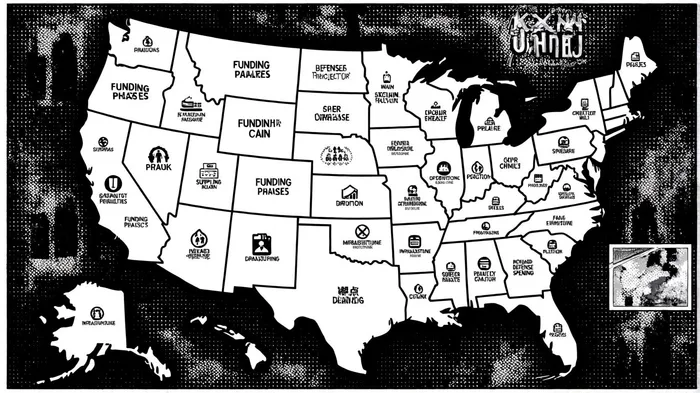







Comentarios
Aún no hay comentarios