
Starknet (STRK): Navigating Short-Term Volatility Amid Strong Fundamentals and Growing Ecosystem Momentum
Near-Term Price Pressures: A Volatile Landscape
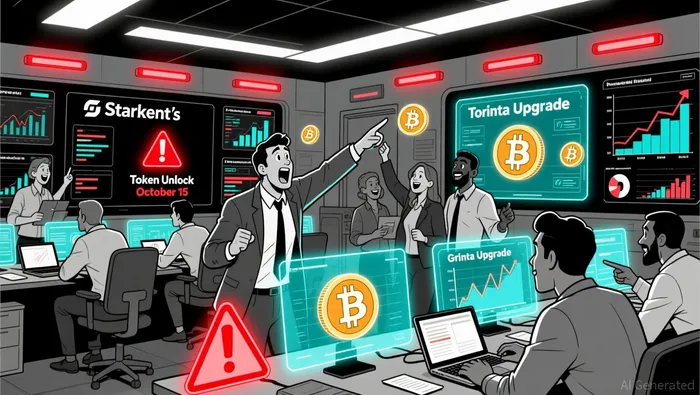
STRK has experienced significant price turbulence in Q4 2025, with a 7.89% decline over 24 hours and a 30-day drop of -21.39%, according to CoinMarketCap's latest STRK analysis. This underperformance relative to the broader crypto market is attributed to a combination of factors: a technical breakdown below key support levels, algorithmic selling triggered by the breakdown, and a pending token unlock of 127 million STRKSTRK-- ($14.4 million) on October 15, as noted in CoinMarketCap's latest STRK analysis. The unlock, coupled with weak sentiment in the L2 sector, has exacerbated short-term bearish momentum.
Macroeconomic dynamics further complicate the outlook. Rising U.S.-China trade tensions have prompted a risk-off rotation toward BitcoinBTC--, diverting capital from altcoins like STRK, according to CoinMarketCap's latest STRK analysis. Meanwhile, institutional investors-now dominant in crypto markets-are prioritizing infrastructure over speculative tokens, reducing retail-driven volatility but also dampening liquidity for projects like StarknetSTRK--, as reported in Bitget's Bitcoin price analysis.
Long-Term Fundamentals: A Foundation for Growth
Despite near-term turbulence, Starknet's fundamentals are underpinned by transformative upgrades and ecosystem expansion. The Q4 2025 Grinta upgrade (v0.14.0), covered in Starknet's Q3 recap, marked a critical step toward decentralization, introducing a decentralized sequencer architecture with three sequencers operating via Tendermint consensus. This upgrade reduced block times from 30 seconds to 4 seconds, slashed transaction latency to 0.5 seconds, and introduced a fee market inspired by Ethereum's EIP-1559, as noted in Starknet's Q3 recap.
The network's dual-token consensus model, which incorporates both STRK and BTC (with BTC accounting for 25% of security), further strengthens its appeal to institutional investors, as detailed in Starknet's Q3 recap. Staking improvements, including a 7-day unstaking period and the upcoming Staking v3 integration with block validation, are set to enhance capital efficiency and security, as described in Starknet's decentralization roadmap. By year-end 2025, Starknet's migration to an open-source stack (e.g., Apollo sequencer, Stwo prover) and a decentralized governance model via the Starknet Security Council will solidify its position as a leader in scalable, censorship-resistant L2 solutions, as noted in Starknet's decentralization roadmap.
Ecosystem growth metrics reinforce this narrative. The Starknet ecosystem expanded by 168% in 2024, with 193 user-centric projects as of November 2024-up from 72 in 2023, as reported in Starknet's ecosystem report. Gaming emerged as the fastest-growing category, with 51 projects, including 29 powered by Dojo, a dedicated onchain game engine, as detailed in Starknet's ecosystem report. Developer activity surged, with 215 full-time developers and 820 monthly active contributors supported by 4,540+ repositories and 1.6 million commits, according to Starknet developer activity analysis. Partnerships with major exchanges (Binance, Crypto.com) and wallets (Ledger, Keplr) have further broadened onboarding, as covered in Starknet's ecosystem report.
Balancing the Outlook: Catalysts and Risks
The near-term price outlook for STRK is mixed. While the token faces resistance at $0.161 and the $0.10 psychological level, according to CoinMarketCap's latest STRK analysis, bullish catalysts include Bitcoin integrations such as a beta yield product for BTC staking and a trust-minimized bridge with Alpen Labs, as noted in CoinMarketCap's latest STRK analysis. These developments could attract liquidity from the booming BTCFi sector, which has seen a 40% surge in TVL in late 2025, as reported in Starknet's Q3 recap.
However, risks persist. The competitive landscape is intensifying, with projects like MegaETH raising $350 million to challenge Starknet's L2 dominance, according to CoinMarketCap's latest STRK analysis. Additionally, the Fear & Greed Index at 31 suggests an oversold market, but without immediate bullish catalysts, caution is warranted, as noted in CoinMarketCap's latest STRK analysis.
Price projections for Q4 2025 range from $0.15 to $6.16, as reported in StealthEx's STRK price prediction, reflecting divergent views on macroeconomic conditions and adoption trajectories. While the Q3 2025 rally (95% increase from $0.113 to $0.196), according to StealthEx's STRK price prediction, offers optimism, investors must weigh the risks of short-term volatility against the long-term potential of Starknet's decentralized infrastructure and expanding ecosystem.
Conclusion: A Calculated Bet on the Future of L2
Starknet (STRK) embodies the duality of the crypto market: short-term volatility driven by macroeconomic shifts and token supply dynamics, juxtaposed with long-term value creation through technological innovation and ecosystem growth. For investors, the key lies in balancing near-term risks-such as the October token unlock and sector-wide weakness-with the project's foundational strengths, including its decentralized sequencer architecture, institutional-grade security, and expanding developer community.
As Starknet continues its decentralization roadmap and integrates with Bitcoin's growing ecosystem, it remains a compelling case study in navigating the intersection of crypto's speculative nature and its transformative potential.







Comentarios
Aún no hay comentarios