
Starknet's Staking Surge: A Blueprint for Long-Term Value Creation in 2025
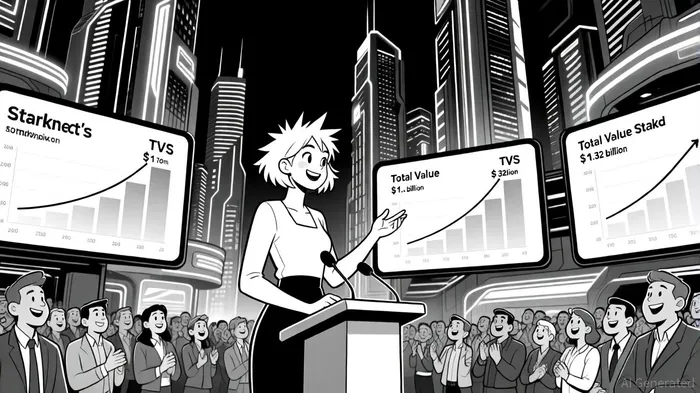
The blockchain landscape in 2025 is witnessing a seismic shift in how value is created and captured, and StarknetSTRK-- is at the forefront of this transformation. With its native STRKSTRK-- token staking activity surging by 23% in September 2025 alone[1], the network has not only solidified its position as a leading EthereumETH-- Layer-2 solution but also demonstrated a compelling long-term value proposition for investors. This momentum, driven by strategic upgrades and a maturing ecosystem, signals a paradigm shift in how decentralized networks balance security, decentralization, and user incentives.
Staking Growth: A Barometer of Network Health
According to a report by Cryptopolitan, Starknet's total staked STRK tokens now exceed 571 million coins, representing 14% of the circulating supply[4]. This growth is not merely quantitative—it reflects a qualitative shift in user behavior. Investors are increasingly prioritizing governance participation and network incentives over speculative trading, a trend underscored by the 21-day withdrawal period and slashing penalties embedded in Starknet's staking mechanism[4]. These design choices align with broader industry demands for robust security and long-term commitment, making Starknet an attractive proposition for both retail and institutional participants.
The Total Value Staked (TVS) on Starknet has further skyrocketed to $1.32 billion, as reported by L2Beat[2]. This figure is a testament to the network's ability to attract and retain capital, with STRK accounting for 83.65% of the TVS. The dominance of the native token highlights Starknet's self-sustaining economic model, where stakers are directly incentivized to secure the network while benefiting from governance rights and yield generation.
Ecosystem Maturity: Staking v2 and Beyond
Starknet's recent launch of Staking v2[2], proposed under SNIP 28, marks a pivotal step toward full decentralization. This upgrade introduces dynamic reward allocation and enhanced slashing conditions, ensuring that validators are both economically and technically aligned with the network's security goals. Coupled with the Grinta upgrade[2], which focuses on improving node accessibility and reducing centralization risks, Starknet is laying the groundwork for a resilient, community-driven infrastructure.
A particularly ambitious move is the network's plan to launch Bitcoin staking by Q3 2025[4]. By bridging the BitcoinBTC-- and Ethereum ecosystems, Starknet aims to tap into the $1.2 trillion Bitcoin DeFi market, offering stakers the ability to earn STRK rewards while leveraging their BTC holdings. This innovation not only diversifies Starknet's TVS composition but also positions it as a cross-chain interoperability hub—a critical differentiator in a crowded Layer-2 space.
The Long-Term Value Equation
For investors, Starknet's staking momentum is more than a short-term rally—it's a strategic play on the future of decentralized finance. The 14% staking rate[1] suggests a healthy balance between liquidity and security, avoiding the pitfalls of over-collateralization seen in earlier blockchain projects. Moreover, the inclusion of Ethereum (11.41%) and stablecoins (3.78%) in the TVS[2] indicates a growing ecosystem where Starknet serves as both a settlement layer and a hub for cross-asset DeFi activity.
The network's focus on economic sustainability is equally compelling. By tying validator rewards to network usage and governance outcomes, Starknet ensures that stakers have skin in the game. This alignment of incentives reduces the risk of “hot potato” staking—a scenario where participants exit quickly to chase higher yields elsewhere—and fosters a stable, long-term capital base.
Future Outlook: Scaling the Vision
As Starknet continues to integrate with centralized exchanges (CEXs) and explore AI-driven use cases[2], its TVS is poised to grow further. The upcoming Bitcoin staking feature, in particular, could catalyze a new wave of adoption, especially among Bitcoin hodlers seeking yield without sacrificing custody. For investors, this represents a unique opportunity to participate in a network that is not only technically robust but also economically innovative.
Conclusion
Starknet's staking surge is more than a numbers game—it's a masterclass in building a decentralized network with a clear-eyed focus on long-term value. By combining technical upgrades, strategic partnerships, and a user-centric staking model, the network is setting a new standard for Layer-2 solutions. For investors, the message is clear: Starknet is not just riding the crypto wave; it's shaping the next phase of blockchain innovation.






Comentarios
Aún no hay comentarios