
Starknet's Resilience and Operational Risks: A Framework for Evaluating Layer 2 Investment Viability
The EthereumETH-- Layer 2 (L2) ecosystem has emerged as a critical battleground for blockchain scalability, with projects like StarknetSTRK--, zkSyncZK--, and OptimismOP-- vying to redefine transaction throughput, cost efficiency, and security. However, as these networks scale, their operational risks-particularly in the face of critical infrastructure failures-demand rigorous scrutiny from investors. Starknet, a zero-knowledge (ZK) rollup leveraging STARK proofs, has faced notable challenges in 2025, offering a case study in how L2 solutions balance innovation with resilience. This analysis evaluates Starknet's operational risks, recovery strategies, and competitive positioning against peers like zkSync and Optimism, while assessing the long-term investment viability of L2 infrastructure.
Starknet's Operational Challenges and Resilience Measures
Starknet's September 2025 outage, triggered by an upgrade to version 0.14.0 (Grinta), exposed vulnerabilities in its decentralized sequencer architecture. The incident, which lasted nine hours and required two chain reorganizations (reorgs), stemmed from Ethereum node discrepancies, manual intervention gaps, and a bug in the blockifier component. While the proving layer-a core STARK-based mechanism-ensured the network's correctness and security during the outage, the incident underscored the fragility of external dependencies, such as Ethereum RPC providers.
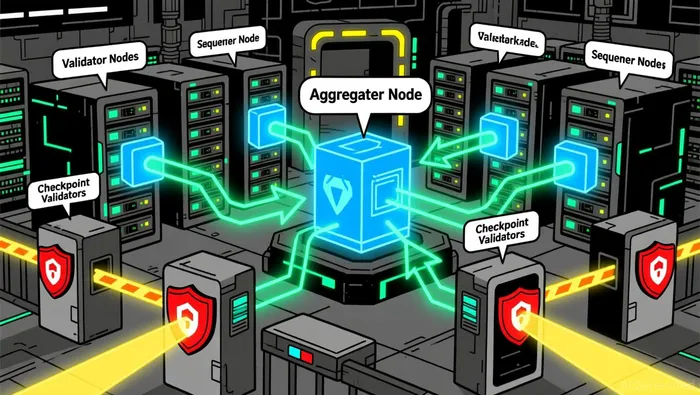
In response, Starknet implemented several long-term improvements: increasing the number of nodes in its internal consensus protocol, introducing safeguards for external dependencies, and reducing reliance on manual interventions. These measures reflect a broader trend in L2 development: prioritizing fault tolerance and automation to mitigate human error. For instance, the January 2026 four-hour outage highlighted ongoing challenges in maintaining reliability during decentralization efforts, prompting further refinements in software updates and rollback protocols.
Despite these hiccups, Starknet's architecture remains a cornerstone of its appeal. Its STARK-based proofs offer quantum-resistant security and high throughput (4,200 TPS), while its ecosystem has expanded into onchain gaming, DeFi, and AI integrations. The network's ability to recover from outages without compromising data integrity-thanks to its cryptographic guarantees-positions it as a leader in the ZK-rollup space.
Comparative Resilience: Starknet vs. zkSync and Optimism
While Starknet's challenges are well-documented, its peers have adopted distinct resilience strategies. zkSync, another ZK-rollup, emphasizes EVM compatibility and low fees (often below $0.01 per transaction), supported by Boojum prover technology to reduce hardware requirements. Its systematic debugging methodologies and phased decentralization efforts aim to preempt outages, though its TVL and activity levels lag behind dominant Optimistic Rollups like ArbitrumARB--.
Optimism, an optimistic rollup, leverages a bicameral governance model (Token House and Citizens' House) to balance token holder influence with democratic voting. Its Bedrock upgrade in 2024 reduced fees and enhanced interoperability, while its "Superchain" vision promotes cross-L2 composability. However, Optimism's reliance on fraud proofs introduces inherent latency, as invalid transactions require post-execution challenges-a process that can delay finality during critical failures.
The divergence in resilience strategies reflects broader trade-offs between speed, decentralization, and security. Starknet's STARK proofs prioritize cryptographic correctness but require complex development ecosystems (e.g., Cairo programming language), while Optimism's optimistic model favors developer familiarity at the cost of slower recovery from invalid states.
Investment Implications: Balancing Risk and Growth
For investors, the key question is whether L2 solutions can sustain growth while addressing operational risks. Starknet's 2025 incident demonstrates that even cutting-edge ZK-rollups are not immune to infrastructure failures. However, its proactive response-increasing node redundancy and automating recovery- aligns with industry best practices for resilience. Similarly, zkSync's focus on decentralization and Optimism's governance innovations highlight the sector's maturation.
The long-term viability of L2 investments hinges on three factors:
1. Technical Robustness: Projects must demonstrate rapid, transparent recovery from outages. Starknet's proving layer and zkSync's Boojum prover exemplify this, while Optimism's governance model offers a human-centric approach to risk mitigation.
2. Ecosystem Adoption: Starknet's expansion into AI and CEX integrations, Optimism's Superchain vision, and zkSync's EVM compatibility signal strong developer and user traction.
3. Regulatory and Cybersecurity Trends: As cyber threats evolve, L2s must align with standards like NIST and CISA. Starknet's quantum-resistant proofs and Optimism's governance transparency may offer advantages in this landscape.
Conclusion: A Calculated Bet on L2 Resilience
The Layer 2 landscape is a high-stakes arena where innovation and operational risks coexist. Starknet's 2025 outage and subsequent improvements illustrate the importance of iterative resilience strategies, while its competitors' approaches underscore the diversity of solutions to Ethereum's scalability challenges. For investors, the path forward requires a nuanced evaluation of technical execution, ecosystem momentum, and governance frameworks.
While no L2 solution is immune to failure, the sector's collective progress in decentralization, cryptographic security, and cross-chain interoperability suggests a maturing infrastructure capable of supporting long-term value. As Starknet, zkSync, and Optimism continue to refine their architectures, the winners will be those that balance cutting-edge innovation with operational pragmatism-a recipe for sustainable growth in the Web3 era.






Comentarios
Aún no hay comentarios