
Starknet Post-Mortem Details Execution Bug Behind Brief Mainnet Outage
Starknet, an EthereumETH-- layer-2 (L2) scaling network, experienced a brief mainnet outage on January 11, 2026. The network halted for just over two hours, disrupting on-chain activity and forcing users to resubmit transactions after service resumed. Despite this, the network's total value locked (TVL) remained at $840 million, and average transaction fees stayed below one cent.
The outage was caused by a software bug in Starknet's blockifier execution layer. The bug created a mismatch in network state handling, which led to an incorrect transaction execution. The issue was flagged by the proving layer before final settlement on Ethereum. This mechanism, which checks the correctness of transaction execution, is a core design principle of the StarknetSTRK-- architecture.
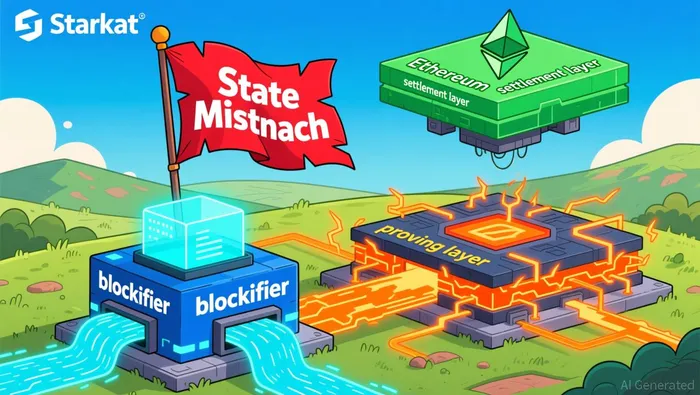
Starknet resumed normal operations after a block reorganization. Approximately 18 minutes of network activity was rolled back, meaning users had to resubmit transactions that were affected by the error. The proving layer acted as a safeguard, ensuring the faulty execution never reached Ethereum's finality.
Why Did This Happen?
The outage originated from a discrepancy in the handling of state changes between the blockifier and the proving layer. Specifically, the blockifier incorrectly remembered a state-writing that should have been discarded after a function reverted. This occurred under a specific combination of cross-function calls, variable writes, and reverts. The proving layer then detected the inconsistency and halted the faulty execution before it could be finalized.
The blockifier is a core component of Starknet's sequencer, responsible for executing transactions efficiently. However, it operates differently from the Cairo program used in the proving layer. The blockifier simulates execution in a simplified manner to maintain high throughput. In this case, the simulation diverged from the expected behavior during a complex set of function calls.
How Did Markets Respond?
The market reaction to the latest outage was muted. At the time of writing, the STRKSTRK-- token was trading around $0.089, up about 1.3% over the past 24 hours. Daily trading volume had risen by more than 38% to roughly $63.7 million. Despite the relatively short duration of the outage, STRK's price remains well below its early-2024 peak of $4, reflecting broader market conditions and lingering concerns about supply and network reliability.
Investors and users were not significantly impacted in terms of fund security. The proving layer's intervention ensured that no permanent damage was done. However, traders and applications that depend on fast and predictable transaction execution were affected by the disruption. Affected transactions had to be resubmitted, which could be problematic for time-sensitive operations.
What Are Analysts Watching Next?
Starknet has committed to improving testing and code audits to prevent similar incidents. The team is implementing new fuzz-testing suites to compare blockifier execution results directly with the proving system. These tests will help identify edge-case interactions that could lead to incorrect state handling.
In addition, Starknet plans to shorten the time between transaction execution and prover-compatible execution. This will allow mismatches to be detected sooner, limiting how much network activity would need to be rolled back in the future.
The team also acknowledged the need to improve overall stability as layer-2 technology continues to mature. While the incident demonstrates that the proving layer functioned as intended, ongoing testing and architectural changes are necessary to reduce the frequency of such disruptions.
This outage follows a pattern of interruptions in Starknet's transition toward a more decentralized architecture. In September 2025, a major protocol upgrade known as Grinta caused a more severe disruption that lasted over five hours. The team has since committed to architectural changes and expanded monitoring to reduce the likelihood of similar issues.
Starknet continues to position itself as a bridge for Bitcoin-related decentralized finance (BTCFi) within the Ethereum ecosystem. The recent outage highlights the challenges of maintaining stability as the network scales and introduces new features.






Comentarios
Aún no hay comentarios