
Starknet's January 2026 Outage: A Critical Test of Resilience for Ethereum Layer-2
In January 2026, Starknet-a leading EthereumETH-- Layer-2 scaling solution-faced a significant outage that tested its operational resilience and technical maturity. The incident, which lasted over four hours, exposed vulnerabilities in its execution layer while also showcasing the robustness of its proving infrastructure. For investors, the outage raises critical questions: Can StarknetSTRK-- balance innovation with reliability? Does its roadmap align with long-term viability in a competitive Layer-2 landscape?
The Outage: A Bug in the Blockifier
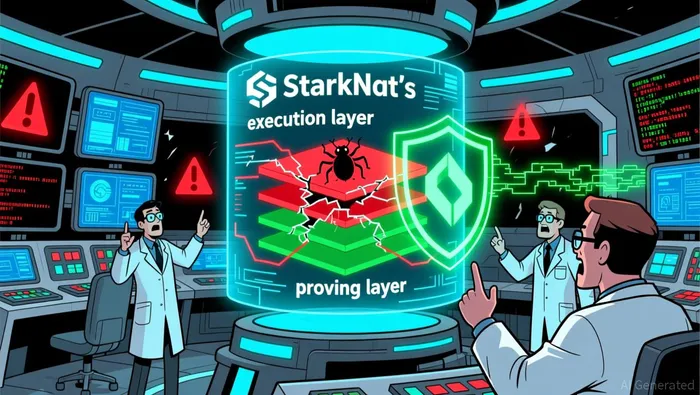
On January 5, 2026, Starknet's block production halted between 09:24 and 14:17 UTC due to a bug in the blockifier, a component responsible for simulating transaction execution. The issue arose from a complex interaction involving nested function calls, reverts, and variable writes, causing the blockifier to retain incorrect state changes. While the proving layer-a cryptographic verification system-prevented these inconsistencies from compromising the blockchain's integrity, the network had to revert 18 minutes of activity and pause operations for debugging.
This outage marked Starknet's second major disruption in four months, following instability linked to the September 2025 Grinta upgrade. The incident highlighted the growing pains of scaling a zero-knowledge (ZK) rollup architecture, particularly as the network transitions toward decentralization.
Market Response: Mixed Signals for Investors
Despite the disruption, the market's reaction to the outage was muted. The STRKSTRK-- token experienced minimal price volatility, with traders viewing the incident as a fixable technical issue. However, broader concerns about reliability persisted. Data from January 2026 shows that Starknet's total value locked (TVL) lagged behind competitors like ArbitrumARB-- ($16.6 billion TVL) and OptimismOP--, which have maintained more consistent uptime.
Developer sentiment also reflects caution. While Starknet's roadmap includes ambitious goals like quantum-resistant cryptography and BitcoinBTC-- integration, repeated outages have raised questions about its operational maturity. In contrast, Arbitrum and Optimism have solidified reputations for developer tooling and ecosystem growth, offering a more predictable environment for builders.
Innovation vs. Operational Risk: A Delicate Balance
Starknet's response to the outage underscores its commitment to innovation. The team implemented aggressive fuzz-testing to identify edge-case logic gaps in the blockifier and initiated an internal audit of its revert logic. Additionally, architectural changes were introduced to enable faster detection of mismatches between sequencer and prover execution, minimizing potential reorgs.
These measures align with Starknet's 2026 roadmap, which prioritizes decentralization and cross-chain interoperability. Key upgrades include:- Decentralized sequencer architecture: Three sequencers now operate in rotation, reducing single points of failure.- S-two prover integration: A next-generation proving system to enhance efficiency and support client-side validation.- BTCFi initiatives: Trust-minimized bridges to enable Bitcoin-related financial applications on Ethereum's infrastructure.
However, the January outage revealed a critical tension: innovation often comes at the cost of operational risk. As Starknet pushes forward with quantum-resistant cryptography and Bitcoin integration, it must prove it can maintain reliability without sacrificing its technical edge.
Long-Term Investment Viability: A Calculated Bet
For investors, Starknet's long-term viability hinges on its ability to execute its roadmap while mitigating operational risks. The network's proving layer and proactive mitigation strategies demonstrate a commitment to security and correctness. Yet, repeated outages and complex bug fixes suggest that operational maturity lags behind technical ambition.
Comparative metrics further complicate the picture. While Arbitrum and Optimism dominate TVL and developer adoption, Starknet's focus on ZK-rollup innovation and cross-chain use cases positions it as a long-term contender. However, investors must weigh the potential rewards of Starknet's vision against the risks of its current instability.
Conclusion: A Network at a Crossroads
Starknet's January 2026 outage was a pivotal test of its resilience. The incident exposed vulnerabilities in its execution layer but also highlighted the strength of its proving infrastructure and commitment to transparency. For investors, the key takeaway is clear: Starknet's long-term success will depend on its ability to balance innovation with operational reliability.
As the Ethereum Layer-2 ecosystem evolves, Starknet's roadmap-anchored by decentralization, quantum resistance, and cross-chain integration-offers a compelling vision. Yet, until it can consistently deliver uptime and stability, its position as a top-tier investment remains a calculated bet. The next phase of its journey will determine whether it can transform growing pains into lasting resilience.






Comentarios
Aún no hay comentarios