
Starbucks' Hybrid Model: Can Tech-Driven Productivity and Human-Centric Design Sustainably Boost Sales and Shareholder Value?
Starbucks' strategic pivot under CEO Brian Niccol has positioned the coffee giant at a crossroads, balancing automation with human-centric design to revive its flagging sales and restore investor confidence. As the company navigates a challenging retail landscape marked by declining same-store sales and rising labor costs, its hybrid approach-combining technological innovation with renewed emphasis on in-store experience-has emerged as a critical test of its long-term viability.
The Financial Landscape Under Niccol
Since assuming leadership in 2023, Niccol has inherited a business grappling with six consecutive quarters of declining North American same-store sales. By Q3 2025, the decline had moderated to 2%, but the broader trend remains concerning. Despite this, StarbucksSBUX-- has expanded its footprint, adding 1,620 net new stores to reach 41,097 globally. However, the stock price has fallen from $95.90 to $84.17 by September 2025, reflecting investor skepticism about the pace of recovery. A recent dividend increase to $0.62 per share, announced in November 2025, signals a commitment to shareholder returns, even as the stock remains down 10% year-to-date.
The Role of Technology and Leadership
A pivotal element of Starbucks' turnaround strategy is the appointment of Anand Varadarajan, former Amazon Grocery tech leader, as chief technology officer in January 2025. Varadarajan's expertise in scaling supply chain and digital solutions aligns with Starbucks' goal of modernizing its operations. His leadership underpins the $500 million Green Apron Service initiative, which seeks to harmonize automation with human touchpoints. This program includes AI-driven tools like Green Dot Assist, enabling baristas to provide instant recipe guidance, and order sequencing algorithms to reduce mobile order bottlenecks. 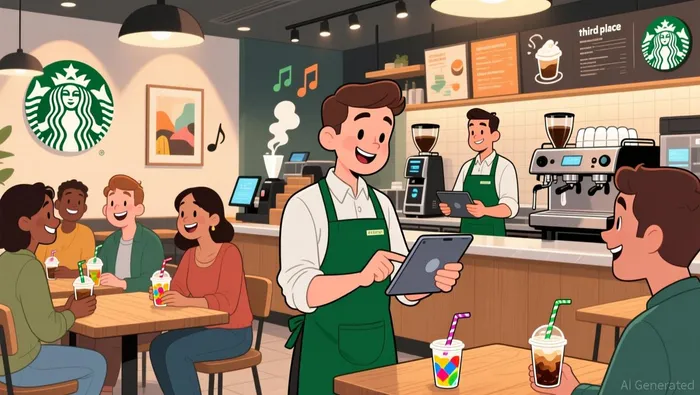
The initiative also emphasizes labor investment, with additional hours allocated to company-owned cafes to ensure service quality amid rising digital orders. Pilots in 1,500 stores have shown promising results: 80% of in-café orders completed in under four minutes, a key metric for customer satisfaction. These efforts aim to reinforce Starbucks' "third place" identity while addressing operational inefficiencies.
Balancing Automation and Brand Loyalty
Starbucks' hybrid model faces a delicate balancing act. On one hand, automation tools like AI and data analytics can streamline operations and reduce costs. On the other, the brand's legacy hinges on personal connections-evidenced by initiatives like writing customer names on cups. Early data from Green Apron Service suggests this duality is achievable: improved service speed has coincided with stronger customer engagement, particularly during peak seasons like pumpkin spice launches.
However, challenges persist. Labor tensions remain unresolved, with over 12,000 employees unionized under Starbucks Workers United. While Green Apron's labor investments may mitigate some concerns, the absence of a union contract under Niccol's tenure highlights ongoing friction. For investors, the question is whether these initiatives can sustainably reverse declining sales without eroding the brand's human-centric ethos.
Investor Implications and Long-Term Viability
The market's mixed response to Starbucks' strategy underscores uncertainty. A discounted cash flow analysis estimates the stock's intrinsic value at $49.70 per share, suggesting a 72% overvaluation relative to its current price. This discrepancy may reflect optimism about international expansion and leadership changes, but also underscores risks if operational improvements fail to translate into consistent sales growth.
For the hybrid model to succeed, Starbucks must demonstrate that technology enhances-rather than replaces-the human elements of its brand. Varadarajan's focus on scalable tech solutions and Niccol's emphasis on customer experience provide a framework for this, but execution will be key. The recent 9.1% monthly stock rally hints at investor hope, yet the broader 10% annual decline cautions against complacency.
Conclusion
Starbucks' strategic shift under Niccol represents a bold experiment in reconciling efficiency with emotional brand value. While early results from Green Apron Service and Varadarajan's leadership are encouraging, the company's ability to sustain sales growth and shareholder value will depend on scaling these initiatives without compromising its core identity. For investors, the hybrid model offers a compelling narrative but demands patience as the long-term impacts unfold.





Comentarios
Aún no hay comentarios