
Starbucks' Declining Dominance in the Coffee Sector: Investing in High-Growth Alternatives Like Dutch Bros and 7 Brew
The coffee sector, once dominated by Starbucks' relentless expansion and brand loyalty, is witnessing a seismic shift. While the Seattle-based giant remains a behemoth, its financial and operational challenges have created openings for nimble competitors like Dutch BrosBROS-- and 7 Brew. These high-growth alternatives are not only capturing market share but also redefining consumer expectations in the $98 billion U.S. coffee industry. For investors, the question is no longer whether StarbucksSBUX-- is struggling-it is whether the market has priced in the long-term risks to its dominance and the opportunities in its underdog challengers.
Starbucks: A Story of Stagnation and Margin Squeeze
Starbucks' fiscal 2025 results underscore a company in transition. Total revenue rose 2.79% to $37.184 billion, with Q4 net revenues hitting $9.57 billion-a 5.5% year-over-year increase. However, these gains were overshadowed by margin erosion. Non-GAAP operating margins contracted to 9.4% in Q4 2025, down 500 basis points from the prior year, while GAAP operating margins plummeted to 2.9%. The North America segment, which accounts for 61% of Starbucks' global store count, saw operating margins shrink to 4.5%, reflecting the costs of its "Back to Starbucks" restructuring, including the closure of over 600 underperforming stores according to the company's report.
The company's comparable store sales growth, a key metric for retail health, has been tepid. In Q4 2025, global comp sales rose 1%, the first positive quarter in seven. U.S. comp sales were flat, with a 1% increase in average ticket offset by a 1% drop in transactions according to Q4 financials. While management projects 2% U.S. comp growth in Q1 2026, accelerating to 3-4% later in the year, these figures pale in comparison to the double-digit growth seen at rivals according to industry analysis. Zacks Research has even revised its Q1 2026 earnings forecast for Starbucks downward to $0.63 per share from $0.69, reflecting skepticism about its ability to navigate inflation and labor costs according to market research.
Dutch Bros: The Aggressive Challenger with a Drive-Thru Edge
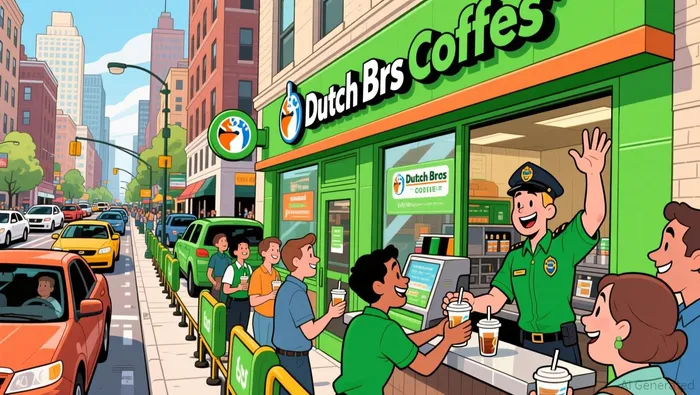 Dutch Bros, the second-largest drive-thru coffee chain in the U.S., has emerged as a standout growth story. In Q3 2025, the company reported 25% year-over-year revenue growth, driven by a 5.7% increase in same-store sales and a 6.9% rise in Q4 2024 sales according to industry reports. Its operating margin of 9.3% and net margin of 4.04% highlight disciplined cost management, even as it expands aggressively according to financial analysis. Dutch Bros currently operates 1,081 locations and aims to grow to 7,000 nationwide-a target that, if achieved, would dwarf Starbucks' current 40,990 global store count according to market analysis.
Market share data further underscores Dutch Bros' momentum. Its U.S. coffee industry share rose from 1.64% in Q4 2024 to 1.73% in Q1 2025. This growth is fueled by a strategy focused on high-traffic areas and a loyal customer base drawn to its "brotherly" brand ethos. However, Dutch Bros' valuation remains a concern: a P/E ratio of 113.36 suggests investors are paying a premium for its growth potential.
7 Brew: The Drive-Thru Disruptor with Explosive Growth
7 Brew, the third-largest drive-thru coffee chain, is another disruptor worth watching. With 321 locations across 31 states as of 2025, the company added 43 new stores in Q1 2025 alone and projects 228 franchised openings in 2025. Its system sales surpassed $500 million, and credit card spending share grew nearly 500% between February 2023 and 2024. This meteoric rise is driven by its focus on convenience-7 Brew's drive-thru model appeals to time-pressed consumers, a demographic Starbucks has struggled to retain according to market research.
While 7 Brew's market share remains smaller than Dutch Bros', its growth trajectory is arguably more aggressive. The company's ability to scale rapidly through franchising and its low-cost model make it a compelling alternative for investors seeking exposure to the coffee sector's next wave of innovation according to industry analysis.
The Investment Case: Balancing Risks and Rewards
Starbucks' brand strength and global footprint remain formidable, but its margin pressures and sluggish comp sales growth signal a plateau. For investors seeking higher returns, Dutch Bros and 7 Brew offer a compelling counterpoint. Dutch Bros' disciplined expansion and 7 Brew's drive-thru-centric model are resonating with consumers, particularly in the U.S. Midwest and Southwest, where both chains are heavily concentrated according to market analysis.
However, these alternatives come with risks. Dutch Bros' high valuation leaves little room for error, while 7 Brew's rapid expansion could strain operational consistency. Investors must weigh these factors against Starbucks' own challenges, including its reliance on China's volatile market and its ability to execute its "Back to Starbucks" strategy according to financial reports.
Conclusion
The coffee sector is no longer a one-horse race. Starbucks' declining margins and tepid growth have created a vacuum that Dutch Bros and 7 Brew are filling with aggressive expansion and customer-centric innovation. While Starbucks remains a dominant force, its rivals are proving that there is room for multiple winners in a market defined by convenience, speed, and affordability. For investors, the key is to allocate capital not just to the incumbent but to the disruptors that are redefining the rules of the game.







Comentarios
Aún no hay comentarios