
Standard Uranium's Breakthrough in Geophysical Targeting at Davidson River: A Catalyst for High-Grade Uranium Discovery
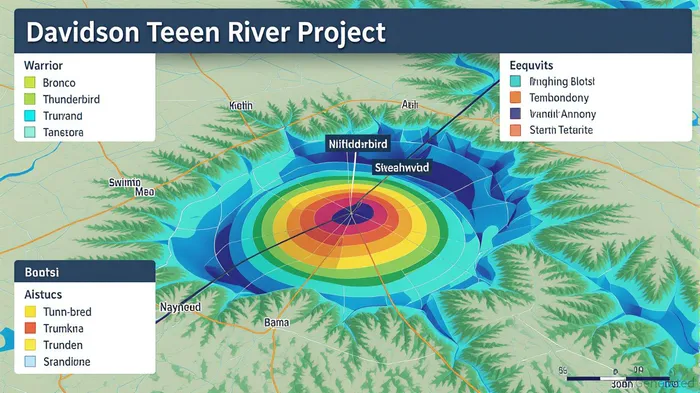
In the race to secure critical minerals for a decarbonizing world, geophysics is no longer just a tool—it's a revolution. Standard Uranium Ltd. (STU:TSX.V) has positioned itself at the forefront of this shift with its groundbreaking work at the Davidson River Project in Saskatchewan's Athabasca Basin. By deploying cutting-edge multiphysics geosurveys, the company is not only redefining exploration efficiency but also unlocking a high-probability path to discovering high-grade uranium deposits in one of the most geopolitically strategic regions on Earth.
The Geophysical Edge: From Noise to Signal
Standard's recent deployment of ExoSphere Multiphysics surveys—a combination of 3D Ambient Noise Tomography (ANT), Horizontal-to-Vertical Spectral Ratio (HVSR), and constrained gravity modeling—represents a quantum leap in subsurface imaging. Traditional exploration methods often rely on fragmented datasets, but Standard's approach synthesizes multiple geophysical signals into a unified model. The results? A 3D “X-ray” of the basement rocks, revealing gravity-low anomalies that align with known electromagnetic (EM) conductors and extrapolated faults. These anomalies are not random; they mirror the geophysical fingerprints of nearby world-class deposits like Arrow and Triple R, which host high-grade uranium mineralization.
The integration of machine learning via ALS GoldSpot's SmartMatch technology further sharpens the focus. By cross-referencing Standard's geophysical data with historical deposit signatures, the algorithm identifies drill targets with a precision that traditional methods cannot match. This is not speculative—it's a data-driven roadmap to where uranium is most likely to accumulate, guided by the same structural traps that have already yielded multi-million-ounce discoveries in the Athabasca Basin.
A Strategic Asset in a Strategic Region
The Davidson River Project spans 30,737 hectares and sits along strike from the Triple R and Arrow deposits, two of the highest-grade uranium discoveries in the basin. The project's four conductive corridors—Warrior, Bronco, Thunderbird, and Saint—are graphitic-sulphidic structures in basement rocks, a geological sweet spot for uranium. Past drilling has already confirmed elevated boron and uranium values, with holes like DR-20-009 and -0113 showing over 1,000 ppm B—a proxy for hydrothermal alteration and mineralization.
What makes this moment pivotal is Standard's ability to prioritize targets based on a convergence of signals: gravity anomalies, EM conductors, and machine learning insights. The upcoming four-to-six-week diamond drill program, set to begin in early September 2025, is not just another phase of exploration—it's a test of a hypothesis that has already passed its first scientific hurdles. If the drill bits confirm the presence of high-grade uranium (defined by Standard as >1.0 wt% U3O8), the implications for the company's valuation could be seismic.
Geopolitical Tailwinds and Market Dynamics
Uranium is no longer a commodity of the past—it's a linchpin of the clean energy transition. With global nuclear power capacity projected to grow by 50% by 2040, and geopolitical tensions disrupting supply chains, the market is primed for a structural shift. Standard's focus on basement-hosted uranium—a type of deposit that often yields high-grade ore—positions it to capitalize on this demand surge.
The spot price of uranium has already begun to reflect this reality, with a multi-year uptick driven by reactor restarts in the U.S. and Europe, and China's aggressive nuclear expansion. Standard's ability to generate a near-term discovery at Davidson River could catalyze a re-rating of its shares, especially as the company moves to raise C$3.5 million through a private placement to fund the drill program.
Investment Thesis: A Catalyst-Driven Play
For investors, the key question is whether Standard can translate its geophysical insights into a drill-ready discovery. The company's technical team, led by President Sean Hillacre (a qualified person under NI 43-101), has laid out a compelling case: the integration of multiphysics data has reduced exploration risk by narrowing the search to high-probability zones. The upcoming drill results will be the ultimate test, but the geological and geophysical evidence is already strong.
This is a catalyst-driven investment with a clear timeline. If the September 2025 drill program uncovers high-grade uranium, Standard could attract joint venture partners or even a strategic takeover—a common outcome for junior uranium explorers with a near-term discovery. Given the company's low market cap and the high leverage of its asset base, the potential upside is significant.
Conclusion: Mining the Future with Science
Standard Uranium's work at Davidson River is more than a technical achievement—it's a blueprint for how advanced geophysics can transform exploration in the 21st century. By marrying cutting-edge technology with a deep understanding of the Athabasca Basin's geology, the company is not just chasing uranium; it's positioning itself to deliver a critical resource for a decarbonized future. For investors with a high-risk, high-reward appetite, this is a story worth watching—and a stock worth considering.







Comentarios
Aún no hay comentarios