
Stamper's BISP Acquisition: Strategic Positioning in Namibia's High-Potential Offshore Energy Frontier

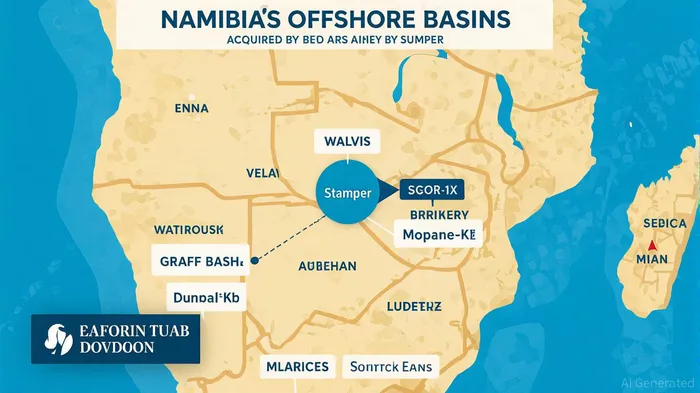
Namibia's offshore oil and gas sector has emerged as one of Africa's most promising energy frontiers, and Stamper Oil & Gas Corp.'s recent acquisition of BISP Exploration Inc. positions the company to capitalize on this high-growth opportunity. By securing indirect interests in five offshore blocks across the Orange, Walvis, and Luderitz basins, Stamper has aligned itself with a region that boasts some of the highest exploration success rates globally[1]. This strategic move, finalized in June 2025, underscores Stamper's ambition to expand its energy portfolio while leveraging Namibia's accelerating transition into a major oil-producing nation[4].
Strategic Positioning in a High-Potential Market
Namibia's offshore basins have attracted global energy giants due to their geological similarities to the prolific South African and Brazilian margins. Major discoveries such as TotalEnergies' Venus field (5.1 billion barrels), Shell's Graff-1X and Jonker-1X (5 billion barrels combined), and Galp Energia's Mopane field (10 billion barrels) have collectively positioned the country as a potential top-10 global oil producer by 2035[2]. These finds, coupled with Chevron's recent announcement of a new exploration well in the Walvis Basin[5], highlight the region's attractiveness. Stamper's acquisition of BISP Exploration grants it access to these high-potential areas, where the company can now initiate resource delineation and exploration programs[1].
The Namibian government's proactive approach further enhances the investment climate. Regulatory streamlining, infrastructure development, and a focus on sustainable growth—such as youth empowerment initiatives like the Future Generations Masterclasses[1]—signal a commitment to fostering long-term industry development. With first oil expected as early as 2029[3], the timeline aligns with Stamper's strategic objectives to establish a foothold in a sector projected to triple Namibia's economy[2].
Synergistic Growth Opportunities
Stamper's acquisition is not merely an expansion of assets but a calculated step toward synergistic growth. By securing interests in multiple offshore blocks, the company can diversify its exploration risk while capitalizing on shared infrastructure and operational efficiencies. For instance, the proximity of the Orange, Walvis, and Luderitz basins allows for coordinated exploration efforts, reducing costs and accelerating timelines[1].
Moreover, the company's emphasis on seeking partnerships and additional funding[1] reflects a pragmatic approach to navigating the technical and financial challenges of deepwater projects. Collaborations with established players—such as those already active in Namibia—could provide Stamper with access to advanced technologies and regional expertise, amplifying its competitive edge. This strategy mirrors broader industry trends, where junior explorers increasingly rely on joint ventures to unlock high-impact opportunities[2].
Challenges and Mitigation Strategies
While the potential is vast, Namibia's offshore sector is not without hurdles. Deepwater exploration remains capital-intensive, and technical complexities such as subsurface uncertainties and environmental regulations require careful management. However, the region's high exploration success rate—among the best globally[2]—mitigates some of these risks. Additionally, the Namibian government's prioritization of infrastructure development[3] and Chevron's recent investment in the Walvis Basin[5] signal growing confidence in the region's viability.
Long-Term Outlook
Stamper's acquisition positions it to benefit from a confluence of factors: a resource-rich jurisdiction, supportive policy frameworks, and a surge in international interest. As the company advances its exploration programs, the potential for significant hydrocarbon discoveries could catalyze both shareholder value and regional economic growth. For investors, this represents an opportunity to participate in the early stages of a sector poised for transformation.





Comentarios
Aún no hay comentarios