
The Stalling of U.S. Crypto Regulation and Its Impact on Institutional Investment
The U.S. crypto market has long been a battleground for regulatory ambiguity, with institutional investors navigating a shifting landscape of policy delays, legislative experiments, and sudden clarity. From 2023 to 2025, the stalling of comprehensive crypto regulation-marked by prolonged debates over SEC and CFTC jurisdiction-created a volatile environment for institutional capital. Yet, as recent legislative breakthroughs and market responses demonstrate, the interplay between regulatory risk and investor sentiment has become a defining force in shaping the sector's trajectory.
Regulatory Stalling: A Tale of Two Agencies
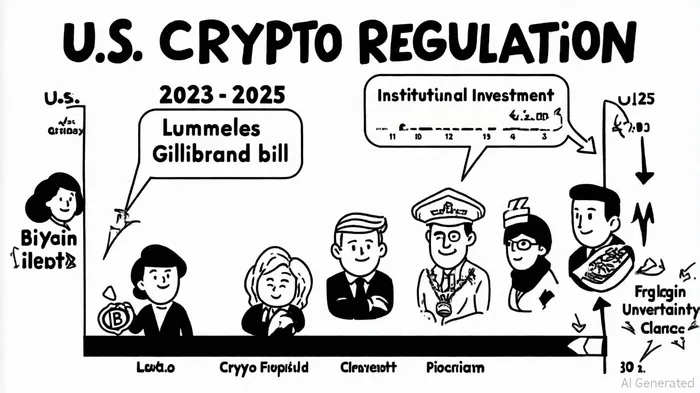
The U.S. regulatory framework for crypto has been mired in dysfunction for years. In 2023, a bipartisan bill introduced by Senators Cynthia Lummis and Kirsten Gillibrand sought to address this by limiting the SEC's role to digital assets with financial interests in business entities, while granting the CFTC exclusive oversight of most cryptocurrencies, as noted in a Skadden report. This effort aimed to resolve jurisdictional conflicts but faced delays due to political gridlock and industry pushback. By 2025, the landscape had evolved: the SEC and CFTC jointly issued a statement allowing registered exchanges to list spot crypto assets, signaling a rare moment of collaboration, according to a Baker McKenzie analysis. However, the October 2025 government shutdown abruptly paused these efforts, halting crypto ETF approvals and freezing regulatory momentum, as reported in a Cryptopolitan article.
The stalling of the Responsible Financial Innovation Act (RFIA) and the SEC's extended timelines for approving crypto ETFs further exacerbated uncertainty. For institutional investors, this meant prolonged reputational risk and operational hesitancy. As one industry analyst noted in a CryptoRobotics report, "The absence of a clear framework forced institutions to treat crypto as a speculative bet rather than a strategic asset."
Institutional Investment: Navigating Uncertainty
Despite regulatory headwinds, institutional adoption of crypto has surged. A 2025 Coinbase survey found that 75% of institutional investors globally plan to increase digital asset allocations, with 59% targeting over 5% of assets under management. This shift is driven by two factors: the normalization of crypto as an asset class and the emergence of regulatory guardrails.
Legislation like the GENIUS Act (establishing stablecoin reserves) and the CLARITY Act (clarifying SEC-CFTC roles) provided much-needed clarity, enabling banks to engage with crypto firms without the "reputational risk" clause that previously constrained them, as outlined in a CryptoRank analysis. Meanwhile, the U.S. government's Strategic BitcoinBTC-- Reserve-holding over 200,000 BTC-signaled a strategic embrace of crypto as a macroeconomic tool, according to a CryptoToolsHub overview.
Yet, institutional investors remain cautious. The SEC's delayed ETF approvals and the ByBit hack in late 2024 underscored the dual risks of regulatory arbitrage and operational security, as discussed in a Blockchain Council report. As a result, many institutions have adopted a hybrid approach: leveraging tokenized assets on EthereumETH-- while maintaining conservative exposure to spot crypto.
Market Sentiment: Political Winds and Public Perception
Market sentiment has been equally influenced by political dynamics. By 2025, 60% of Americans familiar with crypto believed prices would rise under a re-elected Trump administration, reflecting a belief that pro-crypto policies would outweigh trade-related caution, according to a Security.org survey. The administration's "Crypto Task Force" further reinforced this optimism, though its impact was tempered by tariffs that created a more risk-averse environment, as analyzed in a Forbes piece.
Retail investors, meanwhile, continue to drive volume on centralized exchanges, but institutional participation has shifted the market's center of gravity. Chainalysis data shows that North America now accounts for 45% of all crypto transfers over $10 million, with ETFs and custody solutions bridging the gap between traditional finance and digital assets.
The Path Forward: Clarity or Chaos?
The U.S. crypto market stands at a crossroads. While the GENIUS and CLARITY Acts have laid a foundation for stability, the SEC's ongoing delays and the government shutdown's disruption highlight the fragility of progress. For institutional investors, the key question is whether regulators will prioritize innovation or risk aversion in the coming years.
As the European Union's MiCA framework demonstrates, regulatory clarity can catalyze adoption. The U.S. now has a chance to reclaim its leadership role-but only if policymakers resist the urge to stall.





Comentarios
Aún no hay comentarios