
Stablecoins as Yield-Generating Assets: Opportunities in 2026
The financial landscape of 2026 is witnessing a seismic shift in how capital is deployed and optimized. Stablecoins, once seen as mere bridges between fiat and crypto, have evolved into programmable, yield-generating assets that sit at the intersection of institutional finance and decentralized infrastructure. For investors-both institutional and retail-this represents a unique opportunity to leverage stablecoins not just for liquidity, but as a core component of yield strategies.
Ripple's Yield Engine: A New Paradigm for Institutional Lending
Ripple's XRPXRP-- Ledger (XRPL) has emerged as a cornerstone of institutional-grade stablecoin yield generation. The Ripple Yield Engine 2025 introduced a protocol for fixed-rate, fixed-term loans via isolated Single Asset Vaults, enabling banksBANK-- and fintech firms to deploy XRP and stablecoins like RLUSD as collateral without the volatility risks of traditional DeFi according to MEXC. With the XRP Ledger processing over 1,500 transactions per second and settling in under five seconds, it has become a scalable solution for high-volume institutional operations.
The August 2025 SEC settlement-a $125 million resolution- catalyzed institutional adoption by providing regulatory clarity. This was followed by Ripple's $1.25 billion acquisition of Hidden Road, rebranded as Ripple Prime, which now serves as a crypto-owned global prime brokerage. Ripple Prime's tripled activity post-acquisition underscores its role in enabling institutions to use XRP and RLUSD as collateral and trading assets.
For investors, this signals a shift: XRP is no longer just a speculative asset but a utility token underpinning a robust yield infrastructure. The $1.37 billion in cumulative spot ETF inflows into XRP products by early 2026 further validates its institutional appeal, particularly as wealth managers and allocators rebalance portfolios toward assets with clear use cases.
Interest-Bearing Stablecoins: The Rise of Programmable Capital
By 2026, stablecoins have transcended their role as static reserves. Regulatory frameworks like the U.S. GENIUS Act and Europe's MiCA have provided clear guidelines for reserve backing and governance, enabling the proliferation of yield-bearing stablecoins according to The Block. These tokens allow users to earn interest while maintaining a dollar peg, with over 20% of active stablecoins now offering embedded yield or programmability features.
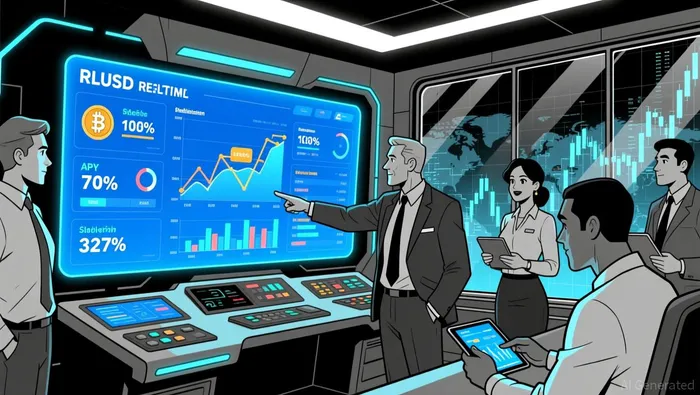
Platforms like Aave and Compound have matured into institutional-grade lending protocols, offering 4–8% APY on stablecoins such as USDCUSDC-- and RLUSD. For example, Gemini's partnership with Ripple and Mastercard to settle credit card payments via RLUSD on the XRP Ledger demonstrates how stablecoins are being integrated into real-time, regulated financial systems.
Retail investors can now access these yields through custodial platforms and staking mechanisms, while institutions leverage them for treasury management and cross-border settlements. The key differentiator in 2026 is capital efficiency: stablecoins are no longer idle balances but dynamic tools for generating returns.
DeFi Collateralization: Bridging On-Chain and Real-World Assets
Decentralized finance (DeFi) has evolved from an experimental niche to a critical infrastructure layer for institutional yield generation. In 2026, DeFi vaults enable institutions to deploy stablecoins into permissioned liquidity pools, collateralized by tokenized real-world assets (RWAs) such as U.S. Treasuries and institutional money market funds. These vaults use over-collateralized structures and automated rebalancing to manage risk while compounding yields.
For example, Zodia Custody's institutional-grade DeFi vaults allow secure, auditable yield generation on stablecoins while adhering to regulatory standards. This bridges the gap between on-chain innovation and traditional finance, enabling institutions to access DeFi's capital efficiency without sacrificing compliance.
Retail investors, meanwhile, can participate via platforms like PayPal and LBank, which offer loyalty programs and staking incentives to transform stablecoin balances into yield-generating assets. The result is a bifurcated market where both retail and institutional players can optimize stablecoin utility.
Regulatory Tailwinds and Global Adoption
Regulatory clarity has been the linchpin of stablecoin adoption in 2026. The GENIUS Act and MiCA have not only reduced compliance barriers but also spurred innovation in tokenized assets and cross-border payments. For instance, non-USD stablecoins-backed by euros, yen, and emerging market currencies-are gaining traction in the EU and Asia, supported by frameworks that address technical challenges like yield logic and interest rate updates.
Globally, the stablecoin market is projected to reach $1 trillion in circulation by 2026, driven by institutional demand and the expansion of yield-bearing tokens. This growth is further amplified by the bifurcation of the FX market, where stablecoin liquidity providers compete on narrow spreads and premium functionalities, making stablecoin transactions increasingly competitive with traditional fiat systems.
Actionable Strategies for Investors
For investors seeking to capitalize on stablecoin yield opportunities in 2026, the following strategies are critical:
1. Allocate to XRP-based stablecoins (e.g., RLUSD) via Ripple's Yield Engine and Ripple Prime, leveraging the XRP Ledger's speed and institutional-grade security.
2. Deploy stablecoins into regulated DeFi protocols (e.g., AaveAAVE--, Compound) to access 4–8% APY while mitigating risks through over-collateralization and automated risk management.
3. Utilize custodial platforms like Zodia Custody to bridge compliance gaps and access institutional-grade yield generation without sacrificing regulatory adherence.
4. Diversify into non-USD stablecoins in regions with favorable regulatory environments (e.g., EU, emerging markets) to capture cross-border yield arbitrage.
Conclusion
Stablecoins in 2026 are no longer just a bridge-they are a foundational asset class. With regulatory tailwinds, technological innovation, and institutional adoption aligning, stablecoins offer a unique combination of liquidity, yield, and programmability. For investors, the key lies in deploying these assets strategically: whether through Ripple's institutional-grade infrastructure, interest-bearing tokens, or DeFi collateralization, the opportunities are vast. As the market matures, those who act early will find themselves at the forefront of a financial revolution.







Comentarios
Aún no hay comentarios