
Stablecoins as a Strategic Hedge in Crisis-Driven Economies: The Case of Bolivia
The Perfect Storm: Bolivia's Economic Crisis and the Rise of Stablecoins
Bolivia's economic crisis is rooted in a confluence of structural and political challenges. A three-year recession, projected to contract by -1.5% in 2027, has been exacerbated by the collapse of the hydrocarbon industry and costly fuel subsidy policies. The country's net international reserves (NIR) have dwindled significantly, creating a stark divergence between the official and parallel exchange rates for the boliviano. This volatility has eroded public trust in the national currency, pushing businesses and individuals to seek alternatives.
Stablecoins have emerged as a natural solution. In 2025, Bolivia lifted a decade-long crypto ban, spurring a 530% year-on-year increase in crypto transactions, which reached $294 million in the first half of the year.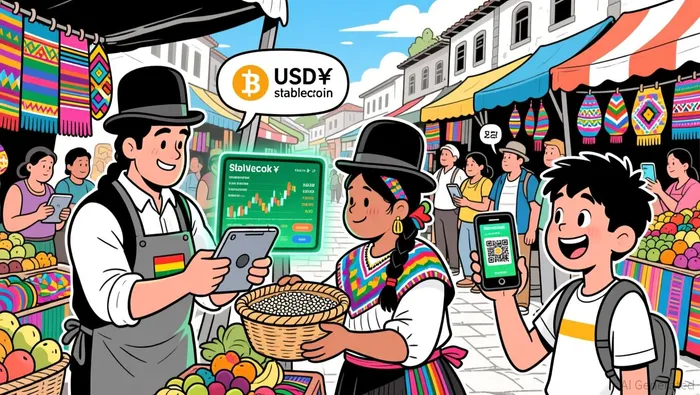 The government has since permitted banks to offer crypto-based services, including savings accounts and credit cards, treating stablecoins as legal tender. This policy shift aligns with broader regional trends: Latin America now accounts for nearly $1.5 trillion in crypto transaction volume, with stablecoins dominating 30% of global on-chain activity.
Infrastructure Breakthroughs: From Car Purchases to Systemic Integration
Bolivia's stablecoin adoption is not merely speculative-it is being embedded into tangible infrastructure projects. A landmark initiative launched in September 2025 allows customers to purchase vehicles, parts, and services using Tether's USD₮ stablecoin. This collaboration between Toyosa S.A., Crown Ltda., BitGo, and Towerbank leverages secure digital custody and regulated banking infrastructure to facilitate transparent, low-cost transactions. By applying stablecoins to high-value commerce, Bolivia is addressing traditional pain points such as cross-border delays and currency volatility, while setting a precedent for other emerging markets.
On a systemic level, the Bolivian government has announced plans to integrate stablecoins into its official financial framework. This includes reforms to formalize gold mining and reduce public expenditure by 30% in 2026, creating a more favorable environment for digital asset adoption according to policy documents. For investors, these developments signal a shift from experimental adoption to institutional legitimacy-a critical threshold for long-term viability.
Investment Potential: Navigating Risks and Rewards
The investment case for Bolivia's stablecoin ecosystem hinges on its ability to address dollar shortages and black market premiums. With USD₮ now facilitating transactions in sectors like automotive and remittances, stablecoins are effectively bypassing the parallel market, which has long been plagued by inefficiencies according to business analysis. For small businesses and importers, this represents a lifeline: stablecoins offer a predictable medium of exchange in an economy where the boliviano's value fluctuates daily according to market reports.
However, risks remain. Political instability, including the recent election of center-right president Rodrigo Paz Pereira, introduces uncertainty about the continuity of pro-crypto policies. Additionally, Bolivia's reliance on multilateral loans-$9 billion in negotiations with the World Bank and CAF-could strain fiscal capacity if economic reforms falter according to financial analysis. Yet, for investors with a medium-term horizon, these risks are counterbalanced by the potential for Bolivia to become a regional leader in digital finance.
A Regional Blueprint for Crisis-Driven Innovation
Bolivia's experience mirrors broader patterns in Latin America, where stablecoins are increasingly seen as a pragmatic response to economic instability. In Brazil, for instance, stablecoins already account for over 90% of crypto flows according to market data. By adopting a similar approach, Bolivia is positioning itself as a testbed for how digital assets can stabilize economies under stress. For global investors, this offers a dual opportunity: to capitalize on Bolivia's unique crisis-driven demand while contributing to a scalable model for emerging markets.
Conclusion: The Stablecoin Imperative in a Fractured Global Economy
As Bolivia's economic crisis deepens, stablecoins are proving to be more than a speculative tool-they are a strategic necessity. By integrating digital assets into commerce, finance, and policy, the country is demonstrating how emerging markets can leverage technology to navigate systemic challenges. For investors, the key lies in identifying infrastructure projects and platforms that align with both Bolivia's immediate needs and its long-term vision for financial inclusion. In a world where traditional systems are increasingly unreliable, stablecoins may well define the next era of economic resilience.






Comentarios
Aún no hay comentarios