
Stablecoins and the Risks to Euro Zone Banking Stability: Navigating Systemic Vulnerabilities and Regulatory Preparedness
The Rise of Stablecoins in the Euro Zone
The Euro Zone's stablecoin ecosystem is expanding at an unprecedented pace. Deutsche Börse, one of Europe's largest exchange operators, has begun integrating MiCA-regulated stablecoins into its settlement systems. Meanwhile, infrastructure providers like Cross River have launched platforms that unify fiat and stablecoin flows, signaling a shift toward on-chain financial infrastructure. These developments reflect Europe's strategic push to embed stablecoins within a robust regulatory framework, ensuring they coexist with traditional finance rather than destabilize it.
However, the dominance of dollar-denominated stablecoins-such as TetherUSDT-- (USDT) and Circle's USDC-has raised red flags. The ECB warns that this reliance could erode European monetary autonomy, as cross-border capital flows become increasingly decoupled from the euro. For investors, this highlights a paradox: while stablecoins promise efficiency and innovation, their foreign-centric nature could undermine the very financial sovereignty the Euro Zone seeks to protect.
Systemic Risks: A Looming Shadow
The ECB's concerns are not unfounded. With a market capitalization exceeding $280 billion, stablecoins now rival traditional money market funds in scale. Yet their structure-often backed by opaque reserve assets-leaves them vulnerable to "runs" if investor confidence falters. A mass redemption event could trigger fire sales of reserves, destabilizing U.S. Treasury markets and creating spillover effects across the Euro Zone.
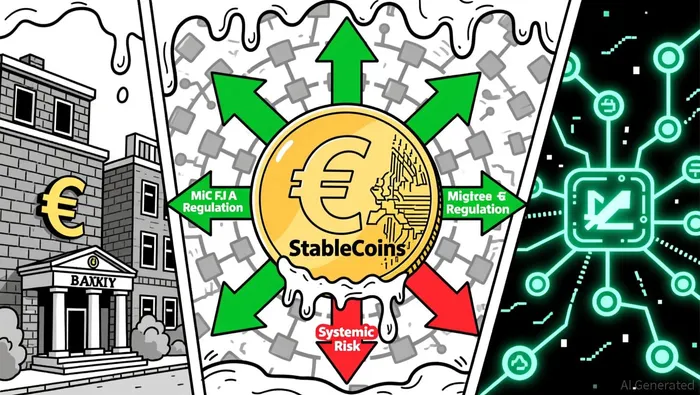
The concentration risk is equally alarming. Tether and Circle control over 90% of the stablecoin market. If either were to fail, the Euro Zone's banking system could face a liquidity crisis akin to the 2008 financial collapse. Cross-border regulatory arbitrage further complicates matters. For instance, joint EU-third country stablecoin issuances could leave European entities undercapitalized to meet redemption demands from both domestic and international holders.
While stablecoins currently serve niche use cases like crypto trading, their adoption in broader financial services-such as cross-border payments-could accelerate deposit outflows from traditional banks. The ECB has warned that this shift could force banks to rely on volatile wholesale funding, increasing their exposure to shocks. For investors, this underscores the need to monitor not just stablecoin growth but also the resilience of the banking systems they threaten to displace.
Regulatory Preparedness: A Fragile Shield?
The Euro Zone's regulatory response has been twofold: stress testing and cross-border coordination. The ECB has emphasized the importance of aligning stablecoin capital requirements with those of traditional banks, ensuring issuers can withstand financial shocks. However, direct stress tests for stablecoins remain underdeveloped. Instead, the European Banking Authority (EBA) has focused on broader EU-wide stress tests for 2025, which assess banks' resilience to macroeconomic downturns. While this approach indirectly addresses stablecoin risks, it lacks granularity for a sector growing at a pace outstripping traditional finance.
Cross-border frameworks are also emerging. The interlinkage between India's Unified Payments Interface (UPI) and the Eurosystem's TARGET Instant Payment Settlement (TIPS) system aims to streamline remittances between the Euro Area and India. Such initiatives reflect a broader push to harmonize stablecoin operations with global standards. Yet, as the ECB notes, global regulatory alignment remains fragmented. The G20's crypto-asset roadmap and Basel Committee recommendations offer a path forward, but their implementation is far from universal.
The Bottom Line for Investors
The Euro Zone's stablecoin experiment is a double-edged sword. On one hand, it positions Europe as a pioneer in regulated digital finance. On the other, it exposes the region to systemic risks that could ripple through its banking sector. For investors, the key is to balance optimism about innovation with caution about fragility.
The ECB's capital adequacy thresholds-such as the 11.2% Common Equity Tier 1 (CET1) requirement provide a baseline for assessing banking resilience. However, these metrics must be paired with real-time monitoring of stablecoin adoption rates and reserve transparency. Cross-border regulatory arbitrage and market concentration will remain critical risks until global standards converge.
In the end, the Euro Zone's success in managing stablecoin risks will hinge on its ability to adapt. As the ECB's warnings make clear, the future of digital finance is not just about technology-it's about ensuring that innovation doesn't come at the cost of stability.





Comentarios
Aún no hay comentarios