
Stablecoins Reach Record $251.7 Billion Market Cap: Assessing the Investment Potential and Systemic Risks of the Fastest-Growing Segment of the Crypto Ecosystem
The stablecoin market has reached a historic inflection point. As of late September 2025, the total market capitalization of stablecoins surpassed $295.7 billion, driven by a confluence of institutional adoption, regulatory clarity, and surging demand for cross-border payment solutions, according to the Stablecoins & CBDCs report. This figure marks a 6.5% monthly increase and a 2% weekly rise; DeFiLlama data shows similar upward momentum. Tether's USDTUSDT--, the sector's dominant player, commands a $173 billion market cap-58.8% of the total-while Circle's USDCUSDC-- and Ethena's USDeUSDe-- trail with $74 billion and $14.38 billion, respectively.
The Drivers of Growth: Regulation, Utility, and Macro Trends
The sector's expansion is underpinned by three key factors. First, regulatory frameworks like the U.S. GENIUS Act and the EU's Markets in Crypto-Assets (MiCA) regulation have provided much-needed clarity. The GENIUS Act, enacted in July 2025, mandates full reserve backing for payment stablecoins, prohibits yield-bearing instruments, and restricts large tech firms from issuing them, as noted in the OnChain Standard overview. These measures have bolstered institutional confidence, with USDT's market cap up markedly year to date, as reported by CoinCentral.
Second, stablecoins have become indispensable in cross-border payments. EthereumETH-- and Binance Smart Chain host over $161 billion in stablecoin activity, with transaction volumes exceeding $5.7 trillion in 2024, according to Statista. Platforms like Bitwage highlight that stablecoins now facilitate 30% of global remittances, outpacing traditional SWIFT transfers in speed and cost efficiency.
Third, macroeconomic tailwinds have amplified demand. The Federal Reserve's rate cuts, while reducing issuer revenues by an estimated $500 million annually, have paradoxically spurred stablecoin adoption as investors seek alternatives to low-yield fiat assets, a trend noted by Bitwage.
Systemic Risks: Regulatory Uncertainty and Reserve Transparency
Despite its growth, the sector faces critical risks. The GENIUS Act's prohibition of yield-bearing stablecoins has already disrupted models like PayPal's PYUSD, which previously offered interest-bearing accounts, as detailed in the OnChain Standard overview. Meanwhile, the Fed's rate cuts threaten to erode Tether's annual revenue by $325 million, raising questions about its ability to maintain 100% reserve backing, a concern highlighted by Bitwage.
Regulatory divergence between jurisdictions also poses challenges. While the EU's MiCA framework enforces strict reserve audits and AML compliance, the U.S. is still debating whether to extend the OCC's charter to stablecoin licensing. This ambiguity could stifle innovation or trigger a regulatory race to the bottom.
Investment Considerations: Balancing Opportunity and Caution
For investors, stablecoins present a dual-edged proposition. On one hand, their role as a bridge between traditional finance and DeFi ensures continued demand. USDC's 24.5% market share, driven by its compliance with both MiCA and the GENIUS Act, underscores the appeal of regulated alternatives (per the Stablecoins & CBDCs report). On the other hand, the sector's concentration risk-Tether alone accounts for nearly 60% of the market-means a single issuer's failure could trigger a cascading collapse.
Conclusion: A New Era for Stablecoins
The stablecoin market's $300 billion milestone reflects its maturation as a critical infrastructure layer for global finance. However, its future hinges on navigating regulatory scrutiny, macroeconomic shifts, and competition from central bank digital currencies (CBDCs). For investors, the key lies in diversifying exposure across compliant issuers while hedging against systemic risks. As the sector evolves, the interplay between innovation and oversight will define its trajectory-and its potential to reshape the financial landscape.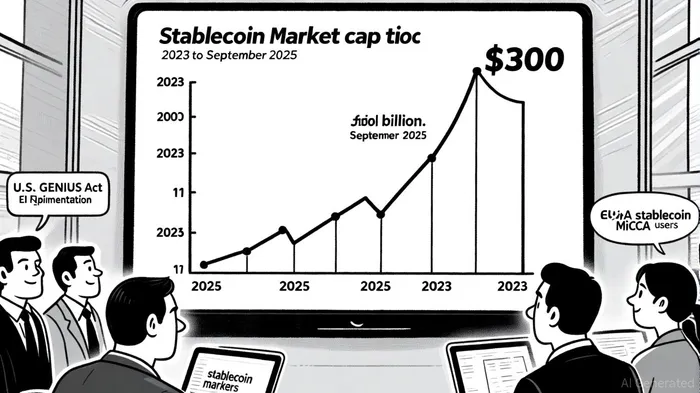





Comentarios
Aún no hay comentarios