
Stablecoins: The New Frontier in Banking Disruption and Yield Opportunities
Stablecoins: The New Frontier in Banking Disruption and Yield Opportunities
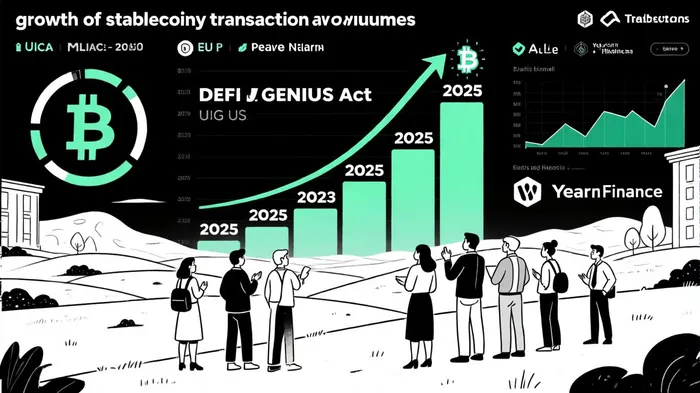
The financial landscape is undergoing a seismic shift, driven by the explosive growth of stablecoins and their integration into both decentralized finance (DeFi) and traditional banking systems. As of mid-2025, the stablecoin market has surged to a total capitalization of $251.7 billion, with transaction volumes exceeding $8.9 trillion on-chain in the first half of the year alone, according to CoinLaw's stablecoin statistics. This growth is not merely speculative-it reflects a fundamental reimagining of how value is stored, transferred, and earned in the digital age. For investors, the intersection of stablecoins, fintech innovation, and DeFi yield strategies presents a compelling opportunity to capitalize on the next wave of financial infrastructure.
Stablecoins as a Catalyst for Banking Modernization
The adoption of stablecoins by traditional financial institutions has accelerated dramatically in 2025, with 49% of surveyed banks already leveraging them for payments, treasury, and settlement systems, according to a Fireblocks survey. Regulatory clarity, particularly through the EU's Markets in Crypto-Assets (MiCA) framework and the U.S. GENIUS Act, has been a critical enabler. For example, Société Générale launched a MiCA-compliant stablecoin for cross-border transactions, while Japanese banks are exploring stablecoins as electronic payment instruments under revised legislation. These developments signal a shift toward tokenized cash, where stablecoins offer faster, cheaper, and more transparent alternatives to legacy systems like SWIFT.
JPMorgan's JPM Coin and PayPal's "Pay with Crypto" service exemplify how incumbents are integrating stablecoins to enhance customer experiences, as described in a Banking 2.0 paper. By 2025, stablecoin transaction volumes have surpassed $27 trillion annually, challenging traditional payment rails and reshaping global finance. For investors, this trend underscores the strategic importance of stablecoins in modernizing banking infrastructure-a sector projected to grow as institutions prioritize efficiency and scalability.
DeFi Platforms: Yield Generation and Strategic Partnerships
Decentralized finance has emerged as a powerhouse for stablecoin-based yield generation, with platforms like Yearn FinanceYFI--, AaveAAVE--, and Ondo Finance leading the charge. Yearn Finance, for instance, automates yield farming across protocols like Curve and Aave, offering users optimized returns without manual intervention. By late 2025, Yearn's TVL and strategic integrations have driven its token (YFI) to price projections of $7,025.09, with a potential 51.86% ROI for investors holding until December 2025, according to a Yearn price prediction.
Aave, another cornerstone of the DeFi ecosystem, has seen its Total Value Locked (TVL) exceed $30 billion by late 2025, with 90% of this value on EthereumETH--, as noted in an Augustcool analysis. The protocol's cumulative flash loan volume hit $7.5 billion in 2025, while its average quarterly revenue surged to $24.6 million-a 5x increase since 2022. Aave's sGHO stablecoin, backed by collateral within its ecosystem, further demonstrates the platform's innovation in secure yield generation.
Ondo Finance has also made waves with its USDY and ONDO token, securing a $1 billion TVL and institutional partnerships like the $250 million Ondo Catalyst fund with Pantera Capital, detailed in Ondo 2025 highlights. These platforms highlight the growing sophistication of DeFi, where stablecoins serve as both liquidity providers and programmable assets for automated financial strategies.
ROI: DeFi vs. Traditional Banking
The return on investment (ROI) disparity between DeFi and traditional banking is stark. In Q1 2025, DeFi platforms offered an average yield of 8.2% for stablecoin lending and staking, with select protocols like Yearn and Aave reaching up to 14%, according to CoinLaw's DeFi comparison. In contrast, traditional banks averaged a mere 2.1% for savings accounts and 1.9% for 1-year fixed deposits. Transaction efficiency further amplifies this gap: DeFi transactions cost $0.06 and settle in 3.6 seconds on Layer-2 networks, compared to $9.40 and 28 hours for traditional wire transfers.
User adoption metrics reinforce this trend. DeFi platforms reported 312 million active users in Q2 2025, with a 14.3% retention rate-far outpacing the 7.1% seen in traditional retail banking apps. This shift reflects a growing demand for financial tools that prioritize speed, transparency, and yield, particularly among younger, tech-savvy investors.
Risks and the Road Ahead
Despite their promise, stablecoins and DeFi face significant challenges. Regulatory scrutiny remains a wildcard, with concerns about systemic risks if stablecoins destabilize traditional banking reserves, as explored in a Forbes analysis. Smart contract vulnerabilities and liquidity management issues also pose threats, as seen in past DeFi exploits. However, the rapid adoption of regulatory frameworks like MiCA and the GENIUS Act suggests a path toward balanced innovation.
For investors, the key lies in diversification and due diligence. Prioritizing platforms with robust security audits, institutional partnerships, and regulatory alignment-such as Aave's Ethereum-focused infrastructure or Ondo's SEC-registered offerings-can mitigate risks while capturing growth.







Comentarios
Aún no hay comentarios