
Stablecoins: The Fragile Foundation of Digital Finance
In the past three years, stablecoins have grown from a niche tool to a $232 billion cornerstone of digital finance, according to a Columbia Law analysis. Yet their rise has been shadowed by a litany of failures, regulatory clashes, and technical vulnerabilities. From the collapse of TerraUSD in 2022 to the recent Yala YU exploit in 2025, stablecoins have exposed a paradox: they promise stability but deliver fragility. For investors and infrastructure builders, understanding the operational governance and risk mitigation challenges in this space is no longer optional-it's existential.
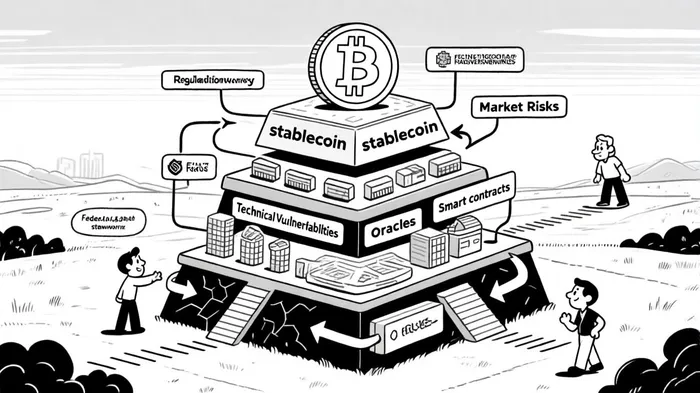
The Regulatory Jenga Tower
The U.S. GENIUS Act of 2025 aimed to unify stablecoin regulation under federal oversight, but its exemption of state-issued stablecoins has created a patchwork of rules, as noted in the Columbia Law analysis. States like Wyoming and Nebraska now operate their own stablecoins (e.g., Frontier Stable Token, FRNT) without federal constraints. This "regulatory floor" approach allows states to innovate but risks fragmentation. For example, Wyoming's FRNT is fully backed by reserves and transparently audited, while other states might adopt laxer standards to attract crypto businesses.
The Stablecoin Certification Review Committee (SCRC), tasked with ensuring state regulations align with federal standards, faces a critical flaw: its definition of "substantially similar" remains undefined, which the Columbia Law analysis highlights. This ambiguity leaves multi-state issuers in legal limbo and creates opportunities for regulatory arbitrage. Legal scholars warn this could lead to a fragmented monetary system akin to pre-1863 America, where states issued their own currencies.
Technical Vulnerabilities: The Silent Killers
Stablecoins are only as strong as their weakest link. In 2025, Yala's YU stablecoin lost its peg after a hacker exploited cross-chain vulnerabilities to mint 120 million tokens, according to an Elliptic risk guide. Despite emergency fixes, YU struggled to regain trust until September 2025, illustrating the risks of thin liquidity and poorly secured smart contracts.
Algorithmic stablecoins, like the now-defunct TerraUSD, remain a cautionary tale. Their reliance on complex arbitrage mechanisms and market confidence makes them prone to bank-run dynamics, as documented in the Elliptic guide. Even fiat-backed stablecoins aren't immune: the collapse of Silicon Valley Bank in 2023 caused USDCUSDC-- and DAIDAI-- to depeg to $0.87 and $0.85, respectively, an outcome tracked in the Elliptic analysis. These events underscore that stablecoins are notNOT-- immune to real-world financial shocks.
Governance Risks: Power Concentration and Market Volatility
The stablecoin market is dominated by a handful of issuers, creating systemic risks. TetherUSDT--, USDC, and DAI collectively control over 80% of the market, a concentration the Columbia Law analysis documents. This concentration raises concerns about liquidity manipulation and regulatory conflicts. For instance, a Tether depeg increases the likelihood of BitcoinBTC-- price jumps fivefold within five minutes, according to a ScienceDirect paper, revealing how stablecoin instability can ripple across crypto markets.
Regulatory uncertainty further exacerbates volatility. Argentina's $LIBRA experiment, a state-backed stablecoin promoted by President Javier Milei, surged to $5.20 before collapsing by 85%, sparking 100+ criminal complaints, an episode the ScienceDirect paper examines. Such political and technical missteps erode trust, particularly in jurisdictions with weak oversight.
Risk Mitigation: A Path Forward
To stabilize the ecosystem, three pillars must be addressed:
1. Technical Rigor: Smart contracts and oracles must undergo formal verification and continuous audits. Multi-signature controls and time delays for critical operations can reduce exploit risks, as the Elliptic guide recommends.
2. Regulatory Alignment: The SCRC must clarify "substantially similar" standards and enforce interoperability between state and federal frameworks, a key recommendation from the Columbia Law analysis.
3. Market Resilience: Stablecoin issuers should maintain deep liquidity pools and transparent reserve management. Wyoming's FRNT model, which mandates full reserve backing, offers a blueprint noted in the Columbia Law analysis.
Conclusion: Stability Through Discipline
Stablecoins are a critical infrastructure layer for digital finance, but their promise hinges on overcoming systemic vulnerabilities. For investors, the lesson is clear: stablecoins are not risk-free assets. They require rigorous due diligence on technical, regulatory, and governance fronts. As the market evolves, the winners will be those who prioritize stability over speed-because in a world where $1 pegs can vanish in minutes, the only constant is uncertainty.






Comentarios
Aún no hay comentarios